Showing posts with label Constitutional Foundation of Intellectual Property. Show all posts

Friday, January 31, 2025

In Podcast, Prof. Adam Mossoff Talks Founding Fathers and IP Rights

The January 6th episode of the IP Protection Matters podcast, "The Historical and Constitutional Foundations of Patent Protection," features an interview with Adam Mossoff, Professor of Law at the Antonin Scalia Law School at George Mason University. In addition to being a Senior Fellow at the Hudson Institute and a Visiting Intellectual Property at the Heritage Foundation, Prof. Mossoff is a member of the Free State Foundation's Board of Academic Advisors.

In the podcast episode, Prof. Mossoff discusses the American Founding Fathers' views on intellectual property (IP) rights. As he explains, the Founders "saw intellectual property largely as the same type of property right that arose from the creation of any other type of property right" through their value-creative productive labors. The Founders recognized the importance of protecting intellectual labor and included the IP Clause in Article I, Section 8 of the U.S. Constitution. 


Prof. Mossoff then discusses the historical significance of the Constitution's IP Clause, the significance of President George Washington and the First Congress, the differences between IP rights in the American constitutional order and monopolies under old English law, and the importance of IP protections for ensuring the marketability of IP. These basic principles of IP law apply to both copyrights and patents. The latter part of the interview focuses on contemporary patent reform issues. 


For an insightful take on IP rights by an excellent scholar, be sure to check out the IP Protection Matters podcast interview with Prof. Mossoff. And for a deeper dive, Prof. Mossoff has published several academic journal articles


The IP Protection Matters podcast is a project of the Center for Individual Freedom. 


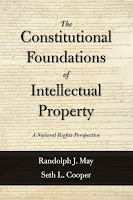
P.S. Many of the key themes about the Founders and IP rights in America’s constitutional order that come up in the podcast interview are analyzed in a book that I co-authored with FSF President Randolph J. May, The Constitutional Foundations of Intellectual Property: A Natural Rights Perspective (Carolina Academic Press, 2015). 

Thursday, June 08, 2023

Law Journal Article Endorses American Music Fairness Act

On May 17, the Journal of Legislation published an article titled "Oh Brother, Where Art Thou Royalties? Reflecting on the Emergence of Bluegrass and Appalachian Folk Music in Promoting the American Music Fairness Act." Written by Mark Edward Blankenship, Jr., the article discusses the 2000 movie named in the title as a window into the need for Congress to pass legislation securing full public performance rights in music sound recordings. Existing law exempts terrestrial AM/FM radio stations that broadcast copyrighted sound recordings over-the-air from having to pay royalties to the owners of those recordings. As the article points out, "[t]errestrial radio is the only medium allowed to use intellectual property without copyholders' permission or compensation, which is fundamentally unfair."

The article provides a straightforward legal history of public performance rights as well as their extension to performances of copyrighted sound recordings – except when it comes to terrestrial radio broadcasting. That historical backdrop sets the stage for the American Music Fairness Act (MMA), which has been introduced in the 118th Congress  S.253 and H.R. 791.  The article rightly concludes that "[a]dopting the AMFA would benefit many artists, honor intellectual property owners’ rights, and promote the progress in the arts." 

The AMFA also is the subject of my February 2022 Perspectives from FSF Scholars, "American Music Fairness Act Would Secure Copyrights in Sound Recordings." 

As an important conceptual sidenote, I disagree with the article's statement that "[u]nlike its foreign counterparts that employ a natural-rights view, the United States employs an economical view of copyright protection." In The Constitutional Foundations of Intellectual Property: A Natural Rights Perspective (Carolina Academic Press, 2015), Free State Foundation President Randolph May and I cited ample historical evidence that the Founding Fathers as well as jurists and legal scholars of the nineteenth century understood copyrights as natural property rights to the fruit of one's labors. Certainly, Congress takes economic considerations seriously in defining the boundaries of copyright protections. That is consonant with the Founders' political philosophy of natural rights, according to which copyright protections promote progress in the useful arts as well as financial opportunities for creators. 

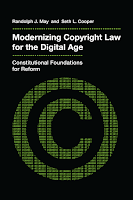
However, it is true that U.S. copyright law is premised on a different set of principles than foreign countries. Although European regimes are characterized by some writers as being based on “natural rights,” the occasional use of the term in that context can be highly misleading. Different theories of natural rights exist, but when speaking about the American constitutional order, I think it best to speak of the natural rights principles reflected in the Declaration of Independence and held in common by the likes of the American Founders, James Kent, Daniel Webster, Abraham Lincoln, as well as other American statesmen and jurists. In chapter 6 of our book Modernizing Copyright Law for the Digital Age, Constitutional Foundations for Reform (Carolina Academic Press, 2020), FSF President Randolph May and I described European copyright regimes as being premised on a "moral rights" view. And in that book, we warn Congress against importing those foreign concepts into American law because they actually could undermine the protections for American copyright owners.

Wednesday, March 16, 2022

James Madison: The Father of the Constitution Favored Copyrights

Today is the birthday of James Madison, widely regarded as "The Father of the Constitution." The track record of Madison (March 16, 1751 – June 28, 1836) includes prompting the Philadelphia Convention of 1787, drafting the Constitution, explaining and supporting it in the Federalist Papers, leading the ratification effort in Virginia's state ratifying convention, implementing the Constitution in the First Congress, and managing the proposed Bill of Rights. Not to mention he served as the fourth U.S. President. 

Given Madison's vast contributions to early American political philosophy and constitutionalism, it is easy to overlook his important role in helping to secure copyright protections for American authors and other creative artists. Free State Foundation President and I described James Madison's role in putting copyright protections in the U.S. Constitution in our book, The Constitutional Foundations of Intellectual Property: A Natural Rights Perspective (Carolina Academic Press, 2015). We provided an abbreviated account of Madison's pro-copyright collaboration with Noah Webster in our November 2015 Perspectives from FSF Scholars, "The Copyright Alliance that Shaped Our Constitution." And we touched on Madison's understanding of property rights, including copyrights, in our September 2015 Perspectives, "Why Intellectual Property Rights Matter: The Founders Believed Ownership of One's Labor is a Natural Right." 

Tuesday, December 14, 2021

Maryland's Unlawful Compulsory License for eBooks Should Have a Short Shelf Life

Copyright protections secured by federal law preempt state laws that interfere with them. Yet the Maryland legislature apparently ignored or didn't realize that when it enacted Maryland House Bill (HB) 518 in May of this year. The law, if it goes into effect in 2022, would grant Maryland public libraries a state-level compulsory license to access eBooks, audiobooks, and other digital literary works belonging to copyright owners at state-regulated rates. But a lawsuit filed in U.S. District Court on December 9 almost certainly means that the state's law will have a short shelf life. 

Maryland HB 518 seeks to give Maryland public libraries a special right of forced access to privately-owned digital literary works on supposed "reasonable terms." But under the U.S. Constitution's Copyright Clause and Section 106 of the federal Copyright Act, copyright owners possess exclusive rights to decide who can reproduce, distribute, display, and publicly perform their works and under what conditions. Indeed, the Copyright Act is the exclusive source of law governing the exclusive rights of copyright owners. As a result, Maryland HB 518 is expressly preempted by federal law – and it's not a close call. 

Federal copyright protections for literary works were foremost in the minds of the Founding Fathers when they drafted and ratified the Constitution of 1787. Free State Foundation President Randolph May and I wrote about this extensively in our book The Constitutional Foundations of Intellectual Property: A Natural Rights Perspective (Carolina Academic Press, 2015). The Constitution's Article I, Section 8 Copyrights Clause granted Congress the power "To promote the Progress of Science and useful Arts, by securing for limited Times to Authors and Inventors the exclusive Right to their respective Writings and Discoveries." And as James Madison observed in Federalist No. 43, the Constitution gave Congress that authority because "[t]he States cannot separately make effectual provisions for either of the cases, and most of them have anticipated the decision of this point, by laws passed at the instance of Congress."

The Copyright Act's exclusive jurisdiction over the exclusive rights of copyright owners is stated –  in unmistakably broad terms – in Section 301(a)'s preemption provision: 

On and after January 1, 1978, all legal or equitable rights that are equivalent to any of the exclusive rights within the general scope of copyright as specified by section 106 in works of authorship that are fixed in a tangible medium of expression and come within the subject matter of copyright as specified by sections 102 and 103, whether created before or after that date and whether published or unpublished, are governed exclusively by this title. Thereafter, no person is entitled to any such right or equivalent right in any such work under the common law or statutes of any State.

In our most recent book, Modernizing Copyright Law for the Digital Age: Constitutional Foundations for Reform (Carolina Academic Press, 2020), FSF President May and I strongly urged Congress to reject any future imposition of compulsory licensing and rate regulation on copyrighted works because such onerous restrictions are antithetical to the property rights and free market foundations of American copyright law and policy. Similarly, Maryland and other states should refrain from trying to impose compulsory licenses and rate controls on copyrighted works. 

In view of the strong legal claims raised against Maryland HB 518 in the pending case of Association of American Publishers, Inc. v. Frosh, it is most likely that the law will never go into effect. Other states should learn from HB 518's bad example and not seek to repeat it. 

Friday, April 24, 2020

Panel Video on the Foundations of Intellectual Property

In time for World IP Day on April 26, the Committee for Justice hosted a panel on "Google v. Oracle and the Constitutional Foundations of Intellectual Property Law." I was honored to join the panel, which included Prof. Adam Mossof and CFJ President Curt Levey. Video for the one-hour panel is now available online:
My panel colleagues addressed issues raised in Google v. Oracle, an important copyright case now on the U.S. Supreme Court's docket. And my panel remarks focused on the natural rights understanding of copyrights that formed a backdrop to the U.S. Constitution's Copyright Clause. I also briefly touched on some copyright modernization reform proposals drawn from the new book by Free State President Randolph May and I titled Modernizing Copyright Law for the Digital Age – Constitutional Foundations for Reform. My deep thanks go to the Committee for Justice for inviting me to participate. 

Friday, September 15, 2017

A Day to Remember Our Constitution's Protections for IP Rights

On Constitution Day – September 17 – we celebrate the framers signing of America’s written fundamental law. Among its sections and clauses, the Constitution’s provision for intellectual property (IP) rights deserves renewed appreciation by the public and support by Congress. Stronger security for IP rights enhances our economic climate and fulfills an important constitutional obligation.
Copyrighted works and patented inventions increasingly are vital to our nation’s prosperity in today’s digital Internet-connected global economy. A report by the U.S. Department of Commerce found that value added to our economy by copyright- and patent-intensive industries totaled approximately $1.8 trillion in 2014, amounting to about 10.6% of the U.S. gross domestic product. Also, jobs supplied by copyright-intensive industries totaled 5.6 million in 2014, while patent-intensive industries provided 3.9 million jobs.
The vibrant growth in IP’s value to our economy has been driven by digital technology and Internet connectivity. However, modern means of production and distribution also render IP vulnerable to online theft and infringement. Although often overlooked, the Constitution entrusts Congress with the responsibility to meet such challenges and ensure the security of copyrights and patent rights. The conceptual and historical backdrop of that responsibility are examined in the book, The Constitutional Foundations of Intellectual Property: A Natural Rights Perspective, that I co-authored with Free State Foundation President Randolph May.


Logically, IP rights reflect the natural rights principle that a person has a right to the proceeds of his or her own labors. Those proceeds are a person’s private property, deserving protection by equal laws. Historically, this natural rights and property rights understanding of copyrights and patents prevailed in the newly independent American states. By the time the framers met for the Philadelphia Constitutional Convention in 1787, twelve of the thirteen former colonies had adopted state copyright laws, and a few provided patent protections for inventors.
James Madison concluded that the lack of uniformity of among state copyright laws was a vice that needed to be remedied. Other framers in Philadelphia agreed. The Constitution’s Article I, Section 8, Clause 8 — the intellectual property (IP) clause — grants Congress the power “to promote the Progress of Science and Useful arts, by securing, for limited Times, to Authors and Inventors, the exclusive Right to their respective Writings and Discoveries.” As Madison observed in Federalist No. 43, conferring on Congress the power to protect copyrights and patent rights would be highly useful to individual authors and inventors and also serve the public good.

The First Congress to convene under the Constitution promptly exercised its constitutional power to secure copyrights and patent rights. In addition to establishing a system of taxes and revenues, setting up the federal judiciary, selecting the permanent capital site, and drafting the Bill of Rights, the First Congress passed the Copyright and Patent Acts of 1790. Both acts were signed by President George Washington. Those landmark laws set IP on a free market footing by expressly recognizing authors’ and inventors’ exclusive rights to contract for the sale or licensed use of their writings and inventions. The Copyright and Patent Acts of 1790 also provided civil rights of action for creators and inventors whose protected works or inventions were infringed.

In the nearly two hundred fifty years that have followed, Congress has intermittently exercised its constitutional power to further secure IP rights. Drawing upon natural rights and property rights principles, statesmen such as Daniel Webster and Henry Clay helped pass the first substantial revisions of the Copyright and Patent Acts in the 1830s. Also cognizant of natural rights and property rights principles, in 1891 the Centennial Congress secured copyright protection for foreign authors in order to ensure American authors were treated equitably overseas. In 1897, Congress made willful infringement of certain copyrighted works a crime subject to federal prosecution. And through subsequent legislation by Congress, the scope of copyright protections has expanded beyond books and engravings to include unauthorized reproductions or public performances of motion pictures and digital sound recordings. Likewise, the scope of patent protections now includes inventive designs as well as manufacturing and other production processes that embody the latest digital technologies.
Bearing those constitutional, historical, and economic considerations in mind, there is work ahead for Congress that is essential to securing American IP rights in the Digital Age:

  • The Copyright Office’s capabilities are outdated. Only limited online searching for copyright registration records is available and online searching for recorded copyright title transfer is unavailable. Congress should pass legislation to modernize and restructure the Copyright Office. It should give the Register of Copyrights the independence necessary to make technology upgrades and to establish a comprehensive searchable online database of copyright records. Upgrading the Office’s capabilities will reduce parties’ compliance costs and enhance the economic value of copyrighted works.
  • Steep losses to the U.S. economy caused by overseas piracy of IP need to be curtailed. A 2017 report by the bipartisan IP Commission calculated that counterfeit goods, pirated software, and trade secret theft cost our economy between $225 and $600 billion annually. Congress should urge the Trump Administration to include strong IP rights enforcement provisions in foreign trade negotiations, and proposed treaties that contain such provisions should be ratified and supported by implementing legislation.

As we reflect on our Constitution’s origin as well as its guarantees for representative government and individual freedoms, we should not forget the wisdom of the framers in including the protection of copyrights and patent rights in our nation’s fundamental law. Congress should vigorously pursue its constitutional responsibility to secure IP rights and put our nation’s economy on the strongest possible footing for the Digital Age.


Monday, August 01, 2016

Summer Reading: “Our Republican Constitution”


Regular readers know I don’t often do book reviews in this space, and, truth be told, this won’t be a full-fledged review either. But if you are looking for an important book to read during the summer reading season, I want to commend Randy Barnett’s just published “Our Republican Constitution – Securing the Liberty and Sovereignty of We the People.”
First, two “trigger warnings” of sorts. Our Republican Constitution is a serious, thought-provoking book, but not necessarily one you’d grab for a day at the beach if you usually look for the latest Dan Brown or James Patterson offering.
And please pay attention to the second warning. Mr. Barnett’s book is about two different visions concerning what our Constitution means. He calls these divergent visions the “Democratic Constitution” and the “Republican Constitution.” But, as he says, “I don’t intend these labels to be partisan.” If you read the book, you will see that this is true. Mr. Barnett is not referring to the current Democrat and Republican parties.
With those trigger warnings out of the way, what differentiates the two divergent constitutional visions? According to Mr. Barnett, those who favor the Republican Constitution view the “We the People” – the opening three words in the Constitution’s Preamble – as individuals, while those who favor the Democratic Constitution view “We the People” as a collective entity.
Those who favor a Democratic Constitution hold a conception of popular sovereignty that elevates majority will as the presumptive governing doctrine. So, in this view, “the only individual rights that are legally enforceable are a product of majoritarian will – whether the will of majorities in the legislature who create ordinary legal rights, or the will of majorities who ratified the Constitution and its amendments and created constitutional rights.” Therefore, Mr. Barnett concludes, “under a Democratic Constitution, first comes government and then come rights.” (Emphasis in the original.)
Under a Republican Constitution, the presumptive governing doctrine is reversed. Sovereignty resides in people as individuals. “We the People” is not a collective group but rather a collection of individuals. And, in the words of the Declaration of Independence, it is a “self-evident” truth that each individual is endowed “with certain unalienable Rights, that among these are Life, Liberty, and the Pursuit of Happiness.” As the Declaration goes on to say, “That to secure these Rights, Governments are instituted among Men, deriving their just Powers from the Consent of the Governed.”
I don’t want to make Mr. Barnett’s case here and, in any event, I can’t do it in light of space limitations. But I will say that he marshals considerable evidence to show that our Founders incorporated into the Constitution’s language and its structure, including the Ninth and Tenth Amendments, the Declaration’s claim that individuals possess certain inalienable natural rights. Thus, Mr. Barnett asserts: “A Republican Constitution views the natural and inalienable rights of these joint and equal sovereign individuals as preceding the formation of governments, so first come rights and then comes government.” (Emphasis in the original.)
So now consider the core of the difference between the two constitutional visions: 
The Democratic Constitution – “first comes government and then come rights”
The Republican Constitution – “first come rights and then comes government”
Or put another way, the Democratic Constitution’s vision places much more emphasis on majoritarian rule at the expense of protecting individual rights, while the Republican Constitution places more emphasis on securing individual rights at the expense of giving force to the majority’s will.
In essence, Mr. Barnett argues, convincingly in my view, that the Founders’ primary concern when they met in Philadelphia in the summer of 1787 was to adopt a governing charter that would guard against the excesses of “pure democracy,” especially against violations of property rights, then prevailing in the States under the Articles of Confederation. This concern regarding “pure democracy” – or unconstrained majoritarian rule – was expressed this way by James Madison to Thomas Jefferson in a famous October 1788 letter:
“Wherever the real power in a Government lies, there is the danger of oppression. In our Governments the real power lies in the majority of the Community, and the invasion of private rights is chiefly to be apprehended, not from acts of Government contrary to the sense of its constituents, but from acts in which the Government is the mere instrument of the major number of the constituents.”
Hence, the adoption of a Republican Constitution that created a representative government, with separation of powers and checks and balances, a republic intended to protect individual rights against the power of the majority.
In a portion of the book addressing how the progressive vision of the Democratic Constitution has facilitated the rise of today’s massive administrative state, Mr. Barnett says this about Chevron deference: “[I]t has profoundly weakened the separation of powers that is supposed to secure the sovereignty of the people and their servants in government.” Regular readers know that I have expressed a similar view, most recently here.
A significant portion of Mr. Barnett’s book is devoted to showing the extent to which the Republican Constitution vision has been lost, the adverse consequences of such loss, especially with respect to loss of individual freedom, and how “We the People” can redeem the Republican Constitution. On the latter score, I’ll just add that I agree with Mr. Barnett’s suggestion that the first thing we need to do is understand our constitutional heritage. I’m less enamored of some of the structural changes he suggests, such as establishing term limits for members of Congress or replacing the now-defunct power of state legislatures to select a state’s senators with a new provision giving a majority of state legislatures representing a majority of the population the power to repeal any federal law or regulation.
But read the book and draw your own conclusions!
*     *     * 
Finally, here’s another important book for a summer read, one you can proudly display either while sitting in a beach chair or in your own musty, book-lined study: “The Constitutional Foundations of Intellectual Property – A Natural Rights Perspective”, co-authored by me and Seth Cooper, my Free State Foundation colleague. Our book draws on many of the same historical, philosophical, and jurisprudential sources as Randy Barnett’s in arguing that, by including the Intellectual Property Clause in the Constitution of 1787, the Founders intended to secure the natural right of authors and inventors to reap the rewards from the fruits of their labors. Like Mr. Barnett, we look to John Locke, James Madison, and Abraham Lincoln, among others, in support of our project in support of the protection of intellectual property rights.
Right now, the Constitutional Foundations of Intellectual Property is available here from Amazon at a deeply discounted price. This steep discount may not last for long.

Tuesday, August 26, 2014

“The Expendables 3” Hurt By Pre-Release Piracy

Free State Foundation President Randolph May released a blog earlier in the month about a massive pre-release piracy of the movie, “The Expendables 3.”  At least 2.2 million people had watched the movie before it had even hit theaters. But now that the movie has been out for over a week, let’s see how it did.
Not that well.
According to a New York Post article, “The Expendable 3,” which cost $100 million to produce, has made only $16 million. Because of the leaked version, Lions Gate Entertainment, the movie’s production company, likely lost “tens of millions of dollars” it otherwise would have garnered. It is now suing the websites that posted an illegal version.
While it cannot be predicted how much money the movie would have made but for the pre-release leak onto the Internet, there is clearly still a piracy problem that can severely hurt production companies and artists.
A company like Rightscorp is a good example of how some aspects of the piracy problem possibly can be addressed without government intervention (see the website for more information). Some copyright violators simply do not know that what they are streaming or downloading happens to be an illegal pirated version of a song or video. “The Expendables 3” might have been more obvious than usual because the movie had not been released yet. There is certainly an educational aspect to video and music piracy that should continue to be addressed. For example, maybe part of the answer is teaching students about piracy in computer classes.
Given the amount of money companies and artists are losing from piracy, there seems to be a valuable opportunity for more innovative ideas that can continue to educate Internet users about the harm caused by theft of intellectual property.

Tuesday, August 12, 2014

IP Rights Are Not Expendable!


This is the lead from today's WSJ's story [subscription required] on the pre-release piracy and posting of the "Expendables 3" movie:
"At least 2.2 million people have already watched "The Expendables 3." The problem for the movie's distributor, Lions Gate Entertainment Corp., is that its big-budget action movie doesn't open until Friday.
Just over two weeks ago, a complete and nearly pristine copy of "The Expendables 3," which features more than a dozen stars including Sylvester Stallone, Mel Gibson and Harrison Ford, leaked online. It is Hollywood's highest profile piracy leak since 2009, when an incomplete version of "X-Men Origins: Wolverine" found its way online before the superhero movie came out."
You don't need to have an economics degree from Harvard to appreciate that intellectual property piracy of this magnitude necessarily will impact the decision-making surrounding incentives to invest in future films and other creative endeavors. There are various dimensions to the problem of piracy as it relates to movies, sound recordings, and other intellectual property. But one important dimension that cannot be overlooked, or excused, is the public's all-too-often failure to understand that securing and protecting IP rights is a foundational constitutional principle.
There continues to be a real need to educate the public concerning the importance of respecting this constitutional principle no less than others. That's why at the Free State Foundation we're engaged in an ongoing effort to educate the public, especially including those who otherwise think of themselves as constitutionalists, concerning intellectual property rights.
Here are the first five papers in our ongoing series and there is another posted on our website:
Randolph J. May and Seth L. Cooper, "The Constitutional Foundations of Intellectual Property," Perspectives from FSF Scholars, Vol. 8, No. 13 (2013).

Randolph J. May and Seth L. Cooper, "Reasserting the Property Rights Source of IP," Perspectives from FSF Scholars, Vol. 8, No. 17 (2013).

Randolph J. May and Seth L. Cooper, "Literary Property: Copyright's Constitutional History and Its Meaning for Today," Perspectives from FSF Scholars, Vol. 8, No. 19 (2013).

Randolph J. May and Seth L. Cooper, "The Constitution's Approach to Copyright: Anti-Monopoly, Pro-Intellectual Property Rights," Perspectives from FSF Scholars, Vol. 8, No. 20 (2013).

Randolph J. May and Seth L. Cooper, "The 'Reason and Nature' of Intellectual Property: Copyright and Patent in The Federalist Papers," Perspectives from FSF Scholars, Vol. 9, No. 4 (2014).