Showing posts with label IP Clause. Show all posts

Friday, January 31, 2025

In Podcast, Prof. Adam Mossoff Talks Founding Fathers and IP Rights

The January 6th episode of the IP Protection Matters podcast, "The Historical and Constitutional Foundations of Patent Protection," features an interview with Adam Mossoff, Professor of Law at the Antonin Scalia Law School at George Mason University. In addition to being a Senior Fellow at the Hudson Institute and a Visiting Intellectual Property at the Heritage Foundation, Prof. Mossoff is a member of the Free State Foundation's Board of Academic Advisors.

In the podcast episode, Prof. Mossoff discusses the American Founding Fathers' views on intellectual property (IP) rights. As he explains, the Founders "saw intellectual property largely as the same type of property right that arose from the creation of any other type of property right" through their value-creative productive labors. The Founders recognized the importance of protecting intellectual labor and included the IP Clause in Article I, Section 8 of the U.S. Constitution. 


Prof. Mossoff then discusses the historical significance of the Constitution's IP Clause, the significance of President George Washington and the First Congress, the differences between IP rights in the American constitutional order and monopolies under old English law, and the importance of IP protections for ensuring the marketability of IP. These basic principles of IP law apply to both copyrights and patents. The latter part of the interview focuses on contemporary patent reform issues. 


For an insightful take on IP rights by an excellent scholar, be sure to check out the IP Protection Matters podcast interview with Prof. Mossoff. And for a deeper dive, Prof. Mossoff has published several academic journal articles. 


The IP Protection Matters podcast is a project of the Center for Individual Freedom. 


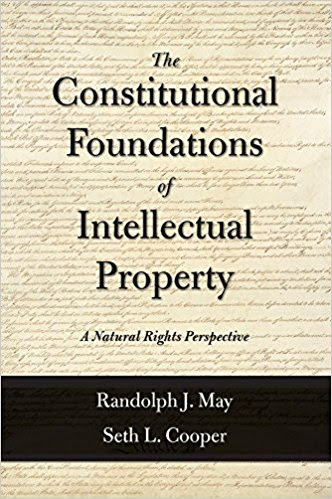
P.S. Many of the key themes about the Founders and IP rights in America’s constitutional order that come up in the podcast interview are analyzed in a book that I co-authored with FSF President Randolph J. May, The Constitutional Foundations of Intellectual Property: A Natural Rights Perspective (Carolina Academic Press, 2015). 

Thursday, August 18, 2022

Enjoying the Fruits of One's Labor and the Copyright Clause

For anyone remotely interested in intellectual property law, and more particularly copyright law, I want to commend to your attention a very important amicus brief just filed in the Supreme Court by Curt Levy and the Committee for Justice. The brief opposes what it characterizes (rightly in my view) as a radical interpretation of the fair use doctrine by the Andy Warhol Foundation for the Visual Arts.

In the context of explaining why the Warhol Foundation's unduly expansive interpretation of the fair use doctrine should be rejected, the Committee for Justice's brief states: "Copyright protections serve to vindicate the fundamental civil right that authors have to the fruits of their labors. This is how the Founders understood it at the time they enacted the Constitution with its Copyright Clause, and this is how this Court has understood it ever since." According to the brief, the Warhol Foundation "wants to change this accepted understanding of the Copyright Clause by replacing it with a utilitarian-based regime…."


The resort by the Committee for Justice's brief to foundational "first principles" regarding the proper interpretation of the Copyright Clause is in all respects consistent with the views articulated by me and Free State Foundation Director of Policy Studies Seth Cooper in our book, "The Constitutional Foundations of Intellectual Property: A Natural Rights Perspective." Indeed, I am pleased that our book was cited as an authority in Committee's brief alongside these "other authorities" – James Kent, William Blackstone, John Locke, Adam Mossoff, Antonin Scalia, Joseph Story, and Federalist No. 43! I would not be so coy as to deny that I am honored and proud to be listed among such illustrious company, and I'm sure Seth fees the same way.

Again, for anyone with an interest in copyright law, and especially anyone with an interest in understanding why the Founders' included the Copyright Clause in the Constitution of 1787, I heartily commend to you the Committee for Justice's excellent amicus brief. And if you want to delve more deeply, well… I commend our book, "The Constitutional Foundations of Intellectual Property: A Natural Rights Perspective." It's still a bargain.