Showing posts with label Copyright Clause. Show all posts

Wednesday, January 18, 2023

Report Spotlights Economic Value and Jobs Created by U.S. Copyright Industries

On December 14, the International Intellectual Property Association (IIPA) published "Copyright Industries in the U.S. Economy: The 2022 Report." The report analyzes the contributions to the U.S. economy between 2018 and 2021 by "core copyright industries" whose primary purpose is to create, produce, distribute, or exhibit copyrighted materials.

According to IIPA's 2022 report:

  • In 2021, core copyright industries added over $1.8 trillion in value to the U.S. gross domestic product (GDP), amounting to 7.76% of the U.S. economy. 
  • Core copyright industries employed 9.6 million workers in 2021, comprising 5.53% of total private employment in the U.S. 
  • Between 2018 and 2021, core copyright industries grew at an aggregate annual rate of 6.15%, an amount three times higher than the average annual 1.76% growth rate of the entire U.S. economy during that four-year timespan. 
  • Core copyright industries accounted for 52.26% of the U.S. digital economy in 2021.
  • Sales of U.S. copyright products in "selected" core industry sectors – recorded music; motion pictures, TV, and video; software publishing; and non-software publications including newspapers, books, and periodicals – amounted to $230.3 billion in 2021, an increase. 

IIPA's 2022 report also estimates the value of economic contributions by "total" copyright industries in the U.S., including industries in which copyrighted goods are only an aspect of their businesses as well as industries that facilitate the creation and production of copyrighted works and industries that develop computers and other devices that support usage of copyrighted goods. According to the report, the value added to GDP by total copyright industries was more than $2.9 trillion, or 12.52% of the U.S. economy. 


In our book, Modernizing Copyright Law for the Digital Age: Constitutional Foundations for Reform (Carolina Academic Press, 2020), Free State Foundation President Randolph and I credit the wisdom of the American Founders in according copyright protections to authors and other creative artists in the U.S. Constitution's Article I, Section 8 Copyright Clause. As we explain in chapter 3 of our book, those constitutional protections rest on a foundational understanding of copyrights as unique forms of private property that can be used and exchanged in a free market setting. IIPA's 2022 report shows that the American public, including the creators who make their living by creating, performing, and selling copyrighted content, continue to benefit greatly from the Founders' constitutional policy favoring copyright protections.  

Thursday, August 18, 2022

Enjoying the Fruits of One's Labor and the Copyright Clause

For anyone remotely interested in intellectual property law, and more particularly copyright law, I want to commend to your attention a very important amicus brief just filed in the Supreme Court by Curt Levy and the Committee for Justice. The brief opposes what it characterizes (rightly in my view) as a radical interpretation of the fair use doctrine by the Andy Warhol Foundation for the Visual Arts.

In the context of explaining why the Warhol Foundation's unduly expansive interpretation of the fair use doctrine should be rejected, the Committee for Justice's brief states: "Copyright protections serve to vindicate the fundamental civil right that authors have to the fruits of their labors. This is how the Founders understood it at the time they enacted the Constitution with its Copyright Clause, and this is how this Court has understood it ever since." According to the brief, the Warhol Foundation "wants to change this accepted understanding of the Copyright Clause by replacing it with a utilitarian-based regime…."


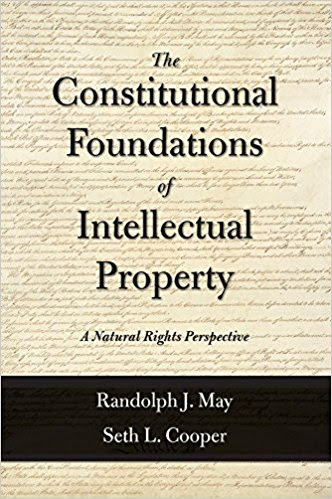
The resort by the Committee for Justice's brief to foundational "first principles" regarding the proper interpretation of the Copyright Clause is in all respects consistent with the views articulated by me and Free State Foundation Director of Policy Studies Seth Cooper in our book, "The Constitutional Foundations of Intellectual Property: A Natural Rights Perspective." Indeed, I am pleased that our book was cited as an authority in Committee's brief alongside these "other authorities" – James Kent, William Blackstone, John Locke, Adam Mossoff, Antonin Scalia, Joseph Story, and Federalist No. 43! I would not be so coy as to deny that I am honored and proud to be listed among such illustrious company, and I'm sure Seth fees the same way.

Again, for anyone with an interest in copyright law, and especially anyone with an interest in understanding why the Founders' included the Copyright Clause in the Constitution of 1787, I heartily commend to you the Committee for Justice's excellent amicus brief. And if you want to delve more deeply, well… I commend our book, "The Constitutional Foundations of Intellectual Property: A Natural Rights Perspective." It's still a bargain.