Showing posts with label china. Show all posts

Friday, June 09, 2023

Report Stresses Importance of Mid-Band Spectrum for 5G and U.S. Leadership

On June 7, the Center for Strategic & International Studies released a report titled "Spectrum Allocation for a Contest with China." Authored by James Andrew Lewis, the report emphasizes the need for allocation of more mid-band spectrum to support commercial 5G services. 

The report argues that American success in competition with China and global influence depends on the U.S. staying at the cutting edge of technology. This includes 5G wireless technologies; "[b]ut the United States lags far behind the rest of the world in allocations of the spectrum needed for 5G." The report states that federal government agencies have been allocated 60% of the mid-band spectrum compared to only 5% for licensed commercial users. Thus, "U.S. mid-band allocations diverge from the practices of other leading economies, including China, all of which have allocated much more mid-band spectrum to 5G uses."
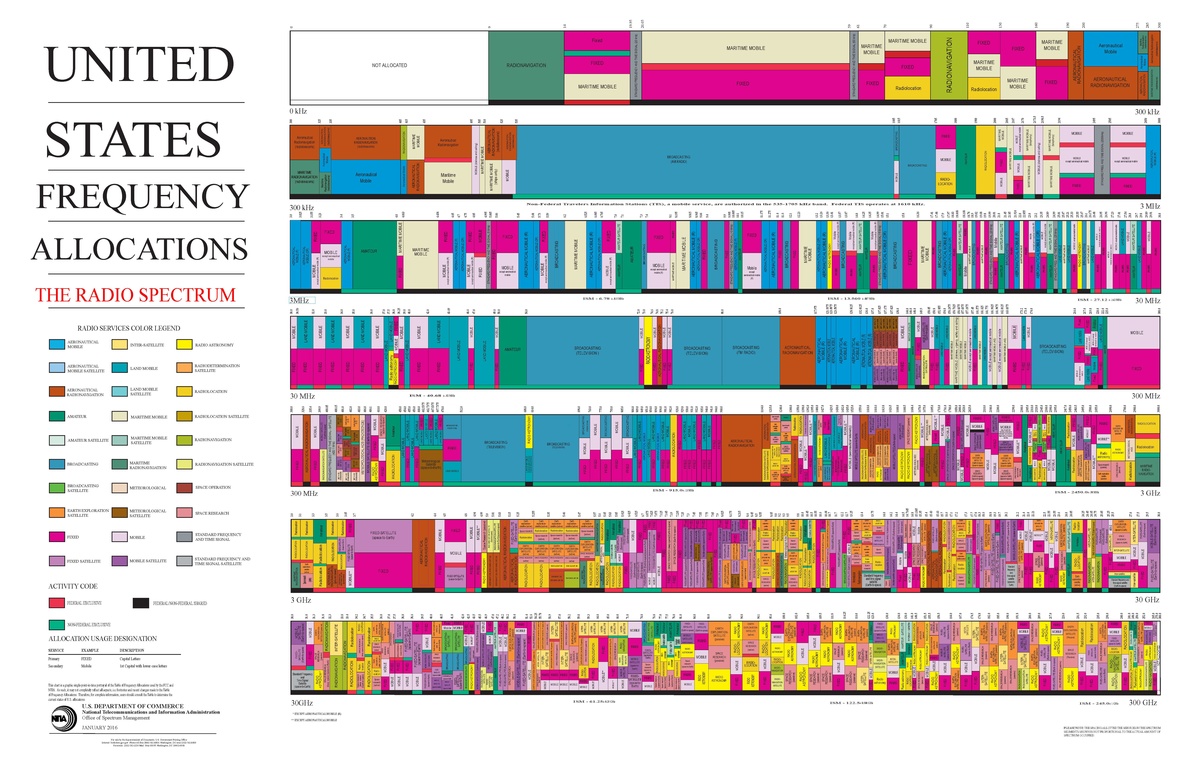
Also, the report acknowledges that the expiration of the FCC's spectrum license auction authority in March of this year "deprives the United States of a valuable spectrum management tool and makes it more difficult to align spectrum use to make the country more competitive with China." And it rightly calls for the U.S. to find ways to allocate sufficient spectrum for 5G while supporting other national security objectives.


Free State Foundation Senior Fellow Andrew Long also wrote about these same important topics in his February 2023 Perspectives from FSF Scholars, "Extending FCC Spectrum Auction Authority Is Essential to the 5G Race."

Wednesday, February 15, 2023

House Bill Would Require FCC List of Foreign Adversary Ownership of Communications Infrastructure

On February 3, Reps. Elise Stefanik, Ro Khanna, and Mike Gallagher announced the reintroduction in the House of Representatives of the Foreign Adversary Communications Transparency (FACT) Act. The bipartisan FACT Act was originally introduced in the 117th Congress on October 25, 2022. The bill – which does not have a number as of this posting – is intended to provide greater transparency regarding foreign governmental influence and access to critical communications infrastructure in the U.S. According to Congresswoman Stefanik's press release:

[T]his bill would provide critical telecommunications transparency by requiring the Federal Communications Commission (FCC) to publish a list of companies who hold FCC authorizations, licenses, or other grants of authority an[d] ownership by foreign adversarial governments, including China, Russia, Iran, North Korea, Venezuela, and Cuba.

The FACT Act appears to be a common-sense measure that deserves full and fair consideration by Congress.  

Friday, January 07, 2022

Ookla Insights: U.S. Leads World in 5G Availability

Ookla's report on global 5G speeds ranks United States 5G networks number one in the world for 5G availability, more than doubling the performance of networks in China, Canada, and almost the entire continent of Europe. This is an encouraging sign ahead of January 19th, the date when AT&T and Verizon will begin activating the high-capacity C-Band spectrum that should substantially boost U.S. 5G network speeds. But it also highlights the need to free more spectrum for 5G. 

Ookla defines 5G availability as the "percent of users on 5G-capable devices [who] spent the majority of their time on 5G," and the United States sits atop the world at 49.2%. This means that roughly half of all 5G device users in the U.S. had 5G connections during a majority of their time on wireless networks. China (20.1%), Canada (23.7%), Japan (7.6%), and the vast majority of European countries are far behind the U.S. on 5G availability, with only Netherlands (45.3%) and South Korea (43.8%) posting comparable availability above 40%.

The report also highlights that the U.S. lags behind other countries in median 5G speeds, but this is partly a function of spectrum policy and should be improved by fast-approaching carrier deployments of C-Band spectrum and other mid-band frequencies like the recently concluded 3.45 GHz auction. So far, U.S. 5G networks have largely relied on low-band spectrum for nationwide 5G deployment and high-band spectrum in certain dense urban settings. Mid-band spectrum, such as C-band spectrum and other nearby frequencies, has the combination of high-capacity and propagation over distances that leads to nationwide fast speeds.

Deployment of C-Band spectrum and other mid-band frequencies will also improve 5G speeds by densifying networks so a higher number of base stations each support fewer customers. The FCC should take additional actions to free mid-band spectrum for commercial use, such as setting a date for the 2.5 GHz auction and announcing auctions in additional bands, so U.S. 5G networks improve their speed ranking.

But the report also highlights that widespread 5G availability in the U.S. is in some ways more important than posting the fastest speeds. For example, Norway ranks second among countries for median 5G download speeds at 426.75 Mbps, but its availability is a mere 8.4%. This means 91.6% of Norwegians spend less than half their time on 5G when connected to wireless networks. This fact suggests that Norway's and other low-availability countries' top speed rankings are paper tigers – their 5G is fast but rarely used in real life. U.S. consumers are experiencing 5G far more often, and at high speeds, like the 160.41 Mbps median 5G speed Ookla measured in our nation's capital.

The United States' first place ranking for global 5G availability in Ookla's report is welcome news. The FCC should continue to act – especially by auctioning more mid-band spectrum – so the U.S. can also claim a top global ranking for speeds.

Monday, October 05, 2020

China Task Force Recommends U.S. Strengthen its 5G Competitiveness and Security

On September 30, the House Republicans' China Task Force (CTF) released its report on the multi-faceted generational threat to the U.S. posed by the Chinese Communist Party (CCP). Included in the CTF report is the following key finding:

The U.S. and the CCP are in a global race for deployment of 5G wireless technology. The CCP seeks to increase its global power by building 5G infrastructure domestically and abroad to dominate standard-setting, technological development, and the global supply chain. The U.S. must promote private and public cooperation on rapid 5G deployment by private industry for consumer services and innovation, economic growth, and national security. 

The CTF rightly emphasizes that "U.S. 5G deployment is driven entirely by the private sector" – as opposed to being government-driven as in communist China. The CTF report further emphasizes that "[s]ecuring U.S. networks and ensuring our allies take similar action are crucial components to maintain U.S. leadership in technology and protect the privacy of all Americans." 


Several recommendations for addressing these concerns are included in the CTF report, along with lists of bills that have been introduced in Congress and that would implement those recommendations. (Although the CTF is comprised of only Republican House members, two-thirds of the legislative bills cited in the CTF report have bipartisan support.) One such recommendation is that Congress "pass legislation to streamline fixed and wireless communications network permitting processes at the federal, state, and local level to ensure all Americans are connected." As the CTF report explains: "[r]educing U.S. regulatory barriers will speed up deployment of broadband and 5G communications infrastructure, and that will promote a market for secure solutions not made in China." 


Additionally, the CTF report includes this key finding:

U.S. leadership in advanced manufacturing across industrial sectors is imperative to put the U.S. on the leading edge of new products, processes, and services, as the CCP seeks to move up the value chain away from its traditional reliance on mass production of low-end goods to more high-tech manufacturing.

The CTF report recommends that the U.S. work with the United Kingdom as well as other nations to form a D-10 group of leading democratic nations that will focus on "developing and deploying 5G and subsequent generations, addressing 5G mobile communications and vulnerable supply chains, and leveraging technical expertise" in emerging technologies for the benefit of democratic nations. 


The CTF report is available online here.

Wednesday, February 12, 2020

Attorney General Barr Presses for U.S. Action Now on 5G

On February 6, Attorney General William Barr delivered the keynote address at the Justice Department's "China Initiative Conference" in Washington D.C. Attorney General Barr primarily addressed the technological and economic challenges posed to the U.S. by China in the areas of intellectual property theft and 5G dominance. His address is worth reading or viewing in full. (For C-SPAN, AG Barr's address begins about 1 hour and 26 minutes into the stream and his remarks on 5G begin at about 1 hour and 38 minutes in.)

In his address, AG Barr stressed the importance of making spectrum resources available for 5G services in the U.S. He specifically identified C-Band and L-Band spectrum as critically important for rapid deployment of 5G. From AG Barr's prepared remarks: 
The FCC has been working hard to get the C-band spectrum out into the market through an auction.  It is critical to get this done within the next few months.  Even then, the U.S. will need 400,000 base stations to cover the nation.  This could take a decade or more to build out. Recently, there have been interesting proposals to jump-start U.S.  5G by also making available L-band spectrum for use in tandem with the C-band.  By using the L-band for uplink, we could dramatically reduce the number of base stations required to complete national coverage.  It has been suggested that this could cut the time for U.S. 5G deployment from a decade to 18 months, and save approximately $80 million.  While some technical issues about using the L-band are being debated, it is imperative that the FCC resolves this question. The bottom line is that we have to move decisively to auction the C-band spectrum, and bring to resolution the issues over L-band.  Our economic future is at stake.  We have to bear in mind that, given the narrow window we face, the risk of losing the 5G struggle with China should vastly outweigh all other considerations.
Free State Foundation scholars have also advocated prompt action by the FCC to put C-Band and L-Band spectrum into commercial use. On February 6, FSF President Randolph May issued a statement regarding the FCC's proposed order to transition incumbent users in the C-band and clear for auction 280 MHz in that band. And my December 19, 2019 blog post, "FCC Should Green Light Wireless Services in L-Band Spectrum," urged prompt FCC decision on Ligado Networks' modified applications to deploy a satellite-terrestrial hybrid mobile network for commercial services in unused L-band spectrum.  

Importantly, AG Barr's keynote address also called attention to the pressing issue of 5G equipment suppliers and the need to have a market-ready alternative to Chinese 5G equipment suppliers. His call that the U.S. and its closest allies need to consider ways to put our large market and financial muscle behind viable competitors – insofar as it is carried out by by private American and allied companies – merits serious consideration. 

Wednesday, August 08, 2018

A Trade War May Not Fix China's Weak IP Protections


Earlier this month, President Donald Trump threatened to impose tariffs on $500 billion of Chinese imports, the value of all U.S. imports from China in 2017, because he claims China has taken advantage of the United States. President Trump already imposed 25% tariffs on $34 billion of Chinese goods. He said his action was taken “in light of China's theft of intellectual property and technology and its other unfair trade practices.” China immediately retaliated with equivalent tariffs, 25% on $34 billion of imported U.S. goods.
President Trump’s concerns about China’s weak protections of intellectual property (IP) rights are justified, but imposing tariffs and igniting a trade war may not be the best way to fix the problem.
In 2013, international trade of counterfeit and pirated goods represented up to 2.5% of world trade, or as much as $461 billion. Of that, China alone is estimated to account for more than 70% of global physical trade-related counterfeiting, amounting to more than $285 billion. Physical counterfeiting accounts for the equivalent of 12.5% of China’s exports of goods and over 1.5% of its GDP. China and Hong Kong together are estimated to account for 86% of global physical counterfeiting, which translates into $396.5 billion of counterfeit goods each year.
China and Hong Kong account for 87% of counterfeit goods seized coming into the United States. The annual cost to the U.S. economy of counterfeit goods, pirated software, and theft of trade secrets exceeds $225 billion and could be as high as $600 billion. According to the Global Innovation Policy Center’s (GIPC) 2018 International IP Index, China ranks 25th out of 50 countries in the study with regard to strong IP systems. So while China’s IP system may not be the weakest in the world, the size of its economy in conjunction with its lack of strong IP protections and enforcement means it is a major threat to U.S. creators and innovators.
IP-intensive industries comprised over 38% of the entire U.S. economy in 2014, equating to $6.6 trillion. And IP-intensive industries directly accounted for 27.9 million jobs and indirectly accounted for 17.6 million jobs, totaling 45.5 million jobs or about 30% of all U.S. employment in 2014. Therefore, when IP rights are violated in the U.S. or abroad, it stifles innovation and job-growth throughout the economy.
As FSF Senior Fellow Ted Bolema discussed in a Perspectives from FSF Scholars, “Why Economists Consistently Support Free Trade Policies,” free trade policies lead to higher paying jobs and lower prices. Protectionist policies, like tariffs and trade wars, ultimately harm consumers and entrepreneurs in both China and the United States and likely harm other countries because investment and innovation are hindered.
The best way to address violations of IP rights in China is through diplomatic efforts, like the adoption of a new free trade agreement creating robust IP protections in China. Hopefully, China will adopt IP protections that are similar to those in the United States, the global leader according to GIPC’s 2018 International IP Index. Then, consumers and entrepreneurs in both countries will benefit from mutual gains from trade and legitimate economic activity.
The U.S.-China Joint Commission on Commerce and Trade (JCCT) is a high-level dialogue on bilateral trade issues between the United States and China, dealing extensively with strengthening IP rights protections in both countries and fostering innovation. Also, the U.S.-China IP Cooperation Dialogue is a group of professionals from both countries who meet to discuss how IP systems can be improved to spur innovation and economic activity between the two countries. The common theme of both of these groups is that China’s IP rights protections can be improved in three main areas: reducing the amount of bad-faith trademarks, combatting online piracy, and decreasing theft of trade secrets.
Bad-faith trademarks are trademarks that are meant to look similar to popular brands and confuse consumers into buying seemingly familiar products. According to GIPC’s Index, China’s trademark law “provides limited criteria for obtaining design protection and no substantive review takes place, leading to many low-value patents and a high rate of invalidations.” China should combat the pervasive problem of bad-faith trademarks by strictly filtering trademark applications. On a positive note, the establishment of China’s IP courts in 2014 has already created a strong precedent on bad-faith trademarks when it found that the Chinese retail sports chain Qiaodan had violated Michael Jordan’s naming rights. Hopefully, this precedent will deter bad-faith trademarks from emerging in the future.
With regard to online piracy, China should adopt e-commerce-related legislation to strengthen the supervision and enforcement of online piracy and counterfeiting. China must continue to provide more licensing opportunities for Internet companies in the music and movie industries, which should discourage piracy by increasing access to legal content. Also, improving the patentability of software by allowing applicants to file partial design claims and extending the grace period that precedes the patent application should reduce rampant software piracy in China by encouraging competition and ultimately lowering prices.
Theft of trade secrets is defined as stealing, misappropriating, or receiving such secrets with intent to convert the trade secret into an economic benefit for anyone other than the rights holder. Although China recently amended its Anti-Unfair Competition Law to shift the burden of proof to the accused infringer for many trade secrets cases, this action does not address the issue sufficiently. The amended law likely will lead to a “one-size-fits-all” enforcement approach that may not be suitable for all types of trade secrets. Instead, China must adopt trade secret legislation which should include steps to assist rights holders in seeking preliminary injunctions and include evidence and asset preservation measures under China’s Civil Procedure Law. Also, China can do more to engage the public about trade secrets protection and streamline its processes for providing trade secrets licensing.
Instead of igniting a trade war, President Trump should welcome free trade with China. With the adoption of a new bilateral free trade agreement (or multilateral if other countries choose to participate), the United States could address the concerns regarding bad-faith trademarks, online piracy, and theft of trade secrets by establishing an IP chapter that creates strong IP rights protections in China. This would spur trade between the two countries even more because a strong IP system in China would encourage additional innovation and economic activity.

Thursday, March 27, 2014

U.S. Case Challenging Chinese IP Enforcement Bears Watching


Ineos Group AG, the largest chemicals producer in the U.K., has filed a lawsuit to enforce its IP rights against Beijing’s Sinopec, a large petroleum and chemical corporation. Foreign companies have brought many cases against Chinese companies for copyright, trade secret, or patent infringements to highlight importance and promote the practice of strong IP enforcement worldwide. But this suit is one of the first challenges brought by a foreign firm against a large state-owned enterprise in China.

The case will test the ability and willingness of Chinese courts to enforce IP rights and technology agreements in China. Although China’s courts have reportedly become more sophisticated in handling commercial disputes, IP theft in China is not under control and the legal system for IP enforcement is not nearly as effective as in foreign courts. The Global Intellectual Property Center (GIPC) ranked China 17 out of 25 countries in its International IP Index. China scored nearly 0 in its protection of trade secrets, market access, IP enforcement.

Ineos’ lawsuit may particularly highlight whether the court will enforce IP agreements against state-owned enterprises. Leaders in Beijing have said they are ready to reform China’s large state-owned enterprises, and this case will test the truth of those promises. The scale of China’s state-owned entities gives the country the means to significantly alter the global market. Ineos CEO Jim Ratcliffe stated, “If they build a half-dozen copy plants, they’ll destroy the [our] business.” The willingness of Ineos to bring this case is an encouraging development toward ensuring IP enforcement in China, despite the risk legal action may pose to business and political relationships.

On Ineos’ website, Mr. Ratcliffe articulated the crux of the issues: “We want to take our best technology to China but we need to know that it will be protected … the fundamental value of Ineos depends upon its technology. We have no option but to defend our hard won intellectual property.” As the Wall Street Journal [subscription required] reported, “The thing to watch is not necessarily the outcome … the question will be whether the Beijing court proceeds in a manner that outside observers would conclude is fair, and delivers a ruling that persuades technical experts that it got the case right.” China’s demonstration that it will enforce IP agreements through a fair process has huge implications for international trade, business, and investment, and the case definitely bears watching.