Showing posts with label licensed spectrum. Show all posts

Monday, November 17, 2025

CTIA Joins Growing Chorus Opposing Military Spectrum Veto

In a November 13 letter to congressional leadership, CTIA President & CEO Ajit Pai warned that Section 1564 of the version of the 2026 National Defense Authorization Act (NDAA) that passed the Senate imposes an "unnecessary" restriction on NTIA's ability to migrate existing military spectrum users into the 3.1-3.45 GHz and 7-8 GHz bands – and thereby free up spectrum in other bands to be auctioned by the FCC for commercial use.

The "One Big Beautiful Bill Act," which called for the auction of 800 MHz of spectrum (and reinstated the FCC's spectrum auction authority through the end of September 2034), explicitly prohibits the auction of spectrum in the aforementioned bands.


Section 1564, which was added to the NDAA by Senator Deb Fischer (R-NE), a senior member of the Senate Armed Services Committee and chair of the Strategic Forces Subcommittee, would go a step further and "[p]rohibit[] any modifications to DoD systems in key spectrum bands without joint certification from the Secretary of Defense and Chairman of the Joint Chiefs of Staff" (emphasis added).

Mr. Pai is not the first to object to the inclusion of Section 1564 in the NDAA.

In a September 10 post to the FSF Blog, Free State Foundation President Randolph May (1) pointed out that the White House in a Statement of Administration Policy objected to Section 1564 because it "would hinder the President's executive authority," (2) agreed that "Congress cannot properly restrict a president's executive authority by handing over final decision-making authority to his subordinates," and (3) urged Senator Fischer to withdraw the provision.

Some additional examples:

  • On October 16, Citizens Against Government Waste's Deborah Collier wrote that, should the Senate version prevail, "the Pentagon will be given the absolute authority to veto the sale or shared use of DOD-controlled spectrum, jeopardizing the ability of the U.S. to remain the global leader in telecommunications and stymie the FCC's ability to auction more spectrum for wireless communications."
  • At a Punchbowl News event on October 9, House Commerce Committee Chairman Richard Hudson (R-NC) expressed similar reservations, stating that "I don't think we need to give any kind of veto authority to the Pentagon. I think that could be counterproductive."
  • At NTIA's 2025 Spectrum Policy Symposium in September, Senator Ted Cruz (R-TX), Chairman of the Senate Commerce Committee, reportedly cautioned that "[p]ractically speaking, this means NTIA would not even be able to move other federal operators to these bands – which it will have to do to clear the spectrum pipeline – unless first receiving approval from the sovereigns at the Joint Chiefs."

Tuesday, May 06, 2025

Decision Time for T-Mobile/UScellular Transaction

On May 2, UScellular announced that it lost about 38,000 wireless post-paid subscribers in the first quarter of 2025 – double the subscriber losses it incurred in the last quarter of 2024. Right now, UScellular is a party to a proposed transaction to transfer about 30% of its spectrum licenses as well as its wireless operations and subscribers to T-Mobile. It is not unexpected for a firm selling assets (or merging with a larger firm) to experience hardships in the marketplace during the pendency of transaction review proceedings by government agencies such as the FCC. Yet such an occurrence is a compelling reason for the Commission to act quickly in completing its review of the T-Mobile/UScellular transaction. 

Today, May 6, is day 188 on the FCC's informal 180-day "shot clock" for reviewing the T-Mobile/UScellular transaction. In other words, the Commission already has exceeded the period that the agency has established as its review timeline goal. Moreover, the Justice Department-led Team Telecom review of T-Mobile/UScellular – with a standard review period of up to 120 days – didn't even kick off until April 10. Thus, further review proceeding delays by both the FCC and Team Telecom threaten to damage UScellular by keeping it in regulatory limbo. Both reviews must be brought to a speedy conclusion.


As explained in comments filed in January 2025 by the Free State Foundation in January – and encapsulated and a March 31 blog post by Senior Fellow Andrew Long – the T-Mobile/UScellular transaction appears to be both pro-competitive and pro-consumer. The record in the proceeding strongly indicates wireless consumers, including existing UScellular subscribers, would benefit from the approval of the transaction. Also, arguments raised in the proceeding by parties opposing T-Mobile/UScellular all but entirely involve matters that are extraneous to the deal. 


Moreover, at a surface level, it is highly unlikely that T-Mobile's acquisition of commercial spectrum licenses, wireless operations, and subscribers would negatively impact U.S. national security. Certainly, no lengthy Team Telecom review should be needed to reach a conclusion. 


The fact that the Biden Administration moved slowly at the commencement of the T Mobile/UScellular review proceeding is all the more reason for the Trump Administration to move with dispatch in considering the transaction. 

Friday, January 24, 2025

Spectrum Pipeline and FCC Auction Bill Introduced in House

In welcome news, on January 23, Rep. Rick Allen W. Allen announced the introduction in the House of Representatives of the Spectrum Pipeline Act of 2025. The Act, if it were to become law, would require the NTIA to identify at least 2,500 megahertz (MHz) of mid-band spectrum for reallocation from federal government use to non-federal or shared use in 5 years of the bill's enactment, including at least 1,250 MHz within the next 2 years.  

Additionally, the Act renews the FCC's authority to conduct spectrum license auctions and issue licenses to bid winners. The Commission's authority lapsed in March 2023. Under the Act, the Commission would be required to auction at least 1,250 MHz of spectrum for full-power commercial wireless service within 6 years, and at least 600 MHz of that spectrum must be auctioned within 3 years. 


Notably, the Act also requires the FCC to allocate at least 125 MHz of spectrum for unlicensed use, such as WiFi. 


At the January 23 hearing on wireless technology held by the House Subcommittee on Communications & Technology, there appeared to be bipartisan unanimity on the conclusion that more spectrum needs to be put into use for licensed and unlicensed use and that the FCC's lapsed spectrum license auction authority should be restored promptly. 


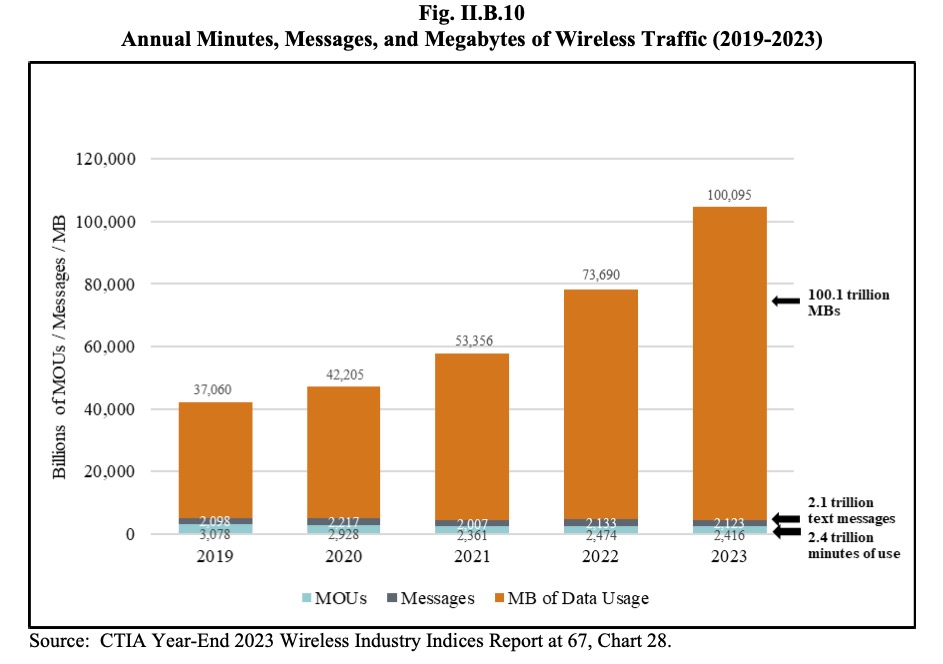
The Commission's 2024 Communications Marketplace Competition Report includes a chart by CTIA that shows the dramatic rise in mobile data traffic, and an unmistakable upward trend that will continue as more and more connected devices go into use and as data usage per subscriber continues to go up: 


Additionally, the 2024 report observes that "[a] large proportion of mobile data traffic is delivered on an unlicensed basis through Wi-Fi, Bluetooth, and similar protocols." Furthermore: "Telecom Advisory Services asserts that the economic benefits associated with Wi-Fi in the United States will rapidly grow to $2.4 trillion in 2027, including an estimated $514 billion in consumer benefit, $624 billion in producer surplus, and $1,286 billion in GDP." And "[a]ccording to LightReading, the average Verizon subscriber offloads approximately 78% of their data onto Wi-Fi, for example, while Comcast subscribers offload approximately 94%." For other highlights from the report, see my Perspectives from FSF Scholars, "The FCC's 2024 Communications Marketplace Report: Time for a Broader View of Competing Broadband Services," published January 24, 2025. 


Also important is the NERA study published on January 23 that estimates the tremendous economic value created through the allocation of spectrum for licensed use. For more on that, see my January 23 blog post, "Report: Putting Mid-Band Spectrum into Licensed Use Adds Billions to Economy."


The Spectrum Pipeline Act that Rep. Allen introduced is a companion to the similarly-titled bill from March 2024 that Senators Ted Cruz and John Thune sponsored. As Free State Foundation President Randolph May stated in a March 11, 2024, Media Advisory regarding the Senate bill from the last Congress: 

No doubt there may be different views regarding the specific dates and amounts identified for reallocation contained in the bill. But there should be widespread agreement that it provides a good basis for moving forward promptly to develop a bipartisan, bicameral plan to address the nation's now-lagging spectrum efforts.

Everything President May said then applies with equal measure to the Spectrum Pipeline Act of 2025. Several months later, no substantial progress has been made on the wireless spectrum front. Timely action by Congress is even more important to get the desired result from having more spectrum in use. Rep. Allen deserves credit for filing the bill and undertaking efforts to make that happen. 

Thursday, January 23, 2025

Report: Putting Mid-Band Spectrum into Licensed Use Adds Billions to Economy

On January 23, CTIA published a report, "The Economic Impact of Each Additional 100 MHz of Mid-band Spectrum for Mobile." 

The report, prepared by NERA, identifies the serious looming shortfall of mid-band range (1 GHz to 7 GHz bands) spectrum for licensed use in the face of sharply rising demand – and it goes on to estimate the tremendous economic benefits that result from putting more spectrum into licensed use:

[T]he wireless industry is rapidly approaching a spectrum deficit that will result in network congestion, thereby hindering the continued growth fueled by the wireless industry. Projections indicate that wireless operators will need at least 400 MHz of additional spectrum by 2027 to meet the needs of the U.S. economy, a deficit that will continue to grow to over 1400 MHz by 2032.

We estimate that each additional 100 MHz of mid-band spectrum to mobile will generate $264 billion of GDP, about 1.5 million new jobs, and about $388 billion in consumer surplus. The impact of 400 MHz of mid-band spectrum would be $1.1 trillion of GDP, 6.18 million new jobs, and about $1.5 trillion in consumer surplus. Beneficial effects would continue to accumulate beyond 400 MHz, and we estimate that by 2028 even 400 MHz of new 5G spectrum will not be enough to keep up with consumer demand.

The report traces the economic benefits of allocating mid-band spectrum for wireless use, including better mobile and fixed wireless access (FWA) for consumers and business employers, as well as support for industries that rely on mobile connectivity or serve the wireless industry.  


Reallocating spectrum occupied by federal agencies for licensed commercial use will require Congress to reauthorize the FCC's authority to conduct spectrum auctions and issue licenses to bid winners. Restoring that authority should be a top priority of the 119th Congress. Achieving this result and maximizing the economic benefits of licensed spectrum use also likely will depend on Congress and the Trump Administration finding ways to accelerate or revamp the existing National Spectrum Strategy to get lower 3 GHz and other spectrum ready on a much faster timetable.  

A New Administration Brings Renewed Hope for Renewed FCC Spectrum Auction Authority

It has been 686 days since Congress allowed the FCC's spectrum auction authority to expire on March 9, 2023. Absent additional auctions, not to mention the identification of specific spectrum bands to be auctioned for commercial use, mobile operators will struggle to satisfy consumers' insatiable demand for wireless data.

Moreover, the U.S. could risk ceding mobile broadband leadership to its global adversaries – in particular, China, the national security concerns regarding which I wrote about recently in two posts to the FSF Blog.

As Rhonda Johnson, AT&T EVP, Federal Regulatory Relations, wrote in a January 15, 2025, blog post, "AT&T stands ready to invest in the next set of 'anything-is-possible' predictions about what 'you will' be able to do in the years to come" – but "[t]he private sector cannot acquire the spectrum it needs in the U.S. until Congress reauthorizes the FCC to conduct auctions and the government allocates more full-power mid-band spectrum for licensed commercial use."

Fortunately, there is reason for optimism.

First, in his Statement on being designated FCC Chairman, Brendan Carr prioritized "unleashing new opportunities for jobs and growth through agency actions on spectrum."

Second, at today's House Committee on Energy and Commerce Subcommittee on Communications and Technology hearing titled "Strengthening American Leadership in Wireless Technology," regarding which Free State Foundation Director of Policy Studies and Senior Fellow Seth L. Cooper blogged yesterday, Subcommittee Chair Richard Hudson (R-NC) noted the following in his Opening Remarks:

Last Congress, the [FCC's] spectrum auction authority expired for the first time due to disagreements about how spectrum resources should be allocated. These auctions have historically brought in billions to our national economy, with the highest spectrum auctions raising over $80 billion from private companies. It is simple economics: there is limited supply, unlimited demand, and a willingness to pay. We need to reauthorize the FCC's spectrum auction authority immediately.

Third, Senate Commerce Committee Chairman Ted Cruz (R-TX) reportedly has described renewal of the FCC's spectrum auction authority as "his top tech policy priority for reconciliation, a process that will allow the GOP to push through budget-related legislation with its slim Senate majority."

In March 2024, Senator Cruz and Senator John Thune (R-SD), the new Senate Majority Leader, introduced the Spectrum Pipeline Act of 2024, legislation that would have renewed the FCC's spectrum auction authority and required it to auction for full-power commercial use at least 1,250 megahertz within 6 years.

Wednesday, January 22, 2025

House Hearing Should Prompt Action on Wireless Spectrum, FCC Auctions

On January 23, the House Subcommittee on Communications & Technology will hold a hearing titled "Strengthening American Leadership in Wireless Technology." The hearing will feature witness testimony addressing spectrum management, licensed versus unlicensed spectrum, spectrum auction authority, international harmonization, and radio access networks (RANs).

The hearing is important because next-generation wireless networks are vital to our nation's economic vitality and competitive. Also, the hearing is timely because there is an urgent need for more spectrum dedicated to commercial wireless use, particularly licensed spectrum and especially spectrum in the mid-band range (1 GHz to 7 GHz).


Wireless device connections and mobile data usage are rising sharply each year, with demand rising ever-higher in the years to come. Unfortunately, the U.S. supply of licensed spectrum is likely to fall short absent the reallocation of additional spectrum from government occupancy to private commercial use. At this moment, there is no spectrum waiting in the wings to be repurposed for commercial use, despite federal agencies using or at least occupying significant amounts of spectrum resources. To make matters more difficult, the FCC's general authority to conduct spectrum license auctions and issues licenses to auction bid winners lapsed in 2023. 


The 119th Congress and the Trump Administration should take decisive action to replenish the stock of mid-band spectrum and revive the Commission's auction authority. The first Trump Administration's National Spectrum Strategy stalled out, and the Biden Administration's National Spectrum has been criticized for its painful slowness and overstudying instead of producing results. Whatever has come before now, every available good option for fast-tracking and getting more spectrum into private use should be pursued and a re-stocked spectrum pipeline made into reality. 


The House Subcommittee's January 23 spectrum hearing memo is available here. Hopefully, the hearing will lead to prompt concrete action in the 119th Congress on spectrum and other important wireless policy issues. 

Thursday, December 12, 2024

House Passes NDAA With Small Spectrum Provision, But Pipeline Still Empty

On December 11, the U.S. House of Representatives passed H.R. 5009, the Servicemember Quality of Life Improvement and National Defense Authorization Act for Fiscal Year 2025 ("NDAA"). Among the massive bill's contents, H.R. 5009 authorizes the FCC to conduct a spectrum license auction for the Advanced Wireless Services (AWS-3) bands, with auction proceeds of up to more than $3 billion going to fund the Secure and Trusted Communications Network Reimbursement Program. Also known as "rip-and-replace," the program reimburses small advanced communications service providers for expenses due to the removal, replacement, and disposal of communications equipment provided by Huawei or ZTE. 

Back in 2014, the FCC conducted Auction 97 for AWS-3 licenses, but 197 of those licenses were entangled in administrative processes and litigation. If H.R. 5009 becomes law, it would do good by enabling that valuable spectrum to be put to use. 


The AWS-3 spectrum license auction provision in H.R. 5009 appears reasonable and beneficial as far as it goes. But H.R. 5009's AWS-3 provision is a targeted measure involving only a small amount of spectrum. The bill would not address the larger issue of the FCC's lapsed general authority to conduct licensed spectrum auctions and issue licenses. Nor would it address the need for significant amounts of more spectrum to be put into the pipeline for repurposing and auctioning by the Commission to support next-generation commercial wireless services. 


In 2025, the 119th Congress needs to make the revival of the FCC's spectrum auction authority a priority and – in coordination with the incoming Trump Administration – hopefully authorize specific bands for repurposing and auction. 

Wednesday, September 18, 2024

Survey Shows Sharp Increases in Mobile Data, Growth in 5G Home Broadband

On September 10, CTIA released its 2024 Annual Survey. The Survey Highlights report is available online. It shows the strong growth in mobile wireless connections, data usage, cell sites, and 5G Home connections during the year 2023.  

CTIA reported that wireless data traffic in the U.S. grew, as U.S. wireless networks supported 100 trillion MB of traffic last year, up from the nearly 74 trillion MB from the year before. Additionally, nearly 40% of wireless devices were 5G devices, for 216 million total active 5G devices in 2023, and the 558 million total wireless connections were up from 523 million from the year prior. Also, the total number of cell sites in the U.S. grew to 432,469 – up 24% from 2018. This continued growth was supported by annual wireless investment totaling $30 billion in 2023. Regarding 5G Home Broadband – or fixed wireless access (FWA) services – CTIA reported: "Over the past two years, 95% of net new broadband subscribers chose 5G home service—and importantly, 1 out of 5 net 5G home adds were entirely new home broadband subscribers." More stats are contained in the 2024 Annual Survey Highlights.


My July 30, 2023, blog post spotlighted CTIA's 2023 Annual Survey Highlights.


To fully realize the benefits of 5G connections, more spectrum will need to be available, especially licensed spectrum for commercial wireless uses. In January 2024, Free State Foundation President Randolph May published "Communications Law and Policy Priorities for 2024." One of those priorities is to "Reopen the Spectrum Pipeline and Act to Fill It." As FSF President May explained in a Media Advisory from March of this year, one constructive proposal for doing that is the Spectrum Pipeline Act of 2024 (S.3909).


Also, legislation for streamlining and speeding up permit processes for wireless infrastructure construction would help foster continued growth in wireless services and improve as well as increase connections for Americans. My blog post from August 7 identified one measure worth considering, the Accelerating Broadband Permits Act (S.4281), which is intended to help ensure the timely processing of permits for building new wireless infrastructure on federal lands. 

Friday, May 10, 2024

Future U.S. Competitiveness Requires More Licensed Spectrum

On May 6, CTIA published a report, "How Licensed Spectrum Fuels U.S. Competitiveness." CTIA's report makes a case for why more full-power licensed commercial spectrum – especially in the mid-band – is needed to ensure that the U.S. remains a competitive leader and realizes its full economic potential in the years ahead.

CTIA's report emphasizes wireless-enabled U.S. economic gains in international export-focused sectors, including agriculture, transportation, as well as pharmaceuticals, health care, and life sciences. Its overview of the economic benefits of wireless to manufacturing, machinery, and equipment is particularly insightful:

  • "Wireless connectivity is a critical innovation-enhancing input that boosts productivity across several key traded sectors, while constitutive parts of the wireless industry, like equipment, components, chips, devices, and software, are also themselves exported around the world."
  •  "A healthy U.S. 5G ecosystem makes for a stronger U.S. semiconductor industry" to fabricate chips used to power smartphones and other wireless devices.
  • "U.S. firms enjoy over 25 percent of global handset market share and dominate smartphone operating systems worldwide" due partly to early US leadership in 4G LTE networks. 
  • The U.S. is "a significant player in development of the intellectual property underlying wireless communications. With this IP, U.S. firms are major contributors to wireless communications standards, which are then used around the world."
  • "Researchers estimate the global 5G value chain, including network operators, providers of underlying technology and components, device and equipment manufacturers, and 5G application developers, will contribute $3.6 trillion in economic output by 2035."
  • "A significant component of this economic potential comes from efficiency-driving insights from Internet of Things (IoT) deployments… More spectrum will ensure 5G networks have the capacity to support a deeper integration of IoT sensors and devices to further enhance use cases across industries."
  • "Increasing U.S. manufacturing productivity—squeezing more from each dollar invested—is essential to making American manufacturing more globally competitive, and how to do this is a key consideration for policymakers who are looking to encourage manufacturers to produce more goods in America."
  • "The Manufacturing Institute surveyed manufacturing leaders on the impact of 5G on their business, finding manufacturers believe 5G can help lower costs by an estimated average of 38%, while increasing machine productivity by an estimated 42% and workforce productivity by 41%."
  • "This productivity impact comes from many 5G applications, such as smart factory connectivity, real-time insights from digital twins, and enhanced training and maintenance capabilities."

However, the report cites other report findings that the U.S. faces a "spectrum crunch." According to the report: "Researchers estimate that by 2027, U.S. operators will need an additional 400 megahertz of full-powered mid-band license spectrum, even accounting for optimistic growth in infrastructure, spectral efficiency, and Wi-Fi offload." This projected deficit increases to almost 1,500 MHz by 2032. By contrast, "China has already allocated 1460 megahertz of mid-band spectrum for 5G." That amount is 3.2 times more than the U.S.  Also, "[r]esearchers estimate that China may dedicate up to a total of 1660 megahertz of mid-band spectrum for 5G in the coming years."


CTIA's report calls for more full-power, mid-band spectrum for wide-area commercial 5G networks to ensure strong U.S. competitiveness against leading foreign rival China. It makes a call to fast action to license suitable sections of the lower 3 GHz and 7/8 GHz bands for full-power networks. As the report states, "policymakers should rely on tried-and-true auctions to identify those entities best positioned to generate the greatest value out of the limited frequencies available."


Free State Foundation President Randolph May and Senior Fellow Andrew Long reiterated the need for a replenished spectrum pipeline in January 2024 public comments to the NTIA for its Implementation Plan for the National Spectrum Strategy. The importance of re-establishing the FCC's statutory authority to conduct competitive bidding spectrum license auctions as well as the importance of more spectrum availability – both licensed and unlicensed – were discussed during the "Hot Topics in Communications Law and Policy" panel at the Free State Foundation's Sixteenth Annual Policy Conference. The panel video is available online. 

Monday, March 11, 2024

MEDIA ADVISORY: Reaction to Cruz-Thune "Spectrum Pipeline Act of 2024"


Regarding the introduction of the proposed “Spectrum Pipeline Act of 2024” by Senators Ted Cruz and John Thune, the following statement may be attributed to Free State Foundation President Randolph May:

“While the Free State Foundation doesn’t support or oppose specific legislation, I applaud Senators Cruz and Thune for introducing their spectrum bill. It has important features that, if adopted, will help ensure the United States does not lose its leadership position in wireless, especially in 5G. Today, spectrum is a key part of the nation’s broadband infrastructure — just like cables and wires. The Cruz-Thune bill would reestablish the FCC’s lapsed auction authority, and it would require that a considerable amount of mid-band spectrum be reallocated for commercial use and be made available by specific dates. The pipeline established would include a much-needed supply of licensed spectrum, while not ignoring the need for more unlicensed spectrum, which also is an increasingly important part of the broadband infrastructure.

No doubt there may be different views regarding the specific dates and amounts identified for reallocation contained in the bill. But there should be widespread agreement that it provides a good basis for moving forward promptly to develop a bipartisan, bicameral plan to address the nation’s now-lagging spectrum efforts."   

Wednesday, February 07, 2024

Report Shows U.S. Needs to Allocate and Harmonize More Mid-Spectrum for Wireless Use

On February 7, CTIA released a report by Accenture titled "Advancing U.S. Wireless Excellence – The Case for Global Spectrum Harmonization." The report itself is excellent in describing both the economic benefits of allocating mid-band spectrum for commercial wireless use and the benefits of harmonizing U.S. spectrum allocations in the mid-band range with other nations. 

But to reap those benefits, the U.S. needs to maintain its leading role by making more mid-band spectrum available. In its report, Accenture found that, as of 2023, the five leading countries in mid-band spectrum availability dedicated an average of 652 MHz to commercial wireless use. But the U.S. faced a 202 MHz mid-band spectrum deficit compared to those nations. Accenture projects that in the year 2027, the five leading nations will dedicate an average of 970 MHz of mid-band spectrum to commercial wireless use. But due to the lack of spectrum in the pipeline in the U.S., our nation's spectrum deficit will grow to 520 MHz in 2027.


Accenture identifies the 3.3-3.45 GHz band, the 4.4-4.94 GHz band, and the 7.125-8.5 GHz band as ideal for commercial use and global spectrum harmonization. As explained in the report, spectrum harmonization could benefit U.S. consumers and businesses to the tune of tens of billions of dollars: 

Spectrum harmonization can standardize network equipment and wireless device production, resulting in less market variation in radio requirements for these technologies. With more harmonization, fewer variations of network radios and wireless devices must be produced, and complex devices that support a wide range of frequencies can be simplified. These efficiencies result in cost savings for end users and drive additional downstream benefits (e.g., accelerated network deployment, earlier adoption of industry use cases, etc.) unlocking approximately $23B-$44B in value for industry and consumers over the next 10 years. Additionally, harmonization will improve network performance through minimized downtime, reduced interference, and better roaming.

And the Accenture report estimates that the overall economic benefits of industry expansion, innovation, and job creation from future U.S. leadership in a more harmonized wireless ecosystem total between $125 billion and $155 billion over a decade. 


But the U.S. will miss out if it fails to promptly replenish the spectrum pipeline with mid-band spectrum for licensed commercial wireless use. On January 2 of this year, Free State Foundation Randolph May and Senior Fellow Andrew Long submitted public comments to the NTIA regarding the agency's implementation of the National Spectrum Strategy. As explained in FSF's comments, although the NTIA's November 13, 2023 Strategy identifies 2,786 MHz of spectrum for study, that is no guarantee that a single megahertz actually will be dedicated for commercial wireless use and the Strategy "fails to tackle the difficult work necessary to rationally balance government and commercial demands for this high-value, limited resource." FSF's comments conclude: "The reality… is that NTIA must embrace the challenging work required to identify – and in fact repurpose – government-held spectrum that would better serve our nation's interests were it put to commercial use, whether on a licensed or unlicensed basis. And do so in a timely manner." 


For more, see my November 2023 blog post, "NTIA Releases National Spectrum Strategy, But Pipeline Remains Empty."

Thursday, June 15, 2023

Report on Fixed Wireless Access Competition Shows Need for More Mid-Band Spectrum

Today, Econ One released a report titled "Competitive Effects of Fixed Wireless Access on Wireline Broadband Technologies." There is an ongoing debate over the potential impact of fixed wireless access (services) on broadband competition. This interesting report, authored by Hal Singer and Augustus Urschel, provides a significant contribution to the debate.

The Econ One report estimates the competitive effects of FWA entry into broadband markets. The estimates are based on surveys of consumer responses to hypothetical scenarios in which FWA services are made available at different price levels and in local markets with differing choices among incumbent providers of cable modem and/or fiber broadband services. 


According to Econ One's report: "In all scenarios—including at current prices or alternative discounted prices, and in markets with only cable or those with a mix of cable and fiber offerings—the introduction of FWA packages yields price reductions and significant consumer welfare gains." That is, the report found that FWA market entry would prompt many subscribers to switch from incumbent services to competitively priced FWA services and also lead to price reductions for subscribers to cable broadband services. For the details, check out Econ One's report.


Notably, Econ One's report "assumes sufficient capacity to support all potential subscribers with high-speed FWA service." That assumption is key because mid-band spectrum is a necessary input for supporting FWA services for large numbers of subscribers. But as Free State Foundation scholars have pointed out in April 2023 public comments to the NTIA for its National Spectrum Strategy proceeding, in Perspectives from FSF Scholars papers, and in blog posts, there is a shortfall of mid-band spectrum available for commercial licensing on an exclusive basis. The Econ One report is on solid ground in concluding that "[t]he best and fastest way to increase home broadband competition, which will bring significant consumer savings, is getting more full-power, licensed, mid-band spectrum into the hands of FWA providers."


FSF scholars have supported prior FCC allocations of spectrum for use on an unlicensed basis, including the Commission's 5.9 GHz Order. Congress and federal agencies also ought to be open to pursuing new opportunities to dedicated other spectrum resources to unlicensed uses. But it is now imperative that Congress and federal agencies prioritize the repurposing of mid-band spectrum for exclusive licensed use. Congress needs to renew the FCC's authority to conduct competitive bidding auctions for spectrum licenses and get additional mid-band spectrum into use to support FWA.  

Friday, June 09, 2023

Report Stresses Importance of Mid-Band Spectrum for 5G and U.S. Leadership

On June 7, the Center for Strategic & International Studies released a report titled "Spectrum Allocation for a Contest with China." Authored by James Andrew Lewis, the report emphasizes the need for allocation of more mid-band spectrum to support commercial 5G services. 

The report argues that American success in competition with China and global influence depends on the U.S. staying at the cutting edge of technology. This includes 5G wireless technologies; "[b]ut the United States lags far behind the rest of the world in allocations of the spectrum needed for 5G." The report states that federal government agencies have been allocated 60% of the mid-band spectrum compared to only 5% for licensed commercial users. Thus, "U.S. mid-band allocations diverge from the practices of other leading economies, including China, all of which have allocated much more mid-band spectrum to 5G uses."

Also, the report acknowledges that the expiration of the FCC's spectrum license auction authority in March of this year "deprives the United States of a valuable spectrum management tool and makes it more difficult to align spectrum use to make the country more competitive with China." And it rightly calls for the U.S. to find ways to allocate sufficient spectrum for 5G while supporting other national security objectives.


Free State Foundation Senior Fellow Andrew Long also wrote about these same important topics in his February 2023 Perspectives from FSF Scholars, "Extending FCC Spectrum Auction Authority Is Essential to the 5G Race."

Tuesday, May 16, 2023

Report: More Licensed Commercial Spectrum Needed to Avoid Looming Deficit

On April 17, CTIA publicly released a report by the Brattle Group, "How Much Licensed Spectrum is Needed to Meet Future Demands for Network Capacity?" This interesting report, which is worth reading in full, presents a scenario regarding macro cellular wireless networks that Congress and federal agencies ought to take very seriously:

We find that if no new spectrum bands are allocated for terrestrial mobile use in the next 5 years, then the U.S. is expected to have a capacity deficit of roughly 10 exabytes per month and a spectrum deficit of roughly 400 megahertz. In ten years, without new mobile spectrum, the capacity deficit will increase to almost 17 exabytes per month and the spectrum deficit will more than triple to approximately 1,400 megahertz.

The Brattle Group's report includes a brief overview analysis of why, in their view, possible technical solutions to reduce or avoid such a spectrum deficit, including Wi-Fi offloading, increased spectral efficiency, and construction of more physical facilities such as towers and small cells will be inadequate means to accommodate growing mobile data traffic demand. Indeed, the report includes the Brattle Group's projection that mobile data traffic in North America will increase from 5,846 petabytes (PB) per month in 2022 to 33,918 PB per month in 2032. 


The report's prescription for more commercial licensed spectrum availability is spot on. On the same day of the report's release, the Free State Foundation filed public comments with the NTIA for its Development of a National Spectrum Strategy proceeding. Those comments called attention to the empty spectrum pipeline and called for the repurposing of at least 1,500 MHz of mid-band spectrum for licensed commercial use. 

Thursday, May 11, 2023

FCC Set to Vote on Future Spectrum Use in the 12.2 GHz and 12.7 GHz Bands

At its May 18 public hearing, the FCC will be voting on a Report and Order and Further Notice of Proposed Rulemaking regarding use of spectrum in the 12.-12-7 GHz (12.2 GHz) band. The draft Report and Order, if approved by the Commission, would not authorize high-powered terrestrial mobile broadband services to operate in the 12.2 GHz band. The Report and Order cites apparent concerns about significant risk of harmful interference with existing and emergent services that use the 12.2 GHz band, including satellite services, as the basis for that policy conclusion. However, the Report and Order would continue investigation into the potential for terrestrial fixed use or unlicensed use in the 12.2 GHz band.  

The 12.2 GHz item now teed up for the Commission's May 18 public meeting also includes a Notice of Proposed Rulemaking and Order regarding expanded use of the 12.7-13.25 GHz (12.7 GHz) band for mobile broadband or other use. In its draft NPRM and Order, the Commission states:

[W]e propose to repurpose some or all of the 550 megahertz of mid-band spectrum for mobile broadband or other expanded use. The record demonstrates substantial support for repurposing these mid-band frequencies for next-generation wireless technologies including 5G, 5G Advanced, and 6G services that will depend on extremely high data rates, and the reliability, low latency, and capacity that the 12.7 GHz band spectrum can provide.

Without expressing any view on the merits of the Commission's determinations about potential significant harmful signal interference in the 12.2 GHz band or on any specific proposals for future use in the 12.7 GHz band, the Commission's forthcoming vote on the 12.2 GHz and 12.7 GHz bands is important because it is a step toward maximizing use of those valuable mid-band spectrum resources. The NPRM and Order on the 12.7 GHz rightly recognizes the significance of mid-band spectrum for the future of commercial wireless services in the U.S. And with the 12.2 GHz/12.7 GHz item scheduled for a vote on May 18, Commission appears to making a good faith effort to fulfill its public trust to promote valuable use of spectrum. 

Tuesday, April 18, 2023

FSF Calls for Fast Action on Mid-Band in National Spectrum Strategy

On April 17, the Free State Foundation filed public comments with the National Telecommunications and Information Administration (NTIA) in the agency's proceeding for the Development of a National Spectrum Strategy. As FSF's comments observe, there is a lack of available spectrum that is needed for delivering next-generation wireless services in the years ahead. To maintain of U.S. global leadership on 5G makes it imperative that the spectrum pipeline be replenished. The federal government is the primary occupier and user of a significant amount of spectrum, particularly in the mid-band. And while spectrum is needed for continued support of national security, law enforcement, and other governmental functions, much of the government-occupied is going underutilized. Hopefully, the NTIA's development and implementation of a National Spectrum Strategy will be swiftly developed and implemented to make more spectrum available for commercial services and help ensure that its value and use are maximized.

To this end, two policy imperatives are set forth in the initial paragraph of FSF's comments are set forth in the initial paragraph: 

The agency should adopt and implement its proposal to identify at least 1,500 MHz of spectrum for study – and, importantly, it should make determined efforts to reallocate at least 1,500 MHz of spectrum for more commercial use. And while the maintaining the availability of sufficient unlicensed spectrum should remain an important objective, the National Spectrum Strategy's short-term priority should be accomplishing the repurposing of more mid-band spectrum for exclusive licensed use, starting with the 3.1-3.45 GHz band. 

FSF's comments recommend that low-, mid-, and high-band spectrum be identified and reallocated for commercial wireless use. Additionally, FSF's comments recognize that dedicating spectrum for unlicensed use such as Wi-Fi also can yield considerable value and use. For more details, FSF's comments are available online. 


The NTIA's ongoing efforts to develop and implement a National Spectrum Strategy was a subject of a keynote address at #FSFConf15 on March 28 of this year by Scott Blake Harris, Senior Spectrum Advisor at the NTIA. Video of Mr. Blake's keynote is available online


A National Spectrum Strategy has been long awaited. Indeed, back in January 2019, FSF filed comments with the NTIA, under the prior administration, for the agency's earlier proceeding to develop a sustainable national spectrum strategy. That earlier proceeding never succeeded in accomplishing its task. Hopefully, the current administration and proceeding at the NTIA will continue apace and have an implementation plan ready by the summer of this year. We wish Mr. Harris and the agency success in promptly assembling and putting into action a National Spectrum Strategy that will boost spectrum use and efficiency and put the U.S. solidly out in front on 5G and, one day, 6G.

Thursday, January 05, 2023

The End of 3G Wireless Era Enables America's 5G Future

On January 3, Verizon announced that its 3G CDMA mobile network has been decommissioned. The retirement of Verizon's 3G network had been scheduled to take place by December 31, 2021. Now all three nationwide mobile wireless broadband providers now have retired their 3G networks.

As explained in my September 2021 Perspectives from FSF Scholars, "AT&T's 3G Sunset Will Make Way for Speedy 5G Services": "Old 3G networks consume significant amounts of spectrum for a small and fast-shrinking user base. That valuable spectrum needs to be repurposed to timely roll out 5G networks… so that consumers can benefit from their promised speeds and capabilities." And in an August 2021 Perspectives from FSF Scholars titled "T-Mobile's Timely 3G Sunset Will Spur Stronger Services," I wrote that "any regulatory intervention to extend the life of 3G networks would keep wireless services stuck in the slow-speed era to the overall detriment of consumers." Blog posts (herehere, and here) by FSF scholars also tracked the progress of 3G network retirement during 2022.


Fortunately, unjustified regulatory obstacles to 3G retirement appear to have been avoided. When it comes to the deployment of 5G services, every bit of available spectrum helps. The spectrum used to support dwindling 3G legacy services is now available for next-gen 5G services.  

Wednesday, December 14, 2022

Report: Wireless Benefits U.S. Economy

On December 7, CTIA published a report by Compass Lexecon titled "The Importance of Licensed Spectrum and Wireless Telecommunications to the American Economy." The report spotlights the economic output and job creation enabled by wireless services between 2011 and 2020:

The substantial investments in licensed spectrum and infrastructure during the past decade have allowed the industry to deliver wireless services to hundreds of millions of consumers throughout the U.S., contributing nearly $9.5 trillion in gross output and $5.4 trillion in GDP to the American economy, and employing an annual average of more than three million people… In 2020 alone, the wireless industry contributed over $1.3 trillion in gross output, $825 billion in GDP, and nearly 4.5 million jobs to the American economy. 

These trillions in output and millions of jobs include the direct effects of the core wireless industry (mobile network operators and resellers) on the economy, as well as the secondary effects of the wireless supply chain and select downstream market segments that rely heavily upon wireless and mobile broadband services (including smartphone app developers, search engines, digital advertising agencies, mobile gaming, and social networking sites). It does not take into account the contributions made by other sectors that also depend on and use wireless services that could represent hundreds of billions in additional gross output and GDP, as well as millions of workers. Therefore, the estimates presented in this study are a baseline, or lower bound, for the contributions made by wireless- related sectors to the American economy. 

The decade's impressive economic output and job creation spurred by the wireless industry depended upon wireless network operator investment of $265 billion in infrastructure during that same period of time. Moreover, "[b]etween 2011 and 2020, spectrum auctions pertaining to wireless services have raised $155 billion in auction revenues."  


Compass Lexecon's report cites many other pro-consumer results from the strong private sector investments made in wireless networks between 2011 and 2020, including significantly expanded competing network coverage, mobile wireless download speed increases, mobile data traffic growth, and downward pricing trends. The report thus provides a reminder of the importance of maintaining a free market-oriented light-touch regulatory framework for wireless broadband services that promotes private investment and innovation. 


Acknowledging that demands for mobile wireless services is expected to increase significantly in the years ahead, the report presents a key policy takeaway for ensuring that wireless providers can meet those future demands: 

For the wireless industry to continue to provide these considerable, widespread positive effects to the American economy, it is necessary to provide mobile network operators access to dedicated, licensed spectrum. It is also important to allow potential licensees to compete to acquire the spectrum licenses, and, once acquired, to allow the licensees to determine the optimal allocation and usage of that spectrum in the economy based on economic market forces. 

The report doesn't analyze any specific bands. But as public debate continues regarding whether exclusive licensed and shared spectrum frameworks ought to be established by Congress or by the FCC for future commercial spectrum allocations, the findings contained in Compass Lexecon's report deserve careful consideration alongside facts, data, and analysis offered by parties with other viewpoints.