Showing posts with label CPI. Show all posts

Monday, June 01, 2026

Computing the Cost of Intelligence: The Consumer Price Index and Information Products

Every month the U.S. Bureau of Labor Statistics (BLS) announces its latest estimate of the cost of all consumer goods and services. These initial estimates are then revised as additional data come in. One of the key drivers of the American economy over the last few years has been the declining cost of information in relation not only to other goods and services but occasionally also in nominal prices. This blog reviews the current procedures for measuring information costs, hopefully giving readers more context about the long-term trends.

We examine seven discrete categories of goods and services that have the primary purpose of collecting and processing information. Four of these goods are members of the broader category of Information technology, hardware and services. Two lie within the category of Telephone services. The final one lies within the category of Video and audio.

Approximately half of the index for telephone hardware, calculators, and other consumer information items consists of cellphones (about 95 percent of which are smartphones) with home-based phones, phone accessories and smartwatches making up the rest. The Consumer Price Index (CPI) records the actual price of a smartphone, with promotions deducted from the advertised price. The BLS also separates out the price of hardware from accompanying services such as Internet access and television subscriptions. These services are collected in a separate category of spending.

One of the most important information products is smart phones. These goods are the only item in their broader category that are quality adjusted due to the rapid rate of technological advancements and improved quality for consumers. For the vast majority of products, BLS simply records the price without any adjustment for quality. However, for smartphones BLS economists have developed a hedonic regression model that allows them to identify how much of a price rise is due to specific improvements in quality. Assuming some of a price increase was due to product improvements such as better screen resolution, BLS would add the value of those improvements to the previous price of the smartphone and compare it to the new price. If both prices were the same, consumers would be paying more but also getting more, as opposed to paying more for the same benefit due to general inflation. Wireless telephone services and television services undergo similar adjustments.

CPI also uses the concept of directed substitution for both smartphones and computers because of the rapid quality improvements in each good. Basically, twice a year BLS assumes that consumers are purchasing the newer version of a product even if the older one is still available. The resulting data recognizes that manufacturers are improving the cost and/or quality of the product even if consumers are not purchasing it yet.

Another key fact is that information services make up a growing share of consumers’ total spending. This multiplies the impact of cost restraint. A 50 percent price reduction in housing, which currently accounts for more than 44 percent of spending, has a much larger effect on living standards than a 50 percent cut in furniture and bedding, which makes up less than 1 percent. Table 1 shows the relative weights for selected categories of information spending for 2017-18 compared to 2024. Some items have increased their share of the consumer’s budget while others have contracted.

Table 1: Relative Importance of Components in the CPI, 2017-18 and 2024

Spending Category

2017-18

2024

Computers, peripherals, and smart home assistants

0.285

0.293

Computer software and accessories

0.016

0.027

Internet services and electronic information providers

0.856

0.923

Telephone hardware, calculators, and other consumer information services

0.066

0.461

Wireless telephone services

1.824

1.340

Residential telephone services

0.405

0.126

Cable, satellite and live streaming television service*

1.145

0.606

*Was Cable and satellite television service in 2017-18

It is important to note that the CPI only collects data on consumer items. Price and quality improvements on products purchased by businesses are not recorded. This excludes a major source of innovation and productivity in the economy. However, many of these changes are eventually captured as competition eventually forces companies to pass most of the benefit on to consumers. Also excluded from this table are subscriptions to on-line magazines, games, and music and video downloads, which are treated just as if the consumer purchased them offline. Non-business subscriber fees for residential television are included, but pre-recorded video-on-demand subscription streaming services are not.

BLS faces a constant problem separating out changes in general inflation from changes in the quality and capacity of specific goods and services. Products that seldom change from one period to another present little problem. However, the true prices of products that change rapidly are more difficult to measure. A current example is the rise in pay-per-view streaming which charges viewers fees for a greater choice of programming content. If a replacement product is better than its predecessors and BLS can measure the value of the difference in quality, it will raise the price from the previous month to reflect that there has been no change in the real price. In cases like this, nominal price increases may simply reflect the fact that consumers are getting more for their money. In this case the market is doing exactly what it should.

The relationship between prices and growth is complex. Some experts argue that much of the U.S. productivity boom in the 1990s and 2000s was due to statistical agencies using hedonic measures to overestimate productivity gains. However, others point to the large unincluded value of free services such as ChatGPT, Facebook, Gmail, Google Maps, and YouTube. Although these services deliver tremendous value to consumers, they are not counted in GDP. This debate will not end soon. In the meantime, the important point is that technology does increase our living standards even if the inherent level of data uncertainty makes this hard to see. 

Friday, October 14, 2022

In the Face of Inflation, Prices Fall for Internet and Wireless Services

On October 13, the U.S. Bureau of Labor Statistics released Consumer Price Index (CPI) data for September 2022. The overall CPI for September 2022 showed a sharp year over year increase of 8.2%, as Americans continue to be battered by inflation. However, CPI data for September 2022 shows significantly smaller increases or even slight decreases for communications and multi-channel video programming distributor (MVPD) services. Residential landline services have risen 3.6% year over year, and satellite and cable TV subscription services have gone up just 2.2%. Meanwhile, prices for internet services actually decreased 0.01% year over year, and prices for wireless services decreased 1.1% over that same timespan. 

One cannot reasonably or honestly deny that Americans are facing serious hardships due to high inflation. But the fact that communications and MVPD services are outperforming the bad inflationary trends – and even holding the line in the face of those trends for Internet and wireless services – is a testament to the strong private network investment and the competition in those markets. As USTelecom has reported, broadband providers' capital expenditures reached $86 billion in 2021. And CTIA reported that wireless providers' capital expenditures totaled $35 billion last year. Those investments have increased fixed and wireless broadband network capacities and geographic reach, giving overwhelmingly most consumers competing choices across platforms.
 

To help ensure pro-consumer pricing trends continue in fixed and mobile broadband Internet access services, the FCC should continue adhering to the light-touch regulatory framework that it applies to those services under Title I of the Communications Act. The Commission should maintain its reforms that bar unreasonable local permitting process delays for constructing wirelines and wireline infrastructure facilities as well as for making minor modifications and upgrades. And the Commission should act as quickly as it reasonably can to repurpose more spectrum for licensed commercial wireless use, including in the lower 3 GHz band. Promoting market investment and competition offer the best practical means for the Commission to ensure broadband availability and affordability. 


P.S. For an examination of broadband pricing trends against a longer timeframe, see Free State Foundation Senior Fellow Andrew Long's June 30 blog post, "2022 USTelecom Broadband Pricing Report: Further Proof that Competition is Benefiting Consumers. 

Wednesday, July 06, 2022

Misleading Evidence in Private Antitrust Suit Against T-Mobile/Sprint Merger

Dale v. Deutsche Telekom AG, a recent class action antitrust lawsuit filed in the Northern District of Illinois, alleges that the T-Mobile/Sprint merger harmed consumers by causing price increases. The Dale complaint largely rehashes arguments brought by state attorneys general that Judge Victor Marrero rejected back in 2020, but it also hangs its hat on new misleading evidence: the claim that the Consumer Price Index's "quality-controlled prices" for wireless telephone services have increased since the consummation of the merger.

The problem with that argument is that the CPI's "quality-controlled prices" do not control for quality improvements brought by 5G service.

Currently, the CPI records changes in wireless telephone plans from 4G networks to 5G networks, but does not quality adjust for these changes. The CPI continues to observe the changes in customer access of 5G networks to determine if quality differences can be quantified.


So, the tiny price increases that the CPI measured in late 2020 do not account for the increased quality brought by 5G service. That's a serious problem for the plaintiffs in Dale, because one of the reasons Judge Marrero approved the T-Mobile/Sprint merger was that he found it likely to expedite the rollout of 5G service. To that point, he seems vindicated, as OpenSignal's periodic "5G Report" repeatedly has found that T-Mobile's 5G network is delivering on its commitments and has improved on its past performance levels. So, if the CPI actually adjusted for improved quality from 5G service, it might not show price increases at all.

As a matter of antitrust law, it would be strange to find that the company with the highest-performing and continually improving network is suppressing competition. And as a reminder, antitrust law does not prevent businesses from increasing prices for improved service.

Also, since a brief small spike in late 2020, wireless prices have resumed their downward trend, and are nearing their all-time low on the CPI. Likewise, wireless telephone services are one of the only goods or services measured by the CPI currently decreasing in nominal price despite 40-year-high inflation. As I wrote in May, wireless telephone prices decreased by .7% between April 2021 and April 2022. Inflation during that period was 8.3%, so during the same time, real wireless prices decreased by 9%.

Evidence of improved 5G service quality, recent wireless price decreases, and additional evidence of increasing broadband competition – all of which Free State Foundation scholars included in their 2022 Communications Marketplace Report comments – will be hard for the Dale plaintiffs to overcome.

Friday, May 13, 2022

Dropping Consumer Broadband Prices Indicate Lack of Market Power

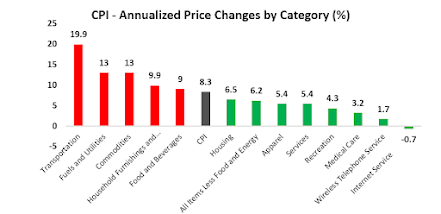
The Consumer Price Index (CPI) for April 2022 shows fixed and mobile broadband prices dropping, after accounting for our nation's staggering inflation rate. Despite the aggregate CPI having a 40-year-high 8.3% annualized inflation rate, mobile broadband prices have decreased by .7% and fixed broadband prices have only increased by 1.7% over the same period. So both are decreasing on "real" (inflation adjusted) terms.

In fact, importantly, wireless broadband prices are dropping even without taking to account inflation. These price changes amount to a 6.6% and 9.0% annualized price cut for fixed and mobile broadband, respectively, providing convincing evidence rebutting assertions that broadband providers have significant market power. As the chart below displays, fixed and wireless broadband annualized prices changes are among the smallest on the CPI.

Note: The CPI refers to fixed broadband as "Internet Service" and mobile broadband as "Wireless Telephone Service"

Price cuts indicate that broadband providers cannot charge higher prices without risking significant competitive backlash. The plunge in real broadband prices is consistent with the view Free State Foundation Director of Policy Studies Seth Cooper and I advanced in our January 2022 Perspectives from FSF Scholars that "overall competitive conditions in the broadband . . . market and across service sectors within the market remained equally strong or even improved." The evidence for robust broadband competition has only strengthened since publication of our Perspectives, with further substantial subscriber growth for innovative, low-price fixed wireless subscriptions and cable MVNO offerings

Real broadband price decreases are also consistent with the benefits of infrastructure reforms implemented by the FCC over the past 5 years that removed substantial deployment barriers, such as the 2018 “Small Cell Order” and 2017 “IP Transition Order.” Removal of those barriers, combined with increasing competition, may have created an environment where provider cost reductions from infrastructure reforms are being returned to the consumer, at least in part, through real price cuts.