Showing posts with label broadband pricing. Show all posts

Tuesday, August 04, 2026

FCC Simplifies Its Broadband "Nutrition" Labels

On July 22, the Commission adopted a Report and Order modifying its broadband "nutrition" label rules. According to the News Release, these changes "mak[e] [the labels] a more useful tool for consumers and reduc[e] compliance burdens on providers." They also bring those rules into better alignment with their authorizing congressional language.

2021's Infrastructure Investment and Jobs Act directed the Commission to "promulgate regulations to require the display of broadband consumer labels, as described in the Public Notice of the Commission issued on April 4, 2016 (DA 16–357), to disclose to consumers information regarding broadband Internet access service plans" (emphasis added).

"GFiber FCC Broadband Label" by Wikimedia Commons user JBoots07 is licensed under CC BY-SA 4.0.

But as I cautioned in a Perspectives from FSF Scholars published prior to the adoption of the original rules in November 2022, various commenters would have the agency ignore such statutory guardrails and instead "overload those labels with extraneous information intended to advance unrelated policy agendas rather than facilitate broadband comparison shopping."

Regrettably, the FCC at that time did not embrace my concerns.

The item adopted on July 22, however, addresses that overreach – and at the same time renders the labels more useful for consumers and less burdensome for ISPs. As the News Release underscores, the "initial broadband label rules … resulted in sometimes-confusing labels that strayed beyond the statutory framework Congress created, increasing compliance costs for providers in the process."

Among other things, the updated rules:

  • Allow customer service representatives to communicate information contained in the labels conversationally rather than requiring them to read the labels word for word;
  • Ensure "that consumers have … clear, accurate, and concise information about broadband plans, making the labels a more useful shopping tool";
  • Eliminate obligations to provide outdated information, such as references to the since-discontinued Affordable Connectivity Program;
  • Allow providers to "use links or icons at point-of-sale to avoid unwieldy amounts of information that can overwhelm consumers"; and, most saliently,
  • Remove obligations that exceed the underlying statutory mandate.
In his Separate Statement, Chairman Brendan Carr assured that "[n]one of those changes come at the expense of transparency…. The result is a label that's easier for consumers to use, while reducing costs for providers. That's a win for everyone."

Friday, May 22, 2026

USTelecom's 2026 Broadband Pricing Report Sings a Familiar Refrain: Backtracking Prices and Surging Speeds

The latest broadband pricing report released by USTelecom | The Broadband Association (USTelecom) tells a familiar – and welcome – tale of falling prices and rising speeds.

Released on Tuesday and, as in previous years, prepared by Business Planning, Inc.'s Arthur Menko, "2026 Broadband Pricing Index: Faster Speeds, Lower Prices" (2026 BPI) analyzes data from 2025. It concludes that real (that is, adjusted for inflation) prices fell as speeds continued to climb. Specifically:

  • PRICE: For the most-popular offerings (those delivering download speeds between 100 Megabits per second (Mbps) and 940 Mbps), the 2026 BPI reports that real prices dropped by 6 percent. The price of so-called "entry-level" plans – which provide download speeds between 100 and 249 Mbps and which USTelecom characterizes as "the most accessible tier for price-sensitive households" – reportedly decreased by an even greater margin: over 17 percent. According to the 2026 BPI, the price of gigabit (1,000 Mbps or greater download speeds) services fell nearly 5 percent.
  • SPEED: The 2026 BPI concludes that subscribers to the most-popular offerings in 2025 saw speeds increase by nearly 22 percent – and since 2014, those speeds have increased by 145 percent.

Americans appear to recognize that the broadband value proposition hasn't merely improved but stands as a welcome outlier in comparison to other household expenses. According to a March 2026 survey of 1,500 likely voters conducted by Impact Research and cited in the 2026 BPI, only 2 percent of respondents identified the price of home Internet service as a top two cost concern, rendering it the least pressing of all surveyed categories, which included groceries, health insurance, housing, gasoline, and prescription drugs, among others.

It is important to note, of course, that none of this happens by accident. Thanks to the expenditure of tens of billions of dollars in private capital each year – according to an October 2025 USTelecom investment report, nearly $90 billion in 2024 and over $2.2 trillion total since 1996 – fierce competition among a diverse set of facilities-based providers increasingly delivers better service at lower cost.

In a companion blog post, USTelecom CEO Jonathan Spalter summarized the report in plain terms – "broadband internet service continues to deliver more value for less money" – and urged policymakers to ensure that those trends continue. Specifically, he identified copper retirement and permitting reform as two areas ripe for further deregulatory action.

As it happens, in comments filed yesterday regarding the Commission's next report on the state of competition in the communications marketplace, FSF President Randolph May and I made the same two points. We also identified the pole attachment "accelerated docket" and the spectrum pipeline as areas where the FCC can take steps to accelerate broadband investment and deployment.

Free State Foundation scholars have summarized every BPI report released by USTelecom. Posts to the FSF Blog addressing previous versions are available here: 2024 | 2023 | 2022 | 2021 | 2020.

Thursday, December 19, 2024

USTelecom Report: Broadband Value Proposition Steadily Improves

Released on Monday, the 2024 edition of USTelecom's annual report on the competitive broadband marketplace tells a familiar tale of falling prices and rising speeds.

Authored by Business Planning, Inc.'s Arthur Menko, "2024 Broadband Pricing Index: Broadband Prices Continue to Decline As Consumers Choose Faster Speeds" (2024 BPI) reveals that, accounting for inflation, the price of the most popular broadband speed tiers ("BPI-Speed") decreased by 9.4 percent between 2023 and 2024 while the price of faster tiers – that is, those at or near gigabit download speeds ("PBI-Gigabit") – fell by 3.9 percent.

Compared to 2015, BPI-Speed inflation-adjusted prices are 59.9 percent lower. BPI-Gigabit inflation-adjusted prices, meanwhile, have decreased 43 percent since 2017. Of course, context is key – and a look at broader economic trends only underscores the increasing affordability of broadband:

  • In real dollars, the per-Mbps price of BPI-Speed offerings has fallen by 81.2 percent since 2015 – and as the overall cost of consumer goods and services grew by 32.2 percent, the nominal price of BPI-Speed offerings fell by 41 percent.
  • In real dollars, the per-Mbps price of BPI-Gigabit offerings has fallen by 43 percent since 2017 – and as the overall cost of consumer goods and services grew by 27.5 percent, the nominal price of BPI-Gigabit offerings fell by 21.4 percent.

While prices are shrinking, speeds are accelerating. In terms of downloads, BPI-Speed offerings are more than twice as fast as in 2015: 301 Mbps versus 141 Mbps. Upload speeds similarly have increased, from 51 Mbps to 96 Mbps.

Free State Foundation scholars have summarized every BPI report released by USTelecom. Posts to the FSF Blog addressing previous versions are available here: 2023 | 2022 | 2021 | 2020.

Tuesday, October 15, 2024

PRESS RELEASE: The FCC Latest Inquiry Regarding 'Data Caps' Avoids Economics in Favor of Anecdotes

Regarding the FCC’s newly-initiated proceeding to examine so-called "data caps" imposed by broadband providers, Free State Foundation President Randolph May issued the following statement: 

If I were a cynic, I might think the FCC's newly launched inquiry into "data caps" is just a political ploy with an election looming. But I'll just deal with the issue on the merits. The FCC's news release announcing the inquiry contains snippets of “stories” related by persons claiming to be adversely impacted by the practices of some broadband providers who charge higher prices for heavier usage. But, tellingly, the release contains not one single word regarding the economics of building out and maintaining ever faster, more reliable broadband networks. There is no apparent recognition that the heaviest users impose greater costs on broadband networks, and that, in reality, so-called "data caps" are just a form of "usage-based pricing" common in many different market segments.


Of course, if broadband networks grew freely on trees, and the costs of building and maintaining them didn't have to be recovered primarily by the users of the networks, it would be far easier to indulge in the polemics of those who advocate for unlimited usage for all at the same low price. But that's not reality. The FCC can't be an "economics free zone" relying on stories it collects if it expects the private sector to continue to invest enormous amounts of capital — over $2 trillion - just in the last two decades to build out and maintain increasingly faster, more reliable broadband networks.


To be sure, there are those who will always need financial assistance to obtain Internet services. But there are ways to provide subsidies to those in need without destroying incentives that lead to economic efficiencies that benefit all consumers.

Thursday, October 12, 2023

USTelecom Report Shows Price Drops and Speed Increases for Broadband Services

On October 11, USTelecom released its "2023 Broadband Pricing Index." This latest edition of the BPI report found that prices for fixed wireline broadband services – DSL, cable, and fiber-to-the-home – declined between March 2022 and March 2023. According to the BPI Report, inflation-adjusted prices for providers' most popular broadband speed tier decreased by 18.1% and prices for their fastest speed tier option went down 6.5%. Additionally, between 2015 and 2023, inflation-adjusted prices for the most popular speed tier declined 54.7% and prices for the highest speed tier option dropped by 55.8%. 

Also, the BPI Report found that, between 2015 and 2023, "download speeds offered in the most popular tier increased by 141.5%, while upload speeds increased by nearly 285%" and that "[i]n the fastest-offered tier, download speeds increased by 117.1%, with upload speeds up by nearly 90%."


The BPI Report also shows Consumer Price Index (CPI) trends for broadband Internet services compared to other goods and services. Between 2015 and 2023, costs for consumer goods and services rose by 28%, according to CPI-U, but consumer prices for the most popular and the fastest speed options went down by 37% and 39%, respectively. 


The report relies on the FCC's Urban Rate Survey of the largest 14 wireline broadband providers that collectively serve 90% of all terrestrial fixed broadband services sold in the U.S. The 2023 BPI Report is available on USTelecom's website. FSF Senior Fellow Andrew Long wrote about the 2022 BPI Report in a June 2022 blog post and about the 2021 BPI Report in a May 2021 blog post


The findings of the BPI Report are particularly significant now that the FCC has opened its Safeguarding and Securing the Open Internet proceeding and proposed to subject broadband Internet access services to public utility regulation. The continuing improvements in network speeds and the consumer-friendly pricing trends on broadband service plans are strong indicators that the broadband marketplace is competitive. Certainly, these market developments do not justify imposing stringent new regulation on broadband services. The Commission should not impose public utility regulation on broadband networks but maintain its market-oriented framework that has helped promote the private investment in competitive wireline broadband networks. For more on this point, see Free State Foundation President Randolph May's September 21, 2023, Perspectives from FSF Scholars, "Reimposing Burdensome Net Neutrality Mandates Will Harm Consumers."

Wednesday, November 30, 2022

New Study Touts the Affordability of Mobile Broadband in America

On November 30, CTIA announced the publication of "Unpacking the Cost of Mobile Broadband Across Countries," a study by Oxford Economics. The study examines consumer prices for mobile broadband services in different countries and analyzes the affordability of those services in the U.S. and other countries. According to Oxford Economics:

We find that, across all plans, the United States consistently ranks in the most affordable half of the distribution when accounting for the incomes earned by the average household. This is especially true for entry-level plans, with the US ranking as the 3rd most affordable for this mobile service category among the 20 benchmark countries, with an annual cost equivalent to 0.3% of the average household personal disposable income… 


Furthermore, our analysis shows US affordability has improved substantially between 2018 and 2021, with entry-level plans falling by 44% as a proportion of household disposable income. 

The study is worth reading in full, and it can be found online at CTIA's website. 


Free State Foundation scholars previously have highlighted the pro-consumer pricing performance of broadband Internet services over the last few years – and particularly in the face of harsh inflation. The affordability of mobile broadband services in the U.S. is a fortunate result of the strong private network investment, innovation, and competition in the U.S. wireless market. Preserving the existing federal light-touch policy framework for regulating communications services – including mobile broadband services – is essential to ensuring that mobile services remain affordable for Americans. 

Friday, October 14, 2022

In the Face of Inflation, Prices Fall for Internet and Wireless Services

On October 13, the U.S. Bureau of Labor Statistics released Consumer Price Index (CPI) data for September 2022. The overall CPI for September 2022 showed a sharp year over year increase of 8.2%, as Americans continue to be battered by inflation. However, CPI data for September 2022 shows significantly smaller increases or even slight decreases for communications and multi-channel video programming distributor (MVPD) services. Residential landline services have risen 3.6% year over year, and satellite and cable TV subscription services have gone up just 2.2%. Meanwhile, prices for internet services actually decreased 0.01% year over year, and prices for wireless services decreased 1.1% over that same timespan. 

One cannot reasonably or honestly deny that Americans are facing serious hardships due to high inflation. But the fact that communications and MVPD services are outperforming the bad inflationary trends – and even holding the line in the face of those trends for Internet and wireless services – is a testament to the strong private network investment and the competition in those markets. As USTelecom has reported, broadband providers' capital expenditures reached $86 billion in 2021. And CTIA reported that wireless providers' capital expenditures totaled $35 billion last year. Those investments have increased fixed and wireless broadband network capacities and geographic reach, giving overwhelmingly most consumers competing choices across platforms.
 

To help ensure pro-consumer pricing trends continue in fixed and mobile broadband Internet access services, the FCC should continue adhering to the light-touch regulatory framework that it applies to those services under Title I of the Communications Act. The Commission should maintain its reforms that bar unreasonable local permitting process delays for constructing wirelines and wireline infrastructure facilities as well as for making minor modifications and upgrades. And the Commission should act as quickly as it reasonably can to repurpose more spectrum for licensed commercial wireless use, including in the lower 3 GHz band. Promoting market investment and competition offer the best practical means for the Commission to ensure broadband availability and affordability. 


P.S. For an examination of broadband pricing trends against a longer timeframe, see Free State Foundation Senior Fellow Andrew Long's June 30 blog post, "2022 USTelecom Broadband Pricing Report: Further Proof that Competition is Benefiting Consumers. 

Thursday, August 25, 2022

Senators Urge Fixes to NTIA's NOFO for Broadband Subsidies

On August 18, a letter signed by thirteen senators was sent to Secretary of Commerce Gina Raimondo, calling attention to aspects of the NTIA's Notice of Funding Opportunity ("NOFO") for the Broadband Equity, Access, and Deployment (BEAD) Program that are contrary to directives made by Congress in the Infrastructure Investment and Jobs Act. The letter is worthwhile reading and NTIA should take up the senators' recommendations and make changes to its NOFO in order to help ensure that the BEAD Program conforms to the Infrastructure Act. 

One of the problems with the NOFO has to do with its provisions that impose or at least encourage controls on broadband prices. According to the senators' August 18 letter to Secretary Raimondo: 

The law clearly states: "Nothing in this title may be construed to authorize the Assistant Secretary or the National Telecommunications and Information Administration to regulate the rates charged for broadband service." In your recent testimony before Congress on April 27, 2022, you recognized this express prohibition on rate regulation. You also noted that State plans to address affordability may not involve rate regulation. 


The NOFO, however, appears to open the door to rate regulation by imposing several requirements not included in the law. The NOFO even suggests a price point of $30 dollars for states to adopt for low-cost options. This appears to be an attempt to pressure Eligible Entities to set rates deemed appropriate by NTIA. Additionally, the NOFO prohibits all data usage-based pricing options, which many existing providers use in conjunction with different tiers of service. This requirement could discourage provider participation by conditioning grants on substantial changes to their current practices. Additionally, the NOFO states that, "each Eligible Entity must include in its Initial and Final Proposals a middle-class affordability plan to ensure that all consumers have access to affordable high-speed internet." A "middle-class affordability plan" is a new term that does not appear in the law. Asking States to pursue various strategies for achieving this new objective, including by requiring "providers receiving [BEAD] funds to offer low- cost, high-speed plans to all middle-class households using the BEAD-funded network," is another indirect form of rate regulation. Elsewhere, the NOFO requires States to review the affordability of a 1 Gbps symmetric service and 100/20 Mbps service as part of their prioritization for program scoring. That requirement is also not part of the law. 


Congress did not invite States to adopt rate regulations that the statute plainly prohibits, nor can NTIA go beyond the statutory affordability initiatives in the law. Unfortunately, the NOFO does not fully conform to this clear limitation and, if NTIA or States move in this direction, it could deter participation in the BEAD program. We therefore urge NTIA to rescind or correct these portions of the NOFO and make clear to States that rate regulation of broadband service is prohibited under this program. 

Indeed, NTIA ought to make the changes prescribed in the senators' letter and alleviate these reasonable concerns that the BEAD Program will result in federal price controls on broadband services. 


Additionally, the senators' letter calls out the NOFO's provisions that discard technological neutrality by favoring fiber technology. FSF Senior Fellow Andrew Long called attention to this problem with the NOFO and the need for NTIA to correct it in his May 24 Perspectives from FSF Scholars, "Future Guidance Can Fix NTIA's Flawed "Fiber-First" Approach." Also, the letter takes issue with the provisions in the NOFO that give preferences to government-owned broadband networks in the BEAD Program grant award process. Those concerning NOFO provisions were addressed in my May 26 Perspectives, "NTIA's Broadband Subsidies Must Respect State Law Limits on Government-Owned Networks."


The senators' letter rightly calls for changes to fix the NOFO's provisions favoring technological non-neutrality and government-owned networks and to bring the BEAD Program more in line with the Infrastructure Act. 

Thursday, June 30, 2022

2022 USTelecom Broadband Pricing Report: Further Proof that Competition Is Benefiting Consumers

On Wednesday, USTelecom | The Broadband Association released its third annual Broadband Pricing Index (BPI) Report. Once again, the facts demonstrate that competition between broadband service providers is benefiting consumers through ever-higher speeds and – critically, given rising costs overall – steadily decreasing prices.

"2022 Broadband Pricing Index: A Comparative Analysis Showing Decreasing Prices and Increasing Value for U.S. Broadband Service Over Time" (2022 BPI Report) focuses on two types of broadband service tiers – the most popular and the highest speed – and compares their average prices and speeds in 2020 to those from (1)  the year prior, and (2) 2015.

According to the 2022 BPI Report, over the last twelve months, prices for goods and services generally grew 8 percent. By contrast, the average cost of the most-popular tier, adjusted for inflation, fell 14.7 percent, from $42.59 to $36.33. The average price of the highest-speed tier, adjusted for inflation, decreased by 11.6 percent, from $65.78 to $58.12.

Since 2015, inflation-adjusted prices have plummeted 44.6 percent, from $65.62 to $36.33, for the most popular tier and 52.7 percent, from $122.94 to $58.12, for the highest-speed tier.

Meanwhile, average speeds for both tiers increased dramatically between 2015 and 2022:

  • Download speeds for the most-popular tier grew 127.7 percent, from 43 megabits per second (Mbps) to 98 Mbps;
  • Upload speeds for the most-popular tier expanded at nearly twice that rate: 249.3 percent, from 13 Mbps to 44 Mbps;
  • Download speeds for the highest-speed tier increased 84.6 percent, from 141 Mbps to 259 Mbps; and
  • Upload speeds for the highest-speed tier increased 107 percent, from 51 Mbps to 103.7 Mbps.

The full 2022 BPI Report is available here, an overview here. For summaries of, and links to, the first two reports, please check out these posts to the FSF Blog: 2021 BPI Report and 2020 BPI Report.

Friday, May 13, 2022

Dropping Consumer Broadband Prices Indicate Lack of Market Power

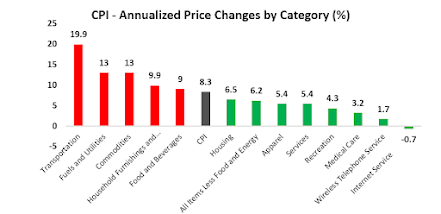
The Consumer Price Index (CPI) for April 2022 shows fixed and mobile broadband prices dropping, after accounting for our nation's staggering inflation rate. Despite the aggregate CPI having a 40-year-high 8.3% annualized inflation rate, mobile broadband prices have decreased by .7% and fixed broadband prices have only increased by 1.7% over the same period. So both are decreasing on "real" (inflation adjusted) terms.

In fact, importantly, wireless broadband prices are dropping even without taking to account inflation. These price changes amount to a 6.6% and 9.0% annualized price cut for fixed and mobile broadband, respectively, providing convincing evidence rebutting assertions that broadband providers have significant market power. As the chart below displays, fixed and wireless broadband annualized prices changes are among the smallest on the CPI.

Note: The CPI refers to fixed broadband as "Internet Service" and mobile broadband as "Wireless Telephone Service"

Price cuts indicate that broadband providers cannot charge higher prices without risking significant competitive backlash. The plunge in real broadband prices is consistent with the view Free State Foundation Director of Policy Studies Seth Cooper and I advanced in our January 2022 Perspectives from FSF Scholars that "overall competitive conditions in the broadband . . . market and across service sectors within the market remained equally strong or even improved." The evidence for robust broadband competition has only strengthened since publication of our Perspectives, with further substantial subscriber growth for innovative, low-price fixed wireless subscriptions and cable MVNO offerings

Real broadband price decreases are also consistent with the benefits of infrastructure reforms implemented by the FCC over the past 5 years that removed substantial deployment barriers, such as the 2018 “Small Cell Order” and 2017 “IP Transition Order.” Removal of those barriers, combined with increasing competition, may have created an environment where provider cost reductions from infrastructure reforms are being returned to the consumer, at least in part, through real price cuts.

Friday, March 04, 2022

Ex-Commissioners Unite, Urge Second Circuit to Affirm Lower Court Decision Enjoining Enforcement of NY Broadband Price Control Law

Four recent members of the Federal Communications Commission, representing both sides of the political aisle, have filed with the Second Circuit Court of Appeals an Amicus Curiae brief in response to the state Attorney General's appeal of the lower court decision in New York State Telecommunications Association v. James.

In their submission, the ex-Commissioners urge the Second Circuit to affirm the U.S. District Court for the Eastern District of New York's conclusion that a New York state law prescribing the prices that broadband providers may charge low-income households constitutes an impermissible attempt to regulate interstate communications rates.

The Affordable Broadband Act (ABA) is a New York state statute that was passed in early 2021. It requires providers of high-speed Internet access operating in New York to make available to eligible low-income households service at specific speeds and, critically, prices: 25 megabits per second (Mbps) downstream for $15 per month and 200 Mbps downstream for $20 per month. It also mandates that broadband providers "make all commercially reasonable efforts to promote and advertise the availability of" these plans.

As Free State Foundation Director of Policy Studies and Senior Fellow Seth L. Cooper noted in "Court Halts New York Price Controls on Broadband Internet Services: California's Net Neutrality Law Should Suffer Similar Fate," a June 2021 Perspectives from FSF Scholars, the U.S. District Court for the Eastern District of New York earlier that month appropriately enjoined the state of New York from enforcing the ABA.

Specifically, the court held (1) that the ABA regulates rates; (2) that "rate regulation is a form of common carrier treatment"; and (3) that because the FCC has classified broadband as an "information service" rather than a "telecommunications service" (that is, a common carrier offering), the ABA "conflicts with the implied preemptive effort of both the FCC's 2018 [Restoring Internet Freedom Order] and the Communications Act."

For a detailed discussion of the conflict preemption issues raised by the ABA, please see Mr. Cooper's January 2022 Perspectives, "State-Level Price Controls on Broadband Conflict With Federal Policy: Court Should Affirm the Preemptive Force of the FCC's 2018 Order."

In their friend-of-the-court brief, Former FCC Chairman and Commissioner Ajit Pai, former Acting Chairwoman and Commissioner Mignon Clyburn, and Former Commissioners Jonathan Adelstein and Michael O'Rielly express their agreement with the district court's conclusion. In doing so, they focus on the big picture:

While much ink has been spilled debating whether broadband is an information service that is regulated under Title I of the Communications Act … or a telecommunications service that is regulated under Title II …, that question does not determine the proper resolution of this case. Whatever the answer, broadband remains an interstate communications service, and broadband rates may not be regulated by state governments.

A copy of their brief is available here.

Friday, February 11, 2022

Study Indicates Broadband Internet Service Prices Have Fallen the Last Five Years

A study released on February 7 by BroadbandNow found across-the-board decreases in prices for broadband Internet service offerings over a five year period ending in the fourth quarter of 2021. The publication is called "Broadband Pricing Changes: 2016 to 2022." Among the BroadbandNow's findings, the average monthly price for broadband offerings with speeds in the range of 25Mbps to 99 Mbps fell by $8.80 or 14% over that span of time. And the average monthly price for 500+ Mbps offerings decreased by $59.22 or 42%. BroadbandNow's study provides evidence that effectively rebuts claims by proponents of rate regulation that prices for broadband have been increasing and made broadband supposedly unaffordable. 

For more on the topic of broadband pricing and affordability, see Free State Foundation Fellow Andrew Long's August 2021 Perspectives from FSF Scholars, "Evidence of Falling Broadband Prices Grows Despite Overall Spike in Inflation." Mr. Long's Perspectives analyzes sources that indicate that prices for broadband Internet service offerings decreased between 2020 and 2021, while putting those figures in the context of the strong capital investment in broadband networks that is benefiting U.S. consumers. Also check out his August 2021 blog post, "New BroadbandNow Report Further Demonstrates Affordability of Broadband."

Monday, August 30, 2021

New BroadbandNow Report Further Demonstrates Affordability of Broadband

A report released on August 18, 2021, by BroadbandNow provides additional proof that the number of U.S. consumers with access to affordable broadband service is both vast and growing rapidly.

In "Evidence of Falling Broadband Prices Grows Despite Overall Spike in Inflation," a recent Perspectives from FSF Scholars, I compared USTelecom broadband pricing information to Consumer Price Index (CPI) data released by the U.S. Bureau of Labor Statistics.

The former revealed that, between 2020 and 2021, the cost of connectivity fell across the board: entry level tier prices dropped by 9.1 percent, the most popular tier prices by 7.5 percent, and the highest speed tier prices by 2.3 percent.

By contrast, and over the same time period, the latter demonstrated that the cost of other in-demand consumer goods – various food items, electricity, fuel oil, and gasoline – increased by an average of over 7 percent.

Free State Foundation President Randolph May and I highlighted similar data in May 2021's "Biden Broadband Plan: Claims That Broadband Is 'Too Expensive' Are Unfounded," a direct response to unsupported assertions contained in the American Jobs Plan Fact Sheet released by the White House at the end of March.

BroadbandNow's "The State of Broadband in America, Q2 2021," provides still more evidence that competitive marketplace forces are driving down prices at an impressive pace.

Specifically, the report finds that, as of the second quarter of this year, 87 percent of Americans were able to subscribe to "low-priced" high-speed Internet access service – that is, offerings priced at $60 per month or less – providing speeds that meet the FCC's definition of "broadband": 25 megabits per second (Mbps) downstream and 3 Mbps upstream.

Impressive in isolation, that figure reflects incredible and rapid progress: an increase of 10 percentage points from just three months prior (Q1 2021) and, amazingly, over 35 percentage points since Q1 2020.

The report also notes that the percentage of Americans with access to "low-priced" offerings at even faster speeds – 100 Mbps downstream and 25 Mbps upstream – grew by 11 percent over that same brief period of time.

Thursday, May 27, 2021

Latest USTelecom Broadband Pricing Report Shows Continued Decline in Costs, Increase in Speeds

In "Biden Broadband Plan: Claims That Broadband Is 'Too Expensive' Are Unfounded," a May 7, 2021, Perspectives from FSF Scholars, Free State Foundation President Randolph J. May and I cited a number of sources, including USTelecom's 2020 Broadband Pricing Index, to demonstrate the efficient operation of the broadband marketplace. Prices are on a long downward trajectory, the number of competitors is growing, and service quality (including, but not limited to, speed) is improving.

On Thursday, USTelecom released the 2021 edition of its Broadband Pricing Index. It confirms that, even as the COVID-19 pandemic drove a dramatic spike in usage, between 2020 and 2021 prices continued to decline and speeds once again increased. In the words of USTelecom CEO Jonathan Spalter, "more Americans have cheaper and flat-out better broadband service choices than they did one year ago."

Key takeaways:

  • In the past year the price of the most-popular broadband service tiers declined by an additional 7.5 percent (in constant 2015 dollars) after falling 20.2 percent between 2015 and 2020. When inflation is taken into account, those values increase to 9.3 percent and 28.1 percent, respectively.
  • The price of the highest-speed tiers decreased an additional 2.3 percent last year after falling 37.7 percent between 2015 and 2020. Adjusted for inflation, those totals are 4.2 percent year-over-year and 43.9 percent during the prior five-year period.
  • Download speeds for the most-popular tiers have risen by 126 percent since 2015, from 43 megabits per second (Mbps) to 98 Mbps.
  • Download speeds for the highest-speed tiers have climbed from 141 Mbps in 2015 to 248 Mbps in 2021, an increase of 77 percent.
  • Upload speeds have risen by even greater percentages over the same time period: 256 percent for the most-popular tiers (from 13 Mbps to 45 Mbps) and 98 percent for the highest-speed tiers (from 51 Mbps to 99 Mbps).

For purposes of comparison, the author of the report, Telcodata and Business Planning, Inc. founder Arthur Menko, notes that the cost of all U.S. consumer goods and services, as measured by the Bureau of Labor Statistics' Consumer Price Index, has increased 12.2 percent since 2015 and by 2.6 percent between March 2020 and March 2021.

The Perspectives referenced above is the third to date in an ongoing series of pieces highlighting flaws in the Biden Broadband Plan. I urge you to read "Biden Broadband Plan: Misdirected Broadband Subsidies Hurt Competition and Consumers" and "'Future Proofing' Subsidized Broadband Would Inflate Consumer Prices," as well.

In addition, "Biden Broadband Plan Favoring Government-Owned Networks Lacks a Constitutional Foundation," by Mr. May and Seth L. Cooper, Free State Foundation Director of Policy Studies and Senior Fellow, provides an insightful critique of the plan's stated preference for broadband networks owned and operated by local municipalities.

Friday, May 07, 2021

Latest FSF Critique of Biden Broadband Plan Disproves Claim That Service Is "Too Expensive"

The Free State Foundation today published the third piece in an ongoing series exposing flaws in the broadband-specific elements of President Biden's American Jobs Plan.

In "Biden Broadband Plan: Claims That Broadband Is 'Too Expensive' Are Unfounded," FSF President Randolph May and I tackle head-on the factually incorrect assertion that "Americans pay too much for the Internet." Citing multiple data sources, we demonstrate convincingly that the efficient operation of the competitive marketplace for high-speed Internet access is producing greater consumer choice, lower prices, and higher speeds. Make no mistake, time-tested trends prove that market forces are doing their job.

In "Biden Broadband Plan: Misdirected Broadband Subsidies Hurt Competition and Consumers," published on April 28, 2021, we described the harm that necessarily would result from the use of taxpayer dollars to overbuild existing, privately funded broadband networks: private investment would decrease, competition would suffer, and consumers ultimately would be worse off, not better.

And the first in the series, "'Future Proofing' Subsidized Broadband Would Inflate Consumer Prices," an April 13 post to the FSF Blog, explained how the Biden Administration's stated preference for "gold-plated" funding-eligible networks – that is, infrastructure capable of providing far more capacity than consumers demand, particularly in the upstream direction – inevitably would incentivize subsidy recipients to target areas already served and, more broadly, lead to higher, not lower, prices.

Thursday, September 24, 2020

USTelecom Report on Broadband Documents Price Reductions, Speed Increases

USTelecom – The Broadband Association recently released a report comparing 2015 broadband pricing and speeds to those available today. "2020 Broadband Pricing Index: An Analysis of Decreasing Prices and Increasing Value for Broadband Service Over Time," as its name suggests, finds that "Americans are paying less today for broadband services that are significantly more capable than they were five years ago."

A few highlights:
  • The price of the most popular broadband service tier is 20.2 percent lower in 2020 than it was in 2015 – and 28.1 percent lower when inflation is taken into account.
  • Savings are even greater for the highest-speed tier: 37.7 percent (and 43.9 percent when inflation is considered).
  • Speeds, meanwhile, have increased, by 15.7 percent for the most popular offering and 27.7 percent for the highest-speed offering.

All of this is made possible by the $70-80 billion that providers invest annually in broadband infrastructure.

And while these statistics make plain that broadband is far more affordable than in the past, USTelecom at the same time acknowledges that there is more work to be done by government and private stakeholders to remove obstacles to adoption.

As I noted in a previous post, USTelecom is a partner in the "K-12 Bridge to Broadband" initiative, which works with school districts to identify, and connect at discounted rates, the 30 percent of students who lack the connectivity necessary to participate in remote learning during the COVID-19 pandemic.

The full report, authored by Arthur Menko, founder, Telcodata and Business Planning, Inc., is available here.


Monday, November 14, 2016

FCC's Privacy Order Will Result in Higher Broadband Prices

On October 27, 2016, the FCC adopted a Report and Order purporting to “protect the privacy of customers of broadband and other telecommunications services.” The rules require consumers to affirmatively opt-in before Internet service providers (ISPs) can collect “customer proprietary information,” which applies to information that the ISP “acquires in connection with its provision of telecommunications service.”
For example, if a consumer who subscribes to Comcast chooses not to opt-in, it appears Comcast cannot collect information regarding that consumer’s Amazon purchases because the data would be acquired through the Comcast-provided Internet connection. However, Comcast will be able to purchase that consumer’s Amazon information either directly from Amazon or perhaps from the consumer’s operating system and/or web browser. In other words, ISPs are allowed to purchase consumer information from edge providers, which are not subject to the FCC regulations, even though the edge providers have greater access to consumer information than ISPs.
FCC Commissioner Michael O’Rielly discussed this important issue during his dissent:
[A]ll that the FCC has really done is raise the transaction costs. The FCC, in its typical nanny state fashion, seems to assume that consumers prefer an opt-in regime. But when consumers find out the end result is that they may have to pay more for heightened privacy rules that they never asked for, I doubt they will be grateful that the FCC intervened on their behalf. Indeed, this is a grandiose attempt to enact legacy talking points into rules so that Commission leadership can pat itself on the back while consumers receive no actual, practical protections.
Because the FCC’s regulations with the opt-in default are not imposed on edge providers, such as Google, these platforms will continue to collect massive amounts of consumer information. As FSF scholars stated in their comments, due to encryption technologies, edge providers have a greater access to consumer information than ISPs. In order to provide targeted benefits, such as zero-rated services, to consumers who choose not to opt-in, ISPs will have to purchase information from edge providers or other Internet companies. (See my Perspectives from FSF Scholars entitled “FCC Privacy Rules Would Harm Consumers by Creating Barriers for ISP Advertising.”)
As Commissioner O’Rielly discussed, because ISPs need consumer information in order to offer targeted benefits, these regulations simply raise the costs for ISPs to engage in online advertising, zero-rated programming, or other targeted consumer offerings. Consumers who choose not to opt-in will be confused because edge providers will continue to collect their information and sell it to ISPs. And it’s likely ISPs will increase the price of broadband service in order to cover the costs of purchasing consumer data from edge providers.
The FCC order also envisions case-by-case investigations of “pay-for-privacy” practices. ISPs will be less likely to charge different prices to consumers with different privacy preferences. For example, consumers who choose not to opt-in but who still want to receive targeted offerings should end up paying more than those who choose to opt-in because ISPs need to purchase consumer information on their behalf. However, the FCC’s investigation likely will chill any efforts by ISPs to offer differentiated pricing based on consumer privacy preferences. Therefore, if ISPs want to offset the increase in regulatory costs, the FCC’s investigation is more likely than not to force providers to raise broadband prices for all consumers, not a subset.
With its new regulations, the FCC claims to “protect consumer choice” and “toughen pay-for-privacy safeguards.” But by expanding the definition of “customer proprietary information” to include non-sensitive information, the effect of the FCC order will be to impose higher prices for all broadband consumers without actually creating more choices. (See my October 2016 blog.) Instead of a fraction of consumers paying for privacy, all consumers are harmed by the likely result that the FCC's new regulations will lead to higher broadband prices.

Tuesday, June 04, 2013

Pricing Variation as an Answer to Rising Problems

FSF's lunch seminar, "If I Were the FCC Chairman..." featured a robust panel discussion about the future course of communications policy at the FCC.

Pricing variation or price discrimination was on key topic raised during the question and answer portion of the seminar. In particular, mention was made regarding certain statements apparently made by NCTA's CEO and President Michael Powell regarding broadband pricing and network congestion.

Rather than attempt to speak for Mr. Powell -- who was not present at the seminar -- consider what he said at FSF's Fifth Annual Conference. FSF recently released the transcript for the Conference panel titled "The Right Regulatory Approaches for Video Service Providers." To let Mr. Powell speak for himself, here is an excerpt from the transcript:

[T]here are three or four rising problems to which usage of variable pricing models may be beneficial. And I can emphasize "may be." 
First thing, this country has an adoption gap. We are persistently stuck with a hundred million Americans who have access to broadband but are not subscribing to it. We can have all kinds of healthy debates about why that is. One of the things that price discrimination often does well is it helps penetrate parts of the market that heretofore have been unwilling to come on the Net. The greatest threat to the United States is more than the silly debates about where we rank in the world. It's whether all of our citizens are online, have universal access to that capability. And if price discrimination can create tiers that are more affordable and more suited to the needs of that hundred million people and get them on the Net, that would be a major achievement. 
That's one thing. The second thing is, when the Internet started most of us probably did roughly the same kinds of things. What we're seeing happen as the Internet grows and matures is there's a wider variation coming on about the way people use the Internet. There are power users who use massive amounts of data and gigabytes. There are those who love to cut the cord and do NetFlix streaming, and there are still plenty, probably 80% of the mass market of users who do very low bandwidth things: e-mail, Facebook, Skype, Twitter. These things do not use substantial capacity. 
So as we get wider variety among the users, you do have a subsidization problem. You have people who are all paying the same price and getting different values of use. Frankly, the power elite user is enjoying the benefits of the subsidy that's being masked by an unlimited pricing model. That is not to say that model isn't simple and predictable, and you might like it for those reasons. But it does mask that cross-subsidization that in another context we worry about. 
The third thing, it's not a congestion argument. It's important to just jettison this, because we're really not being honest. We're not really talking about congestion. I'll say it over and over and over again. We've been saying it for a while, but it still gets cited as what we're doing. What we're doing is what any company does that has massive, fixed costs. 
We often hear our profitability talked about while people ignore completely the cost of building and maintaining the network. The network is a $200 billion expense over the last decade, and it takes $30 billion a year across all broadband providers to keep it going. That includes digging up the ground, laying wires, and keeping those wires current. You have to sink that money in the ground before you're paid one dime from a subscriber. 
The question is, when you go to recover those costs, what's the fairest way to allocate those costs among the people who buy your service? If you have people who use it a little, should they pay the same as the people who use it a lot? Or, should you have the people who use it a lot pay more than the people who use it a little? That's what we're really trying to figure out: the fairest way to allocate the cost of a high fixed cost network. 
And the last thing that I don't think is talked about enough is that bandwidth is not an infinite resource, whether it's wireless or wireline. You can get congestion. You can get overloading. What we have to do is make sure everybody has incentives to build for efficient broadband use. We have to do it as network engineers. But, right now, a lot of apps providers, service providers have absolutely no incentive to design their application or their services in a way that will use as little bandwidth as required. Why should they? 
They don't have any cost to really deeply internalize as a consequence of it. It's like when Windows used to write software code, it could be more and more bloated, and as long as Intel kept making faster processors, it didn't matter. But, I assure you, if we go to 100 GBs, or a trillion gigabytes, software can bloat to meet that demand if there are incentives for efficiency. And, if you want that NetFlix steam to continue at high capacity, they should also have to be concerned about efficient algorithmic design.