Showing posts with label lower prices. Show all posts

Wednesday, December 20, 2023

Report Chronicles the Competitiveness of Today's Wireless Services Market

On December 11, CTIA released a report by Compass Lexecon titled "An Economic Analysis of Mobile Wireless Competition in the United States." The report provides an excellent overview of data points demonstrating that the wireless market is effectively competitive. And as the report rightly concludes, the competitive state of the wireless market means that imposing "utility regulation like that found in Title II of the Communications Act is both unnecessary andlikely to be a harmful deterrent to future investment and industry performance due to imposed costs and diverted resources."

The Compass Lexecon report cites strong capital investment in wireless network infrastructure:  $364 billion in nominal dollars invested 2010 to 2022. It also cites rapid network deployment and upgrades, with a 64% increase in cell cites activated over the prior decade and 5G deployment by 3 nationwide wireless providers to 98% of the population. Also, speeds have quadrupled over the past seven years and doubled over the past three years. The number of devices and data usage per wireless user have risen, with overall U.S. mobile traffic growing at a compound rate of about 55% between 2010 and 2022, and overall subscribership grew at a compound annual rate of about 5% during that same time span. And inflation-adjusted wireless price indices published by the Bureau of Labor Statistics declined by 18%-to-19% since 2017, with the price of wireless declining over the past 24-month period while the price of other products has risen 12%. 


Citations to those data points as well as to other positive indicators of wireless competition are contained in Compass Lexecon's report. It is a worthwhile read.  


On December 14, the Free State Foundation filed public comments with the FCC in its Safeguarding and Securing the Open Internet proceeding. In those comments, we cite the strong competitive conditions of the wireless and overall broadband markets and make the case that imposing public utility regulation on broadband Internet access services is unjustified and harmful to investment and innovation. Wireless services have thrived in a light-touch regulatory environment and wireless competition is an important check on anticompetitive conduct. Wireless consumers are not facing any actual or likely harm that warrants public utility regulation, and regulating wireless services as a public utility would not expand or increase deployment of those services to anyone who does not already have it. 

Friday, October 14, 2022

In the Face of Inflation, Prices Fall for Internet and Wireless Services

On October 13, the U.S. Bureau of Labor Statistics released Consumer Price Index (CPI) data for September 2022. The overall CPI for September 2022 showed a sharp year over year increase of 8.2%, as Americans continue to be battered by inflation. However, CPI data for September 2022 shows significantly smaller increases or even slight decreases for communications and multi-channel video programming distributor (MVPD) services. Residential landline services have risen 3.6% year over year, and satellite and cable TV subscription services have gone up just 2.2%. Meanwhile, prices for internet services actually decreased 0.01% year over year, and prices for wireless services decreased 1.1% over that same timespan. 

One cannot reasonably or honestly deny that Americans are facing serious hardships due to high inflation. But the fact that communications and MVPD services are outperforming the bad inflationary trends – and even holding the line in the face of those trends for Internet and wireless services – is a testament to the strong private network investment and the competition in those markets. As USTelecom has reported, broadband providers' capital expenditures reached $86 billion in 2021. And CTIA reported that wireless providers' capital expenditures totaled $35 billion last year. Those investments have increased fixed and wireless broadband network capacities and geographic reach, giving overwhelmingly most consumers competing choices across platforms.
 

To help ensure pro-consumer pricing trends continue in fixed and mobile broadband Internet access services, the FCC should continue adhering to the light-touch regulatory framework that it applies to those services under Title I of the Communications Act. The Commission should maintain its reforms that bar unreasonable local permitting process delays for constructing wirelines and wireline infrastructure facilities as well as for making minor modifications and upgrades. And the Commission should act as quickly as it reasonably can to repurpose more spectrum for licensed commercial wireless use, including in the lower 3 GHz band. Promoting market investment and competition offer the best practical means for the Commission to ensure broadband availability and affordability. 


P.S. For an examination of broadband pricing trends against a longer timeframe, see Free State Foundation Senior Fellow Andrew Long's June 30 blog post, "2022 USTelecom Broadband Pricing Report: Further Proof that Competition is Benefiting Consumers. 

Friday, May 13, 2022

Dropping Consumer Broadband Prices Indicate Lack of Market Power

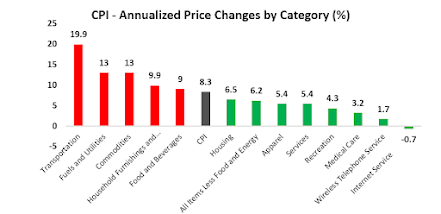
The Consumer Price Index (CPI) for April 2022 shows fixed and mobile broadband prices dropping, after accounting for our nation's staggering inflation rate. Despite the aggregate CPI having a 40-year-high 8.3% annualized inflation rate, mobile broadband prices have decreased by .7% and fixed broadband prices have only increased by 1.7% over the same period. So both are decreasing on "real" (inflation adjusted) terms.

In fact, importantly, wireless broadband prices are dropping even without taking to account inflation. These price changes amount to a 6.6% and 9.0% annualized price cut for fixed and mobile broadband, respectively, providing convincing evidence rebutting assertions that broadband providers have significant market power. As the chart below displays, fixed and wireless broadband annualized prices changes are among the smallest on the CPI.

Note: The CPI refers to fixed broadband as "Internet Service" and mobile broadband as "Wireless Telephone Service"

Price cuts indicate that broadband providers cannot charge higher prices without risking significant competitive backlash. The plunge in real broadband prices is consistent with the view Free State Foundation Director of Policy Studies Seth Cooper and I advanced in our January 2022 Perspectives from FSF Scholars that "overall competitive conditions in the broadband . . . market and across service sectors within the market remained equally strong or even improved." The evidence for robust broadband competition has only strengthened since publication of our Perspectives, with further substantial subscriber growth for innovative, low-price fixed wireless subscriptions and cable MVNO offerings

Real broadband price decreases are also consistent with the benefits of infrastructure reforms implemented by the FCC over the past 5 years that removed substantial deployment barriers, such as the 2018 “Small Cell Order” and 2017 “IP Transition Order.” Removal of those barriers, combined with increasing competition, may have created an environment where provider cost reductions from infrastructure reforms are being returned to the consumer, at least in part, through real price cuts.

Monday, October 16, 2017

Effective Wireless Competition: Lower Prices and More Data

Friday, October 06, 2017

Effective Wireless Competition