Episode 11 of "TMT with Mike O'Rielly," a videocast featuring former FCC Commissioner and Adjunct Senior Fellow at the Free State Foundation Michael O'Rielly, was released on September 26. In the episode, titled "WISPs' Wireless Broadband Offerings & BEAD Funding," Mr. O'Rielly is joined by guest David Zumwalt, President and CEO of WISPA – The Association for Broadband Without Boundaries. The conversation touches on matters such as spectrum, concerns about the Biden Administration’s favoritism for fiber in implementing the Broadband Equity, Access and Deployment (BEAD) Program and the subsequent change to that policy, concerns about federal subsidies being used to overbuild in areas already being served by small wireless providers, and more.
Wednesday, October 09, 2024
MT with Mike O'Rielly – Ep 11: Wireless Broadband & BEAD


Friday, February 10, 2023
New Report Puts a $60B Price Tag on NTIA's Fiber-Broadband Bias
A just-released study commissioned by the Wireless Internet Service Providers Association (WISPA) finds that the National Information & Telecommunications Association's (NTIA) departure from the concept of technological neutrality could increase the cost to extend broadband connectivity to those (largely rural) locations as yet unserved by as much as $60 billion.
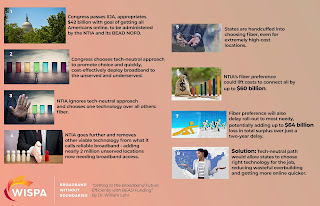
"Getting to the Broadband Future Efficiently with BEAD Funding," a white paper by MIT's Dr. William Lehr, concludes that:
Ignoring wireless ISPs that use unlicensed spectrum increases the number of unserved locations by over 1.922 million locations, or by almost a third. Those locations are concentrated in rural locations where deploying [Fiber-to-the-Premises (FTTP)] is extremely costly and much more costly than for fixed wireless alternatives. Requiring that those locations be served by FTTP instead of lower-cost alternative technologies could increase costs by upwards of $30 to $60 billion depending on the distribution of fiber deployment costs for the unserved locations.
Free State Foundation scholars write regularly about the importance of technological neutrality. For example, in his response to Senator John Thune's December 2022 broadband oversight letter, FSF President Randolph J. May pointed out that "[t]he value of a technology-neutral approach to government-subsidy eligibility is that it maximizes the pool of potential applicants. Just as additional entrants in a competitive marketplace can generate greater efficiency, better quality, increased innovation, and lower prices, so, too, can additional applicants make the best use of grant money."
Consequently, Mr. May criticized NTIA's rules for the $42.45 Broadband Equity, Access, and Deployment (BEAD) Program because they (1) "embody a blind preference for fiber broadband networks," and (2) "exclude by name proven solutions – specifically, satellite-based services and offerings that rely exclusively upon unlicensed spectrum – despite their potential ability in some circumstances to deliver 'broadband' … most efficiently to a specific area."
And in "Senators Urge NTIA to Acknowledge Role of Broadband via Unlicensed Spectrum," a December 2022 post to the FSF Blog describing a letter from seven Republican Senators urging NTIA Administrator Alan Davidson "to continue working to advance broadband deployment in rural states and unserved areas by remaining technology neutral and creating rules and funding opportunities that allow all forms of broadband technology to compete," I explained that:
With respect to any given location, its unique features (population density, geographic features, and so on) can favor certain different distribution platforms –including fiber, cable, DSL, 5G, satellite, and fixed wireless – over others. Such factors influence investment choices in the competitive broadband marketplace, and government-led efforts to extend broadband infrastructure to areas still unserved ought to encourage similarly efficient and informed decisionmaking by subsidy recipients.
Thursday, December 01, 2022
Senators Urge NTIA to Acknowledge Role of Broadband via Unlicensed Spectrum
Seven Senators representing states with significant rural populations recently expressed their concerns regarding the exclusion of offerings operating solely within unlicensed spectrum from the definition of "Reliable Broadband Service" adopted by the National Telecommunications and Information Administration (NTIA) in connection with its $42.45 billion Broadband Equity, Access, and Deployment (BEAD) Program.
In a letter dated November 22, 2022, Senators Steve Daines (R-MT), Marsha Blackburn (R-TN), John Barrasso, M.D. (R-WY), Cynthia M. Lummis (R-WY), Ted Cruz (R-TX), Thom Tillis (R-NC), and John Cornyn (R-TX) urged Assistant Secretary of Commerce for Communications and Information and NTIA Administrator Alan Davidson "to continue working to advance broadband deployment in rural states and unserved areas by remaining technology neutral and creating rules and funding opportunities that allow all forms of broadband technology to compete."

According to the Wireless Internet Service Providers Association (WISPA), as of July 2020 its members delivered broadband over unlicensed spectrum "to approximately nine million Americans, business, anchor institutions and first responders." As a practical matter, fixed wireless Internet service providers (WISPs) are particularly well suited to "serving the hardest to reach, unserved areas of rural America."
Free State Foundation scholars long have argued that broadband infrastructure subsidy programs should embrace the concept of technological neutrality. For example, in a June 2021 Perspectives from FSF Scholars, FSF President Randolph May and I took issue with President Biden's proposal to "future proof" government-subsidized broadband infrastructure, which we interpreted as an intention to favor blindly fiber over other proven solutions:
Should the Biden Broadband Plan make available massive subsidies solely to one modality – fiber – under the meaningless guise of "future proofing," it will discourage continued private investment in otherwise viable alternatives and undermine the competition given birth by a longstanding adherence to the principle of technological neutrality.
With respect to any given location, its unique features (population density, geographic features, and so on) can favor certain different distribution platforms –including fiber, cable, DSL, 5G, satellite, and fixed wireless – over others. Such factors influence investment choices in the competitive broadband marketplace, and government-led efforts to extend broadband infrastructure to areas still unserved ought to encourage similarly efficient and informed decisionmaking by subsidy recipients.
As it stands, however, the BEAD Program's definition of "Reliable Broadband Service" renders ineligible for subsidies WISPs exclusively utilizing unlicensed spectrum, thereby constraining artificially the pool of potential applicants.
In addition, and as the Senators highlighted in their letter, the exclusion "runs the risk of wasting billions of taxpayer dollars by duplicating services in areas that already have access to speeds well above 25/3 Mbps, 100/20 Mbps or even higher, instead of prioritizing rural communities that are truly unserved."


 Posts

