Showing posts with label unlicensed spectrum. Show all posts

Tuesday, May 19, 2026

Revised BEAD Program Connects its First Location

On November 15, 2021, the Infrastructure Investment and Jobs Act – that is, the legislation that created the $42.45 billion Broadband Equity, Access, and Deployment (BEAD Program – was signed into law. On May 14, 2026, 1,641 days later, BEAD Program funding at long last enabled the connection of its very location.

Of course, millions more locations are expected to come online in the coming weeks, months, and years.

In remarks offered on location in Ogallala, Nebraska, NTIA Administrator Arielle Roth highlighted the expediting impact of the "Benefit of the Bargain" revisions adopted last year. She also discussed changes designed to reinstate Congress' technologically neutral intent. In that regard, she noted that "[i]t's not an accident that this connection here in Ogallala is from an unlicensed fixed wireless provider."

Finally, a reminder: Ms. Roth will be a keynote speaker at the Free State Foundation's Twentieth Anniversary Celebration on Thursday, June 4, from 11:45am to 3pm, at the National Press Club. If you haven't already, register here to catch her fireside chat with FSF President Randolph May as well as an impressive lineup of other speakers.

Thursday, February 13, 2025

Report Proposes Much-Needed Repairs to Beleaguered BEAD Program

The Advanced Communications Law & Policy Institute (ACLP) at New York Law School today released a "BEAD Acceleration Checklist" that "offers … a series of straightforward recommendations for accelerating the award of BEAD grant funds [that] focus on freeing BEAD from its bureaucratic shackles."

Those of you who have been following the Free State Foundation's extensive scholarship on the $42.45 billion Broadband Equity, Access, and Deployment (BEAD) Program – and, more broadly, the deeply flawed Biden Broadband Plan for which it serves as the centerpiece – will find familiar many of the fixes set forth in "How to Free BEAD From its Bureaucratic Shackles."


In a companion op-ed published by Broadband Breakfast, Michael Santorelli, Director of the ACLP and co-author (along with ACLP Senior Fellow Alex Karras) of the report blamed the Biden Administration for the BEAD Program's ongoing failure to bring broadband to even one unserved location, pointing the finger specifically at "excessive bureaucracy, regulatory overreach, and a misguided approach by the Biden administration, which prioritized its political agenda and program micromanagement over connecting people to broadband."

In the report itself, the co-authors urge the Trump Administration to make seven course corrections, which include:

  • Eliminating all rules and requirements not expressly prescribed by the Infrastructure Investment and Jobs Act (IIJA) – that is, the legislation that established the BEAD Program. In "NTIA's BEAD Program Needs Revisions to Succeed," an October 2022 Perspectives from FSF Scholars, Michelle P. Connolly, Ph.D., a member of the Free State Foundation's Board of Academic Advisors and Professor of the Practice within the Economics Department at Duke University, identified five superfluous "subgrantee requirements" included in NTIA's Notice of Funding Opportunity: "Buy American" requirements, union labor-related mandates, middle-class "affordability," network management practice limitations (including data caps), and the unreasonable prioritization of municipal broadband.
  • Prohibiting rate regulation. As I pointed out in "Virginia Flags NTIA's Impermissible Pressure to Regulate Broadband Rates," a February 2024 Perspectives, while the IIJA does require that grant recipients make available a "low-cost broadband service option," it also explicitly bans the regulation of rates. And as Free State Foundation President Randolph May argued in "Government Price Controls Jeopardize the BEAD Program's Success," a September 2024 Perspectives, attempts by NTIA and the states to require below-market rates amount to price caps, which "lead to suboptimal levels of supply" and undermine the "policy goal of achieving universal broadband access because experienced ISPs will be discourage from participating."
  • Clarifying the role of low-Earth orbit (LEO) satellites. In "BEAD Program Softens Stance on 'Alternative' Technologies," a January 2025 post to the FSF Blog, I explained that while revised NTIA guidance opened the door in certain extremely high-cost situations to "alternative technologies" – that is, LEO satellites and unlicensed spectrum – it fell well short of putting these distribution platforms on an equal footing with other "Reliable Broadband Service" options.
  • Removing "extraneous requirements," including those referenced in the first bullet point above as well as those relating to climate change and other policy preferences, from NTIA's BEAD Program "Terms and Conditions."
  • Prohibiting the states from imposing their own "extraneous" and "burdensome" requirements beyond that which the IIJA requires.
  • Strongly encouraging states to prioritize public-private partnership applications involving established broadband service providers with a proven track record of success.
  • Allowing states to adjust project-service areas so that they "align with the realities of broadband network deployment."

Friday, January 24, 2025

Spectrum Pipeline and FCC Auction Bill Introduced in House

In welcome news, on January 23, Rep. Rick Allen W. Allen announced the introduction in the House of Representatives of the Spectrum Pipeline Act of 2025. The Act, if it were to become law, would require the NTIA to identify at least 2,500 megahertz (MHz) of mid-band spectrum for reallocation from federal government use to non-federal or shared use in 5 years of the bill's enactment, including at least 1,250 MHz within the next 2 years.  

Additionally, the Act renews the FCC's authority to conduct spectrum license auctions and issue licenses to bid winners. The Commission's authority lapsed in March 2023. Under the Act, the Commission would be required to auction at least 1,250 MHz of spectrum for full-power commercial wireless service within 6 years, and at least 600 MHz of that spectrum must be auctioned within 3 years. 


Notably, the Act also requires the FCC to allocate at least 125 MHz of spectrum for unlicensed use, such as WiFi. 


At the January 23 hearing on wireless technology held by the House Subcommittee on Communications & Technology, there appeared to be bipartisan unanimity on the conclusion that more spectrum needs to be put into use for licensed and unlicensed use and that the FCC's lapsed spectrum license auction authority should be restored promptly. 


The Commission's 2024 Communications Marketplace Competition Report includes a chart by CTIA that shows the dramatic rise in mobile data traffic, and an unmistakable upward trend that will continue as more and more connected devices go into use and as data usage per subscriber continues to go up: 
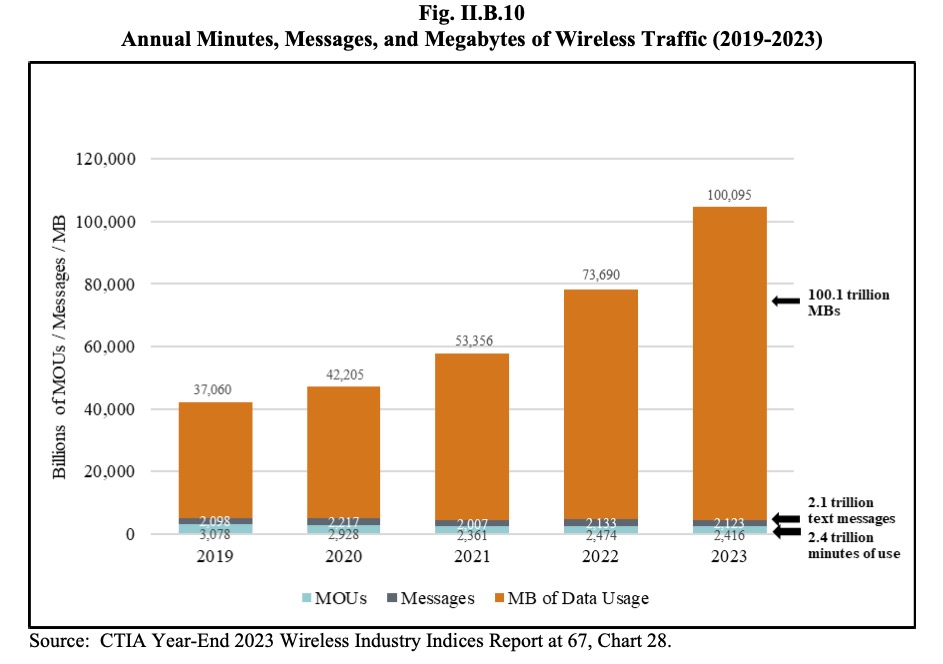

Additionally, the 2024 report observes that "[a] large proportion of mobile data traffic is delivered on an unlicensed basis through Wi-Fi, Bluetooth, and similar protocols." Furthermore: "Telecom Advisory Services asserts that the economic benefits associated with Wi-Fi in the United States will rapidly grow to $2.4 trillion in 2027, including an estimated $514 billion in consumer benefit, $624 billion in producer surplus, and $1,286 billion in GDP." And "[a]ccording to LightReading, the average Verizon subscriber offloads approximately 78% of their data onto Wi-Fi, for example, while Comcast subscribers offload approximately 94%." For other highlights from the report, see my Perspectives from FSF Scholars, "The FCC's 2024 Communications Marketplace Report: Time for a Broader View of Competing Broadband Services," published January 24, 2025. 


Also important is the NERA study published on January 23 that estimates the tremendous economic value created through the allocation of spectrum for licensed use. For more on that, see my January 23 blog post, "Report: Putting Mid-Band Spectrum into Licensed Use Adds Billions to Economy."


The Spectrum Pipeline Act that Rep. Allen introduced is a companion to the similarly-titled bill from March 2024 that Senators Ted Cruz and John Thune sponsored. As Free State Foundation President Randolph May stated in a March 11, 2024, Media Advisory regarding the Senate bill from the last Congress: 

No doubt there may be different views regarding the specific dates and amounts identified for reallocation contained in the bill. But there should be widespread agreement that it provides a good basis for moving forward promptly to develop a bipartisan, bicameral plan to address the nation's now-lagging spectrum efforts.

Everything President May said then applies with equal measure to the Spectrum Pipeline Act of 2025. Several months later, no substantial progress has been made on the wireless spectrum front. Timely action by Congress is even more important to get the desired result from having more spectrum in use. Rep. Allen deserves credit for filing the bill and undertaking efforts to make that happen. 

Tuesday, January 07, 2025

BEAD Program Softens Stance on "Alternative" Technologies

In final guidance released on January 2, 2025, the National Telecommunications and Information Administration (NTIA) opened the door, ever so slightly, to Broadband Equity, Access, and Deployment (BEAD) Program projects utilizing unlicensed fixed wireless and low Earth orbit (LEO) satellites. By no means a course correction to a true technology neutral approach – end-to-end fiber proposals continue to be heavily favored without adequate regard for cost – at least providers using these so-called "alternative technologies" are no longer barred outright from participating in the $42.45 billion BEAD Program.

In the Public Notice, NTIA reiterated its position that states "must seek the most robust technology feasible at each location." Prior to this policy change, that meant (a) end-to-end fiber first ("Priority Broadband Projects"), and (b) cable broadband, digital subscriber line (DSL), or fixed wireless – using either licensed spectrum or a combination of licensed and unlicensed spectrum – second ("Reliable Broadband Service"). Projects using unlicensed spectrum only do not fall within the definition of "Reliable Broadband Service." Nor do LEO satellite-based offerings.

With this final guidance, NTIA will allow states to consider grant applications utilizing distribution technologies that meet the speed (100 Mbps downstream and 20 Mbps upstream) and latency (less than or equal to 100 milliseconds) requirements for "Reliable Broadband Service" but (in my view, at least) arbitrarily remain excluded from that category. Specifically, unlicensed fixed wireless and LEO satellite-based offerings now will be treated as quasi-eligible "Alternative Technologies."

However, and as I highlighted in "BEAD Program Technological Neutrality 'Fix' Falls Short," an August 2024 Perspectives from FSF Scholars, states may consider non-fiber "Reliable Broadband Service" technologies only where the cost to deploy fiber exceeds the "Extremely High Cost Per Location Threshold" (EHCPLT), an often unreasonably high bar that disregards the amount of time it will take to deploy fiber versus other technologies.

"Alternative Technologies," meanwhile, become eligible only after states "demonstrate that no ["Reliable Broadband Service"] was deployable for less than the EHCPLT by leveraging multiple strategies to obtain bids for Priority Broadband Projects and other ["Reliable Broadband Service"] projects that fall under the EHCPLT."

In other words, with this change the funding eligibility priority order has been expanded, somewhat, from two categories – end-to-end fiber followed by other "Reliable Broadband Service" – to three, with unlicensed fixed wireless and LEO satellite at the end of the line.

While in theory an improvement over the exclusionary approach originally set forth in the BEAD Program Notice of Funding Opportunity, the final guidance's creation of a third-place "Alternative Technology" category – well short of a full embrace of the concept of technological neutrality – may not have that much of practical impact.

Monday, December 16, 2024

Wi-Fi 7 Innovation Is Now Deploying to Consumers

On November 25, Charter Communications announced that it has started deploying Wi-Fi 7 routers. Charter is apparently the first major broadband Internet service provider to launch an exclusively designed Wi-Fi 7 technology system for both its residential and business subscribers. In September, AT&T announced that it plans to introduce a new Wi-Fi 7-capable gateway before the end of the year. Also, it is reported that there are dozens of Wi-Fi 7-certified non-exclusive devices in the market as of 2024.

Wi-Fi 7 is an innovative upgrade over prior generations of Wi-Fi technology. It is reported that Wi-Fi 7 enables wider channels for increased bandwidth, improved reliability, and better speeds. In 2025, look for the deployment of Wi-Fi 7 routers, TVs, cell phones, and other Wi-Fi 7-compatible devices to improve network performance and capabilities for American broadband subscribers starting with Charter's subscribers. 


Wi-Fi 7 operates in the 2.4 GHz, 5 GHz, and 6 GHz bands. Fortunately, there is a large amount of spectrum dedicated to unlicensed wireless usage, such as Wi-Fi. The FCC's 6 GHz Order (2020) cleared 1200 MHZ of spectrum for unlicensed use, which quadrupled the total amount of spectrum available for unlicensed devices, most notably Wi-Fi routers and Internet of Things (IoT) devices that use Wi-Fi. 

Monday, March 11, 2024

MEDIA ADVISORY: Reaction to Cruz-Thune "Spectrum Pipeline Act of 2024"


Regarding the introduction of the proposed “Spectrum Pipeline Act of 2024” by Senators Ted Cruz and John Thune, the following statement may be attributed to Free State Foundation President Randolph May:

“While the Free State Foundation doesn’t support or oppose specific legislation, I applaud Senators Cruz and Thune for introducing their spectrum bill. It has important features that, if adopted, will help ensure the United States does not lose its leadership position in wireless, especially in 5G. Today, spectrum is a key part of the nation’s broadband infrastructure — just like cables and wires. The Cruz-Thune bill would reestablish the FCC’s lapsed auction authority, and it would require that a considerable amount of mid-band spectrum be reallocated for commercial use and be made available by specific dates. The pipeline established would include a much-needed supply of licensed spectrum, while not ignoring the need for more unlicensed spectrum, which also is an increasingly important part of the broadband infrastructure.

No doubt there may be different views regarding the specific dates and amounts identified for reallocation contained in the bill. But there should be widespread agreement that it provides a good basis for moving forward promptly to develop a bipartisan, bicameral plan to address the nation’s now-lagging spectrum efforts."   

Saturday, July 29, 2023

FCC Should Finalize Rules for Spectrum Use in the 5.9 GHz Band

This month of July 2023, press outlets such as Communications Daily and FierceElectronics have reported on the fact that the FCC has not yet issued final rules that it proposed more than two-and-a-half years ago regarding use of the 5.9 GHz band. The Commission also has received ex parte filings regarding the lack of final rules. To date, the Commission has only granted some waivers for use of the band. The Commission should move expeditiously to finalize rules for use of 5.9 GHz band spectrum.

The FCC put a lot of work into its November 2020 order and proposed rulemaking that reallocated 45 MHz of spectrum in the 5.9 GHz band for unlicensed use. Indeed, the Commission carried out its work in the face of unusual public opposition from the Department of Transportation. The Free State Foundation filed public comments supporting the agency proposal that subsequently was adopted by the Commission in the 5.9 GHz Order. And FSF Senior Fellow Andrew Long wrote a November 2022 Perspectives from FSF Scholars, "The FCC's 5.9 GHz Proposal Would Advance Both Wi-Fi and Vehicle Safety," in support of the reallocation of the spectrum for unlicensed use. 


The Commission also put a lot of work in its successful defense of the 5.9 GHz Order at the D.C. Circuit in Intelligent Transportation Society of America v. FCC. Mr. Long wrote about that decision in an August 2022 blog post. The court's decision vindicated the FCC's primacy among federal agencies on commercial spectrum policy. 


The FCC ought to now finish what it started in the November 2022 order and proposed rulemaking and promote maximal value and use of the 5.9 GHz band. Clearing the decks on the 5.9 GHz band also would enable to the Commission to devote more of its attention to licensing other spectrum bands. 

Thursday, June 15, 2023

Report on Fixed Wireless Access Competition Shows Need for More Mid-Band Spectrum

Today, Econ One released a report titled "Competitive Effects of Fixed Wireless Access on Wireline Broadband Technologies." There is an ongoing debate over the potential impact of fixed wireless access (services) on broadband competition. This interesting report, authored by Hal Singer and Augustus Urschel, provides a significant contribution to the debate.

The Econ One report estimates the competitive effects of FWA entry into broadband markets. The estimates are based on surveys of consumer responses to hypothetical scenarios in which FWA services are made available at different price levels and in local markets with differing choices among incumbent providers of cable modem and/or fiber broadband services. 


According to Econ One's report: "In all scenarios—including at current prices or alternative discounted prices, and in markets with only cable or those with a mix of cable and fiber offerings—the introduction of FWA packages yields price reductions and significant consumer welfare gains." That is, the report found that FWA market entry would prompt many subscribers to switch from incumbent services to competitively priced FWA services and also lead to price reductions for subscribers to cable broadband services. For the details, check out Econ One's report.


Notably, Econ One's report "assumes sufficient capacity to support all potential subscribers with high-speed FWA service." That assumption is key because mid-band spectrum is a necessary input for supporting FWA services for large numbers of subscribers. But as Free State Foundation scholars have pointed out in April 2023 public comments to the NTIA for its National Spectrum Strategy proceeding, in Perspectives from FSF Scholars papers, and in blog posts, there is a shortfall of mid-band spectrum available for commercial licensing on an exclusive basis. The Econ One report is on solid ground in concluding that "[t]he best and fastest way to increase home broadband competition, which will bring significant consumer savings, is getting more full-power, licensed, mid-band spectrum into the hands of FWA providers."


FSF scholars have supported prior FCC allocations of spectrum for use on an unlicensed basis, including the Commission's 5.9 GHz Order. Congress and federal agencies also ought to be open to pursuing new opportunities to dedicated other spectrum resources to unlicensed uses. But it is now imperative that Congress and federal agencies prioritize the repurposing of mid-band spectrum for exclusive licensed use. Congress needs to renew the FCC's authority to conduct competitive bidding auctions for spectrum licenses and get additional mid-band spectrum into use to support FWA.  

Monday, May 15, 2023

Cable Mobile Wireless MVNOs Off to Strong Start in 2023

Comcast's Xfinity Mobile and Charter's Spectrum Mobile released their latest quarterly number for subscriber additions, both of which are summed up nicely in a May 1 FierceWireless article by Linda Hardesty:

Comcast added 355,000 net wireless lines in its first quarter 2023. During the same quarter, Charter added a whopping 686,000 Spectrum Mobile lines — an indication that its 12-month Spectrum One bundled promotion is paying off in garnering new subscribers.

Comcast now counts 5.7 million lines for its mobile virtual network operator (MVNO) service, while Charter counts 6 million total lines.

May 10 FierceWireless article by the same author also calls attention to Spectrum Mobile’s sharing of Wi-Fi networks with Xfinity mobile as well as other Wi-Fi network partners. It is reported that about 85% of Spectrum Mobile’s data traffic is carried on Wi-Fi and the remainder is carried on Verizon Wireless’s cellular network pursuant to an MVNO agreement. And Spectrum Mobile is now beginning to put some of Charter’s CBRS (3.5 GHz) spectrum into use in order to reduce further its dependency on third party-cellular networks.


Although cable wireless MVNO subscribership is still small compared to that of mobile cellular wireless providers such as AT&T, T-Mobile, Verizon, C-Spire, and US Cellular, cable wireless MVNOs offer consumers a strong facilities-based competitive choice for mobile wireless broadband services. The continued growth of cable MVNOs also is a testament to private innovation and investment as well as the importance of making more spectrum available for commercial uses, both on a licensed and on an unlicensed basis. 


The competitive state of the broadband marketplace is the subject of my Perspectives from FSF Scholars from January of this year: "The 2022 Communications Marketplace Report: Timely FCC Action Could Accelerate Next-Gen Broadband Deployment."

Thursday, May 11, 2023

FCC Set to Vote on Future Spectrum Use in the 12.2 GHz and 12.7 GHz Bands

At its May 18 public hearing, the FCC will be voting on a Report and Order and Further Notice of Proposed Rulemaking regarding use of spectrum in the 12.-12-7 GHz (12.2 GHz) band. The draft Report and Order, if approved by the Commission, would not authorize high-powered terrestrial mobile broadband services to operate in the 12.2 GHz band. The Report and Order cites apparent concerns about significant risk of harmful interference with existing and emergent services that use the 12.2 GHz band, including satellite services, as the basis for that policy conclusion. However, the Report and Order would continue investigation into the potential for terrestrial fixed use or unlicensed use in the 12.2 GHz band.  

The 12.2 GHz item now teed up for the Commission's May 18 public meeting also includes a Notice of Proposed Rulemaking and Order regarding expanded use of the 12.7-13.25 GHz (12.7 GHz) band for mobile broadband or other use. In its draft NPRM and Order, the Commission states:

[W]e propose to repurpose some or all of the 550 megahertz of mid-band spectrum for mobile broadband or other expanded use. The record demonstrates substantial support for repurposing these mid-band frequencies for next-generation wireless technologies including 5G, 5G Advanced, and 6G services that will depend on extremely high data rates, and the reliability, low latency, and capacity that the 12.7 GHz band spectrum can provide.

Without expressing any view on the merits of the Commission's determinations about potential significant harmful signal interference in the 12.2 GHz band or on any specific proposals for future use in the 12.7 GHz band, the Commission's forthcoming vote on the 12.2 GHz and 12.7 GHz bands is important because it is a step toward maximizing use of those valuable mid-band spectrum resources. The NPRM and Order on the 12.7 GHz rightly recognizes the significance of mid-band spectrum for the future of commercial wireless services in the U.S. And with the 12.2 GHz/12.7 GHz item scheduled for a vote on May 18, Commission appears to making a good faith effort to fulfill its public trust to promote valuable use of spectrum. 

Tuesday, April 18, 2023

FSF Calls for Fast Action on Mid-Band in National Spectrum Strategy

On April 17, the Free State Foundation filed public comments with the National Telecommunications and Information Administration (NTIA) in the agency's proceeding for the Development of a National Spectrum Strategy. As FSF's comments observe, there is a lack of available spectrum that is needed for delivering next-generation wireless services in the years ahead. To maintain of U.S. global leadership on 5G makes it imperative that the spectrum pipeline be replenished. The federal government is the primary occupier and user of a significant amount of spectrum, particularly in the mid-band. And while spectrum is needed for continued support of national security, law enforcement, and other governmental functions, much of the government-occupied is going underutilized. Hopefully, the NTIA's development and implementation of a National Spectrum Strategy will be swiftly developed and implemented to make more spectrum available for commercial services and help ensure that its value and use are maximized.

To this end, two policy imperatives are set forth in the initial paragraph of FSF's comments are set forth in the initial paragraph: 

The agency should adopt and implement its proposal to identify at least 1,500 MHz of spectrum for study – and, importantly, it should make determined efforts to reallocate at least 1,500 MHz of spectrum for more commercial use. And while the maintaining the availability of sufficient unlicensed spectrum should remain an important objective, the National Spectrum Strategy's short-term priority should be accomplishing the repurposing of more mid-band spectrum for exclusive licensed use, starting with the 3.1-3.45 GHz band. 

FSF's comments recommend that low-, mid-, and high-band spectrum be identified and reallocated for commercial wireless use. Additionally, FSF's comments recognize that dedicating spectrum for unlicensed use such as Wi-Fi also can yield considerable value and use. For more details, FSF's comments are available online. 


The NTIA's ongoing efforts to develop and implement a National Spectrum Strategy was a subject of a keynote address at #FSFConf15 on March 28 of this year by Scott Blake Harris, Senior Spectrum Advisor at the NTIA. Video of Mr. Blake's keynote is available online


A National Spectrum Strategy has been long awaited. Indeed, back in January 2019, FSF filed comments with the NTIA, under the prior administration, for the agency's earlier proceeding to develop a sustainable national spectrum strategy. That earlier proceeding never succeeded in accomplishing its task. Hopefully, the current administration and proceeding at the NTIA will continue apace and have an implementation plan ready by the summer of this year. We wish Mr. Harris and the agency success in promptly assembling and putting into action a National Spectrum Strategy that will boost spectrum use and efficiency and put the U.S. solidly out in front on 5G and, one day, 6G.

Friday, February 10, 2023

New Report Puts a $60B Price Tag on NTIA's Fiber-Broadband Bias

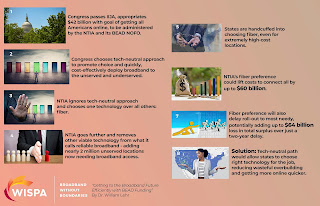
A just-released study commissioned by the Wireless Internet Service Providers Association (WISPA) finds that the National Information & Telecommunications Association's (NTIA) departure from the concept of technological neutrality could increase the cost to extend broadband connectivity to those (largely rural) locations as yet unserved by as much as $60 billion.


"Getting to the Broadband Future Efficiently with BEAD Funding," a white paper by MIT's Dr. William Lehr, concludes that:

Ignoring wireless ISPs that use unlicensed spectrum increases the number of unserved locations by over 1.922 million locations, or by almost a third. Those locations are concentrated in rural locations where deploying [Fiber-to-the-Premises (FTTP)] is extremely costly and much more costly than for fixed wireless alternatives. Requiring that those locations be served by FTTP instead of lower-cost alternative technologies could increase costs by upwards of $30 to $60 billion depending on the distribution of fiber deployment costs for the unserved locations.

Free State Foundation scholars write regularly about the importance of technological neutrality. For example, in his response to Senator John Thune's December 2022 broadband oversight letter, FSF President Randolph J. May pointed out that "[t]he value of a technology-neutral approach to government-subsidy eligibility is that it maximizes the pool of potential applicants. Just as additional entrants in a competitive marketplace can generate greater efficiency, better quality, increased innovation, and lower prices, so, too, can additional applicants make the best use of grant money."

Consequently, Mr. May criticized NTIA's rules for the $42.45 Broadband Equity, Access, and Deployment (BEAD) Program because they (1) "embody a blind preference for fiber broadband networks," and (2) "exclude by name proven solutions – specifically, satellite-based services and offerings that rely exclusively upon unlicensed spectrum – despite their potential ability in some circumstances to deliver 'broadband' … most efficiently to a specific area."

And in "Senators Urge NTIA to Acknowledge Role of Broadband via Unlicensed Spectrum," a December 2022 post to the FSF Blog describing a letter from seven Republican Senators urging NTIA Administrator Alan Davidson "to continue working to advance broadband deployment in rural states and unserved areas by remaining technology neutral and creating rules and funding opportunities that allow all forms of broadband technology to compete," I explained that:

With respect to any given location, its unique features (population density, geographic features, and so on) can favor certain different distribution platforms –including fiber, cable, DSL, 5G, satellite, and fixed wireless – over others. Such factors influence investment choices in the competitive broadband marketplace, and government-led efforts to extend broadband infrastructure to areas still unserved ought to encourage similarly efficient and informed decisionmaking by subsidy recipients.


Thursday, December 01, 2022

Senators Urge NTIA to Acknowledge Role of Broadband via Unlicensed Spectrum

Seven Senators representing states with significant rural populations recently expressed their concerns regarding the exclusion of offerings operating solely within unlicensed spectrum from the definition of "Reliable Broadband Service" adopted by the National Telecommunications and Information Administration (NTIA) in connection with its $42.45 billion Broadband Equity, Access, and Deployment (BEAD) Program.

In a letter dated November 22, 2022, Senators Steve Daines (R-MT), Marsha Blackburn (R-TN), John Barrasso, M.D. (R-WY), Cynthia M. Lummis (R-WY), Ted Cruz (R-TX), Thom Tillis (R-NC), and John Cornyn (R-TX) urged Assistant Secretary of Commerce for Communications and Information and NTIA Administrator Alan Davidson "to continue working to advance broadband deployment in rural states and unserved areas by remaining technology neutral and creating rules and funding opportunities that allow all forms of broadband technology to compete."

NTIA's Notice of Funding Opportunity (NOFO) for the BEAD Program defines "Reliable Broadband Service" in relevant part as "broadband service that … is accessible to a location via … terrestrial fixed wireless technology utilizing entirely licensed spectrum or using a hybrid of licensed and unlicensed spectrum." Conspicuously absent from this list is broadband delivered exclusively by means of unlicensed spectrum.

According to the Wireless Internet Service Providers Association (WISPA), as of July 2020 its members delivered broadband over unlicensed spectrum "to approximately nine million Americans, business, anchor institutions and first responders." As a practical matter, fixed wireless Internet service providers (WISPs) are particularly well suited to "serving the hardest to reach, unserved areas of rural America."

Free State Foundation scholars long have argued that broadband infrastructure subsidy programs should embrace the concept of technological neutrality. For example, in a June 2021 Perspectives from FSF Scholars, FSF President Randolph May and I took issue with President Biden's proposal to "future proof" government-subsidized broadband infrastructure, which we interpreted as an intention to favor blindly fiber over other proven solutions:

Should the Biden Broadband Plan make available massive subsidies solely to one modality – fiber – under the meaningless guise of "future proofing," it will discourage continued private investment in otherwise viable alternatives and undermine the competition given birth by a longstanding adherence to the principle of technological neutrality.

With respect to any given location, its unique features (population density, geographic features, and so on) can favor certain different distribution platforms –including fiber, cable, DSL, 5G, satellite, and fixed wireless – over others. Such factors influence investment choices in the competitive broadband marketplace, and government-led efforts to extend broadband infrastructure to areas still unserved ought to encourage similarly efficient and informed decisionmaking by subsidy recipients.

As it stands, however, the BEAD Program's definition of "Reliable Broadband Service" renders ineligible for subsidies WISPs exclusively utilizing unlicensed spectrum, thereby constraining artificially the pool of potential applicants.

In addition, and as the Senators highlighted in their letter, the exclusion "runs the risk of wasting billions of taxpayer dollars by duplicating services in areas that already have access to speeds well above 25/3 Mbps, 100/20 Mbps or even higher, instead of prioritizing rural communities that are truly unserved."