Showing posts with label Technological Neutrality. Show all posts

Thursday, March 13, 2025

House Commerce, Commerce Department Commence BEAD Reforms

Multiple efforts are underway to reform the beleaguered $42.45 billion Broadband Equity, Access, and Deployment (BEAD) Program.

Representative Richard Hudson (R-NC), Chairman of the House Energy and Commerce Committee’s Subcommittee on Communications and Technology – and Keynoter at the Free State Foundation's upcoming Seventeenth Annual Policy Conference – recently introduced legislation designed to "eliminate the burdensome Biden regulations so that we can get money out the door and shovels into the ground as soon as possible."

In his Opening Statement before "Fixing Biden's Broadband Blunder," a hearing held on March 5, 2025, Chairman Hudson unveiled the Streamlining Program Efficiency and Expanding Deployment (SPEED) for BEAD Act. In the accompanying Press Release, he pointed out that "not a cent of the BEAD funds have been put towards actual deployment for even one household. This is unacceptable. Our rural communities need to be fully connected, and this legislation will do that."

Specifically, the SPEED for BEAD Act would:

  • Clarify that BEAD Program money is to be used for two purposes: broadband deployment and workforce development. Consistent with that refined focus, the bill would replace the word "Equity" with the word "Expansion" in the program's title.
  • Expressly require the return to the U.S. Treasury of unused funds.
  • Prohibit the consideration, when awarding grants, of the following: prevailing wages, project labor agreements, union workforces, collective bargaining, local hiring, commitments to union neutrality, labor peace agreements, workforce composition (or the reporting thereof), climate change, the regulation of network management practices (including data caps), open access requirements, and certain letter of credit requirements.
  • Provide applicants greater flexibility with respect to service area.
  • Expand the definition of "reliable broadband service," consistent with the principle of technological neutrality, to include "any broadband service that meets the performance criteria … without regard to the type of technology by which such service is provided."
  • Expound upon the existing ban on the regulation of rates (see below).

Regarding rate regulation, the bill makes clear that neither NTIA nor the states may:

[R]egulate, set, or otherwise mandate the rates charged for broadband service or the methodologies used to calculate such rates, for consumers generally or for any subset of consumers, including through the capping or freezing of such rates, the encouragement of another entity to regulate such rates, or the use of rates as part of an application scoring process.

The SPEED for BEAD Act explicitly would ban any such forms of rate regulation even if approved prior to its enactment or adopted "in conjunction with the requirement to offer a low-cost broadband service option."

The same day, Secretary of Commerce Howard Lutnick issued a Statement announcing that:

Under [his] leadership, the Commerce Department has launched a rigorous review of the BEAD program. The Department is ripping out the Biden Administration's pointless requirements. It is revamping the BEAD program to take a tech-neutral approach that is rigorously driven by outcomes, so states can provide internet access for the lowest cost. Additionally, the Department is exploring ways to cut government red tape that slows down infrastructure construction.

Since the passage of the legislation that created the BEAD Program, the Infrastructure Investment and Jobs Act, in 2021, FSF scholars repeatedly have criticized the Biden Administration for its prioritization of extraneous policy preferences that discouraged proven broadband providers from participating, raised costs, and ground implementation to a standstill.

They include impermissible rate regulation, inappropriate labor- and climate-related mandates, the unjustified promotion of government-owned networks, and a pro-fiber bias that brazenly defied the statute's technologically neutral intent


Thursday, February 13, 2025

Report Proposes Much-Needed Repairs to Beleaguered BEAD Program

The Advanced Communications Law & Policy Institute (ACLP) at New York Law School today released a "BEAD Acceleration Checklist" that "offers … a series of straightforward recommendations for accelerating the award of BEAD grant funds [that] focus on freeing BEAD from its bureaucratic shackles."

Those of you who have been following the Free State Foundation's extensive scholarship on the $42.45 billion Broadband Equity, Access, and Deployment (BEAD) Program – and, more broadly, the deeply flawed Biden Broadband Plan for which it serves as the centerpiece – will find familiar many of the fixes set forth in "How to Free BEAD From its Bureaucratic Shackles."


In a companion op-ed published by Broadband Breakfast, Michael Santorelli, Director of the ACLP and co-author (along with ACLP Senior Fellow Alex Karras) of the report blamed the Biden Administration for the BEAD Program's ongoing failure to bring broadband to even one unserved location, pointing the finger specifically at "excessive bureaucracy, regulatory overreach, and a misguided approach by the Biden administration, which prioritized its political agenda and program micromanagement over connecting people to broadband."

In the report itself, the co-authors urge the Trump Administration to make seven course corrections, which include:

  • Eliminating all rules and requirements not expressly prescribed by the Infrastructure Investment and Jobs Act (IIJA) – that is, the legislation that established the BEAD Program. In "NTIA's BEAD Program Needs Revisions to Succeed," an October 2022 Perspectives from FSF Scholars, Michelle P. Connolly, Ph.D., a member of the Free State Foundation's Board of Academic Advisors and Professor of the Practice within the Economics Department at Duke University, identified five superfluous "subgrantee requirements" included in NTIA's Notice of Funding Opportunity: "Buy American" requirements, union labor-related mandates, middle-class "affordability," network management practice limitations (including data caps), and the unreasonable prioritization of municipal broadband.
  • Prohibiting rate regulation. As I pointed out in "Virginia Flags NTIA's Impermissible Pressure to Regulate Broadband Rates," a February 2024 Perspectives, while the IIJA does require that grant recipients make available a "low-cost broadband service option," it also explicitly bans the regulation of rates. And as Free State Foundation President Randolph May argued in "Government Price Controls Jeopardize the BEAD Program's Success," a September 2024 Perspectives, attempts by NTIA and the states to require below-market rates amount to price caps, which "lead to suboptimal levels of supply" and undermine the "policy goal of achieving universal broadband access because experienced ISPs will be discourage from participating."
  • Clarifying the role of low-Earth orbit (LEO) satellites. In "BEAD Program Softens Stance on 'Alternative' Technologies," a January 2025 post to the FSF Blog, I explained that while revised NTIA guidance opened the door in certain extremely high-cost situations to "alternative technologies" – that is, LEO satellites and unlicensed spectrum – it fell well short of putting these distribution platforms on an equal footing with other "Reliable Broadband Service" options.
  • Removing "extraneous requirements," including those referenced in the first bullet point above as well as those relating to climate change and other policy preferences, from NTIA's BEAD Program "Terms and Conditions."
  • Prohibiting the states from imposing their own "extraneous" and "burdensome" requirements beyond that which the IIJA requires.
  • Strongly encouraging states to prioritize public-private partnership applications involving established broadband service providers with a proven track record of success.
  • Allowing states to adjust project-service areas so that they "align with the realities of broadband network deployment."

Tuesday, January 07, 2025

BEAD Program Softens Stance on "Alternative" Technologies

In final guidance released on January 2, 2025, the National Telecommunications and Information Administration (NTIA) opened the door, ever so slightly, to Broadband Equity, Access, and Deployment (BEAD) Program projects utilizing unlicensed fixed wireless and low Earth orbit (LEO) satellites. By no means a course correction to a true technology neutral approach – end-to-end fiber proposals continue to be heavily favored without adequate regard for cost – at least providers using these so-called "alternative technologies" are no longer barred outright from participating in the $42.45 billion BEAD Program.

In the Public Notice, NTIA reiterated its position that states "must seek the most robust technology feasible at each location." Prior to this policy change, that meant (a) end-to-end fiber first ("Priority Broadband Projects"), and (b) cable broadband, digital subscriber line (DSL), or fixed wireless – using either licensed spectrum or a combination of licensed and unlicensed spectrum – second ("Reliable Broadband Service"). Projects using unlicensed spectrum only do not fall within the definition of "Reliable Broadband Service." Nor do LEO satellite-based offerings.

With this final guidance, NTIA will allow states to consider grant applications utilizing distribution technologies that meet the speed (100 Mbps downstream and 20 Mbps upstream) and latency (less than or equal to 100 milliseconds) requirements for "Reliable Broadband Service" but (in my view, at least) arbitrarily remain excluded from that category. Specifically, unlicensed fixed wireless and LEO satellite-based offerings now will be treated as quasi-eligible "Alternative Technologies."

However, and as I highlighted in "BEAD Program Technological Neutrality 'Fix' Falls Short," an August 2024 Perspectives from FSF Scholars, states may consider non-fiber "Reliable Broadband Service" technologies only where the cost to deploy fiber exceeds the "Extremely High Cost Per Location Threshold" (EHCPLT), an often unreasonably high bar that disregards the amount of time it will take to deploy fiber versus other technologies.

"Alternative Technologies," meanwhile, become eligible only after states "demonstrate that no ["Reliable Broadband Service"] was deployable for less than the EHCPLT by leveraging multiple strategies to obtain bids for Priority Broadband Projects and other ["Reliable Broadband Service"] projects that fall under the EHCPLT."

In other words, with this change the funding eligibility priority order has been expanded, somewhat, from two categories – end-to-end fiber followed by other "Reliable Broadband Service" – to three, with unlicensed fixed wireless and LEO satellite at the end of the line.

While in theory an improvement over the exclusionary approach originally set forth in the BEAD Program Notice of Funding Opportunity, the final guidance's creation of a third-place "Alternative Technology" category – well short of a full embrace of the concept of technological neutrality – may not have that much of practical impact.

Monday, October 21, 2024

Maine Satellite Plan Casts Doubt on BEAD Program Approach

As reported by Broadband Breakfast (subscription required), the Maine Connectivity Authority (MCA) has announced that it will allocate upwards of $5 million toward the purchase of Starlink terminals for every remaining "unserved" location in the state. What's more, the contract with Starlink "is expected to include capacity guarantees to ensure that the state-purchased terminals can connect to internet service at the newly established speed benchmark of 100/20 Mbps."

Universal access? Check. Speeds that satisfy the FCC's recently updated "broadband" benchmark? Check. A price tag roughly one-twentieth that of fiber? Check. So why, then, will the MCA spend an additional $278 million in federal subsidies from NTIA's Broadband Equity, Access, and Deployment (BEAD) Program to connect "underserved" locations to fiber?

Despite their marketplace-proven ability, technologically speaking, to deliver the speeds that consumers demand – and that the Infrastructure Investment and Jobs Act, the statute that created the BEAD Program, specifies – from day one NTIA has discouraged the use of BEAD Program subsidies to deploy non-fiber broadband distribution platforms.

As I pointed out in "BEAD Program Technological Neutrality 'Fix' Falls Short," an August 2024 Perspectives from FSF Scholars, even recent changes to NTIA's BEAD Program rules approving the use of satellites and unlicensed spectrum do so only under very limited circumstances – to be specific, when the price tag for fiber exceeds a state-specified price ceiling aptly labeled the Extremely High Cost Per Location Threshold (EHCPLT).

Other distribution technologies – cable broadband, fixed wireless access using licensed spectrum, and so on – likewise are eligible for BEAD Program subsidies only if the fiber cost exceeds the EHCPLT.

The MCA's announcement that it will make Starlink terminals available to all 9,000 unserved locations in the state at a cost of just $599 per location, plus free shipping and professional installation, highlights the degree to which NTIA's approach leads to inefficiencies and waste.

Evidence that proves this point can be found in the very same press release announcing the purchase of Starlink terminals: "[i]n 2025, MCA will facilitate the investment of an additional $350 million in broadband infrastructure through the [BEAD] Program to serve the remaining 5% of locations in Maine that currently have slow and unreliable internet service."

According to my back-of-the-envelope math, $350 million in total subsidies works out to almost $12,000 per "underserved" location – that is, locations with Internet access at speeds equal to or greater than 25/3 Mbps but less than 100/20 Mbps. That amounts to a nearly 20X premium for a fiber-based solution as compared to the cost of satellite-based service.

Incidentally, Volume 2 of Maine's Initial Proposal, which was approved by NTIA in June, does not identify a specific EHCPLT. Instead, it indicates that the MCA intends at some point in the future to set the EHCPLT so high that, in virtually all cases, fiber will win the day:

If it is determined that a small number of locations in a given PSA should be served with alternative technologies allowed through the EHCPLT process to ensure maximum impact of BEAD funding, MCA will consider allowing non-fiber service to a minimal number of locations. All other locations in the PSA will otherwise be served by FTTH.

Accordingly, the extent to which satellites and other non-fiber distribution platforms will be eligible for BEAD Program funding likely will be extremely limited.

The BEAD Program's underlying congressional goal is to connect locations still without "broadband" – Internet access at speeds of 100/20 Mbps – in a cost-effective manner. The fact that, in Maine, far more federal taxpayer dollars will be spent on "gold-plated" fiber infrastructure to upgrade "underserved" locations than what is being spent to connect "unserved" locations strongly suggests that NTIA's approach is fundamentally flawed.

Thursday, April 20, 2023

Senator Thune Spearheads Call to Revise BEAD Program Rules

In a letter released earlier today, a group of eleven Republican Senators, led by John Thune (SD), ranking member of the Senate Commerce Committee's Subcommittee on Communications, Media, and Broadband, and including Senate Commerce Committee ranking member Senator Ted Cruz (TX), urged National Telecommunications and Information Administration (NTIA) head Alan Davidson to bring in line with congressional intent the $42.45 billion Broadband Equity, Access, and Deployment (BEAD) Program's rules.

Specifically, the letter pressed Assistant Secretary Davidson to remove several provisions from the May 2022 Notice of Funding Opportunity (NOFO) that "divert resources away from bringing broadband service to rural America and are inconsistent with NTIA's statutory authority in the Infrastructure Investment and Jobs Act (IIJA)."

The letter targets the following extraneous and counterproductive policy priorities not found within the IIJA yet championed by the NOFO:

  • Labor requirements inappropriately designed "to achieve targeted social outcomes";
  • A "misguided" bias in favor of government-owned networks;
  • A fiber-focused failure to heed "Congress' technology neutral stance in the IIJA" with regard to other viable broadband distribution platforms;
  • Affordability and other requirements inconsistent with specific language in the IIJA prohibiting NTIA from '"regulat[ing] the rates charged for broadband service";
  • Climate change mandates "not envisioned by Congress" that raise costs; and
  • "Buy American" mandates that threaten untimely delays absent "a consistent waiver process."

Senator Thune stepped up his broadband-funding oversight efforts late last year with the release of a letter soliciting input on a wide range of topics, including many of those listed above.

In "Senator Thune's New Broadband Oversight Initiative," a December 2022 post to the FSF Blog, Free State Foundation President Randolph May welcomed the arrival of Senator Thune's oversight letter and wrote that he "couldn't agree more on the need for congressional oversight of the various programs providing funds for broadband."

Mr. May submitted a thorough response, referencing dozens of related FSF scholarly papers, on January 6, 2023.

In prerecorded remarks addressing the FSF Fifteenth Annual Policy Conference on March 28, 2023, Senator Thune emphasized the importance of congressional oversight and highlighted the Free State Foundation's substantive contributions to those efforts:

On rural broadband oversight, as many of you know, Congress has allocated an unprecedented amount of money in federal broadband investments. And there are more than 130 federal broadband programs that are administered by 15 federal agencies. That spiderweb of bureaucracy is exactly why I began an effort last year to ensure there is stringent oversight of how these taxpayer funds are being spent. And I greatly appreciate the Free State Foundation taking the time to provide thoughtful responses to my oversight request.

The other signatories to the letter to NTIA Administrator Davidson are Senators Ted Cruz (TX), Marsha Blackburn (TN), Ted Budd (NC), Shelley Moore Capito (WV), Deb Fischer (NE), Eric Schmitt (MO), Dan Sullivan (AK), J.D. Vance (OH), Todd Young (IN), and Roger Wicker (MS). 

Friday, February 10, 2023

New Report Puts a $60B Price Tag on NTIA's Fiber-Broadband Bias

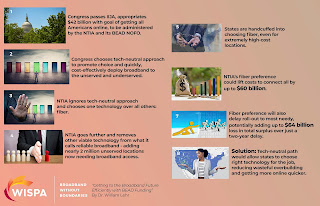
A just-released study commissioned by the Wireless Internet Service Providers Association (WISPA) finds that the National Information & Telecommunications Association's (NTIA) departure from the concept of technological neutrality could increase the cost to extend broadband connectivity to those (largely rural) locations as yet unserved by as much as $60 billion.


"Getting to the Broadband Future Efficiently with BEAD Funding," a white paper by MIT's Dr. William Lehr, concludes that:

Ignoring wireless ISPs that use unlicensed spectrum increases the number of unserved locations by over 1.922 million locations, or by almost a third. Those locations are concentrated in rural locations where deploying [Fiber-to-the-Premises (FTTP)] is extremely costly and much more costly than for fixed wireless alternatives. Requiring that those locations be served by FTTP instead of lower-cost alternative technologies could increase costs by upwards of $30 to $60 billion depending on the distribution of fiber deployment costs for the unserved locations.

Free State Foundation scholars write regularly about the importance of technological neutrality. For example, in his response to Senator John Thune's December 2022 broadband oversight letter, FSF President Randolph J. May pointed out that "[t]he value of a technology-neutral approach to government-subsidy eligibility is that it maximizes the pool of potential applicants. Just as additional entrants in a competitive marketplace can generate greater efficiency, better quality, increased innovation, and lower prices, so, too, can additional applicants make the best use of grant money."

Consequently, Mr. May criticized NTIA's rules for the $42.45 Broadband Equity, Access, and Deployment (BEAD) Program because they (1) "embody a blind preference for fiber broadband networks," and (2) "exclude by name proven solutions – specifically, satellite-based services and offerings that rely exclusively upon unlicensed spectrum – despite their potential ability in some circumstances to deliver 'broadband' … most efficiently to a specific area."

And in "Senators Urge NTIA to Acknowledge Role of Broadband via Unlicensed Spectrum," a December 2022 post to the FSF Blog describing a letter from seven Republican Senators urging NTIA Administrator Alan Davidson "to continue working to advance broadband deployment in rural states and unserved areas by remaining technology neutral and creating rules and funding opportunities that allow all forms of broadband technology to compete," I explained that:

With respect to any given location, its unique features (population density, geographic features, and so on) can favor certain different distribution platforms –including fiber, cable, DSL, 5G, satellite, and fixed wireless – over others. Such factors influence investment choices in the competitive broadband marketplace, and government-led efforts to extend broadband infrastructure to areas still unserved ought to encourage similarly efficient and informed decisionmaking by subsidy recipients.


Thursday, December 01, 2022

Senators Urge NTIA to Acknowledge Role of Broadband via Unlicensed Spectrum

Seven Senators representing states with significant rural populations recently expressed their concerns regarding the exclusion of offerings operating solely within unlicensed spectrum from the definition of "Reliable Broadband Service" adopted by the National Telecommunications and Information Administration (NTIA) in connection with its $42.45 billion Broadband Equity, Access, and Deployment (BEAD) Program.

In a letter dated November 22, 2022, Senators Steve Daines (R-MT), Marsha Blackburn (R-TN), John Barrasso, M.D. (R-WY), Cynthia M. Lummis (R-WY), Ted Cruz (R-TX), Thom Tillis (R-NC), and John Cornyn (R-TX) urged Assistant Secretary of Commerce for Communications and Information and NTIA Administrator Alan Davidson "to continue working to advance broadband deployment in rural states and unserved areas by remaining technology neutral and creating rules and funding opportunities that allow all forms of broadband technology to compete."

NTIA's Notice of Funding Opportunity (NOFO) for the BEAD Program defines "Reliable Broadband Service" in relevant part as "broadband service that … is accessible to a location via … terrestrial fixed wireless technology utilizing entirely licensed spectrum or using a hybrid of licensed and unlicensed spectrum." Conspicuously absent from this list is broadband delivered exclusively by means of unlicensed spectrum.

According to the Wireless Internet Service Providers Association (WISPA), as of July 2020 its members delivered broadband over unlicensed spectrum "to approximately nine million Americans, business, anchor institutions and first responders." As a practical matter, fixed wireless Internet service providers (WISPs) are particularly well suited to "serving the hardest to reach, unserved areas of rural America."

Free State Foundation scholars long have argued that broadband infrastructure subsidy programs should embrace the concept of technological neutrality. For example, in a June 2021 Perspectives from FSF Scholars, FSF President Randolph May and I took issue with President Biden's proposal to "future proof" government-subsidized broadband infrastructure, which we interpreted as an intention to favor blindly fiber over other proven solutions:

Should the Biden Broadband Plan make available massive subsidies solely to one modality – fiber – under the meaningless guise of "future proofing," it will discourage continued private investment in otherwise viable alternatives and undermine the competition given birth by a longstanding adherence to the principle of technological neutrality.

With respect to any given location, its unique features (population density, geographic features, and so on) can favor certain different distribution platforms –including fiber, cable, DSL, 5G, satellite, and fixed wireless – over others. Such factors influence investment choices in the competitive broadband marketplace, and government-led efforts to extend broadband infrastructure to areas still unserved ought to encourage similarly efficient and informed decisionmaking by subsidy recipients.

As it stands, however, the BEAD Program's definition of "Reliable Broadband Service" renders ineligible for subsidies WISPs exclusively utilizing unlicensed spectrum, thereby constraining artificially the pool of potential applicants.

In addition, and as the Senators highlighted in their letter, the exclusion "runs the risk of wasting billions of taxpayer dollars by duplicating services in areas that already have access to speeds well above 25/3 Mbps, 100/20 Mbps or even higher, instead of prioritizing rural communities that are truly unserved."

Thursday, October 28, 2021

City's Preferential Treatment of Fiber-Based Broadband Raises Competition Concerns

In July 2020, the City Council of West Des Moines, Iowa, voted (1) to spend $50 million to construct within public rights-of-way (ROW) a so-called "open access conduit network" that it readily concedes is designed for the exclusive use of fiber-to-the-premises (FTTP) broadband providers, and (2) to enter an "anchor tenant" agreement with Google Fiber that raises serious factual questions as to the ability of even other fiber-based Internet service providers (ISPs) to utilize that infrastructure on reasonably equitable terms.

Given that West Des Moines (the City) also serves as the gatekeeper to those ROW, these actions inevitably create worrisome conflicts of interest. They also violate the principle of technological neutrality and are at direct odds with our nation's longstanding and proven (intramodal as well as intermodal) competition-based approach to the deployment and expansion of broadband access. Moreover, given the abysmal financial track record of municipal involvement in the broadband marketplace generally, a topic I addressed in an August 2021 Perspectives from FSF Scholars, they unnecessarily place taxpayers in economic jeopardy.

MCC Iowa LLC, a subsidiary of Mediacom Communications Corporation (Mediacom), is the local cable system operator in West Des Moines. It provides broadband service throughout the City via a hybrid fiber coaxial (HFC) network at speeds up to a gigabit (1000 megabits per second (Mbps)) downstream and 50 Mbps upstream. Notably, these rates far exceed not only the definition of "broadband" embraced by the Federal Communications Commission (FCC or Commission) – 25/3 Mbps – but also the threshold for a "served" area agreed to by a bipartisan group of Senators in the $1.2 trillion infrastructure bill currently before the House – 100/20 Mbps.

Mediacom is able to provide this level of service to City residents only because it has (1) committed the large amounts of private capital required to build out its network, and, critically, (2) complied with the City's formal permitting processes in order to gain access to ROW.

In May of this year, Mediacom filed with the FCC a Petition for Expedited Declaratory Ruling (Petition) pursuant to Section 253 of the Telecommunications Act of 1996 arguing that the City's actions, which reduce substantially the construction and permitting obligations of fiber-based providers – and, as a result, their costs and time to market – as a practical matter constitute an "effective prohibition" under Section 253 for providers other than Google Fiber. This is particularly so for broadband providers that embrace distribution technologies other than end-to-end fiber (for example, cable HFC networks rely upon coaxial cable for the last-mile connection to the home) and therefore are foreclosed, at least in part, from utilizing this taxpayer-funded infrastructure.

More recently, the City and Mediacom informed the Commission on October 15, 2021, that they have agreed, at least at a high level, to resolve this dispute. As a result, the FCC's Wireline Competition Bureau issued an Order earlier this week pausing the pleading cycle in order to provide the parties with additional time to hammer out the specific details of a settlement.

The fact remains, however, that the City's underlying decision to align its economic interests with a specific distribution technology (if not a specific company utilizing that distribution technology) violates the competition-fostering principle of technological neutrality, incentivizes the City to perform its permitting function in a discriminatory fashion, and arguably implicates Section 253 itself.

Given that Mediacom and the City are in the process of negotiating specific settlement terms, it is conceivable that at least some of the disputed provisions of the City's agreement with Google Fiber will change. In one important respect, that is something we already have observed: a month after Mediacom filed its Petition, the City and Google Fiber agreed to reduce the length of time that the latter would have exclusive use of completed portions of the conduit network from 18 to 6 months.

Accordingly, at this time I will not discuss in detail other aspects of the agreement, particularly those relating to the implications of the conduit network's technical design for other providers, whether fiber-based or not. (I will note, however, that Mediacom's Petition did make numerous compelling allegations regarding the practical ability of other fiber-based ISPs to utilize the conduit network in a manner equivalent to that afforded Google Fiber.)

Instead, I want to highlight a more fundamental question raised by the City's decision to not just express a preference for fiber-based service, but to take substantial steps to reduce the costs and administrative burdens solely for fiber-based providers: Should a municipality's actions to promote a specific distribution technology be evaluated under Section 253?

As Free State Foundation President Randolph May and I explained in "Biden Broadband Plan: 'Future Proofing' Is Likely 'Fool's Proofing'," a June 2021 Perspectives, progress towards reaching the goal of universal broadband access hinges upon adherence to the pro-competitive principle of technological neutrality.

The United States is a large nation, one that encompasses areas with vastly different geographic features and population densities. Truly ubiquitous broadband coverage, as well as price competition and heightened innovation, will be realized only through policies that embrace the unique strengths and weaknesses of the range of distribution technologies – not just FTTP but also cable HFC networks, mobile and fixed 5G, fixed wireless, and satellite – that ISPs leverage to provide consumers with the capacity that they in fact demand.

As such, a policy approach that exclusively prioritizes fiber – for example, the Biden Broadband Plan as articulated in a March 2021 White House Fact Sheet – is wasteful and ultimately counterproductive. But when pursued by a municipality, is it also at odds with the pro-competitive thrust of the Telecommunications Act of 1996, specifically Section 253?

Section 253(a) states that "[n]o State or local statute or regulation, or other State or local legal requirement, may prohibit or have the effect of prohibiting the ability of any entity to provide any interstate or intrastate telecommunications service" (emphasis added). And subsection (d) empowers the Commission to "preempt the enforcement of such statute, regulation, or legal requirement to the extent necessary to correct such violation or inconsistency."

Per the FCC's 2018 Declaratory Ruling and Third Report and Order, (1) "a state or local legal requirement constitutes an effective prohibition if it 'materially limits or inhibits the ability of any competitor or potential competitor to compete in a fair and balanced legal and regulatory environment'" (emphasis added), and (2) "an insurmountable barrier is not required to find an effective prohibition under Section 253(a)."

It seems evident that the City, in choosing to spend $50 million on a conduit network that can be used only by those ISPs that embrace a FTTP model, is making it relatively more difficult for providers utilizing other viable distribution technologies to compete.

In its Opposition to Mediacom's Petition, Google Fiber dedicates an entire section to the concern that the grant of Mediacom's requested relief could have "broad, negative implications on local investment in broadband infrastructure." In response, I offer the following two points. One, as Free State Foundation scholars have pointed out on many occasions, attempts by municipalities to enter the broadband marketplace overwhelmingly have failed to achieve independent financial viability. (See the "Further Readings" at the end of this recent Perspectives from FSF Scholars for examples.) Consequently, those claimed "broad, negative implications" in fact, may generate positive economic outcomes for taxpaying residents.

Two, where the policies and/or spending by a municipality discriminate so heavily in favor of a specific provider (as alleged here, Google Fiber) or a subset of providers (as freely acknowledged here by the City, those ISPs that embrace a FTTP model), does a line exist that, once crossed, benefits one or more competitors rather than, as Congress intended in 1996, competition?

If so, a scenario may arise where preemption pursuant to Section 253(d) by the FCC of a project that so strongly rejects the principle of technological neutrality is warranted.

As noted above, this proceeding remains open. The Wireless Competition Bureau only temporarily suspended the deadline for replies. I will provide further updates on this dispute as developments warrant.