Showing posts with label Rural Broadband. Show all posts

Monday, March 30, 2026

PRESS RELEASE: "Misusing 'Affordability' in Broadband Subsidies Is Wrong"


The following statement should be attributed to Free State Foundation President Randolph May regarding a proposed bill titled ‘‘Prioritizing Rural Broadband Affordability Act" introduced by Rep. April McClain Delaney (D-Md.) and Rep. Rob Bresnahan (R-Pa.):

This bill, which requires the Agriculture Department to consider affordability of broadband service in determining whether an area is unserved, is unnecessary, unworkable, and mischievous. The bill lacks a definition of affordability, nor could one be formulated administratively that would be efficient and not invite waste of taxpayer dollars. More fundamentally, whether an area is unserved should not be linked to an affordability’ determination. Concerns regarding ‘affordability’ properly should be addressed through provision of targeted support to low-income households.

Thursday, October 30, 2025

Ookla: "Broadband" Availability Expanding Rapidly

According to an Ookla report (registration required) released on October 27, the availability of high-speed Internet access that satisfies the FCC's definition of "broadband" grew dramatically during the first half of this year.

Ookla, which operates the Speedtest® website, reported that the number of states in which most of its users enjoy speeds that meet or exceed the minimum benchmarks established by the FCC – 100 Mbps downstream and 20 Mbps upstream – nearly doubled between January and June of 2025. It also found that parity between urban and rural areas increased substantially during that time.

Specifically, Ookla's testing data revealed that the number of states in which at least 60 percent of users have access to "broadband" jumped from 23 (including the District of Columbia) as of year-end 2024 to 39 by the end of June 2025. In five of those states – Connecticut, Delaware, New Jersey, North Dakota, and Rhode Island –over 70 percent of its users receive "broadband."

In only three largely rural states do less than half of Speedtest® users report "broadband" service: Wyoming (48.26 percent), Montana (41.09 percent), and Alaska (38.42 percent).

In addition, the gap between the speeds provided to urban and rural users narrowed in 33 states during the first six months of this year – nearly double the number of states (17) in which that disparity increased. 

Friday, April 11, 2025

House Committee Advances Bill for Vetting Recipients of High-Cost Broadband Subsidies

On April 8, the House Commerce Committee voted 50-1 to pass the Rural Broadband Act of 2025 – HR 2399. The bill would require the FCC to establish a vetting process for future applicants for future high-cost universal service program funding for deployment and supporting broadband Internet access services. The purpose of the vetting process is to ensure that subsidies go to entities that are capable of fulfilling their universal service obligations. 


The Rural Broadband Act has been introduced in prior Congresses. My blog post from February 16, 2023, describes a bit more about the bill as it was introduced in the 118th Congress by Senators Shelley Moore Capito and Amy Klobuchar. 


This bi-partisan legislation appears to be a reasonable measure to help prevent money collected from U.S. consumers via surcharges – effectively, "USF Taxes" – being misspent and wasted. The House of Representatives should give HR 2399 an up-or-down vote.


Meanwhile, the need for an overhaul of the Universal Service Fund is still pressing. As Free State Foundation President Randolph May and I explained in our August 2023 comments to the Universal Service Reform Working Group: "Reform of the USF subsidy system is urgently needed because the system is outdated and no longer fiscally sustainable." The existing universal service regime was established in a voice-centric 1990s context, with a broader contribution base and much smaller sized fund than today with a dwindled base and a bloated annual distribution amount of $7 billion to $8 billion. As a result, the USF Tax has continued to climb, and the most recent proposed quarterly contribution factor increase will raise the USF Tax to 36.6%.


Notably, the constitutionality of the contribution mechanism of the USF was the subject of oral arguments before the Supreme Court on March 26 of this year. Regardless of the Court's verdict on the constitutionality of the USF's contribution system, economic realities require reforms. One possible reform is switching from the USF Tax to appropriations by Congress. Another reform option is expanding the contribution base to major Internet websites that benefit the most from universal broadband connectivity. Those ideas were among the many topics discussed at the Free State Foundation's Seventeenth Annual Policy Conference – #FSFConf17 – held on March 25, 2025, in Washington D.C. Video of the conference panelskeynote addresses, and keynote conversations are available online.

Friday, January 10, 2025

Rural Broadband Survey Shows Signs of Progress in 2024

On January 2, NTCA – the Rural Broadband Association released its "2024 Broadband/Internet Availability Survey Report." The report highlights progress made in the last year in broadband access and service capabilities offered by rural providers. It's based on August 2024 survey questions from 228 rural broadband providers that have an average of 5,257 residential subscribers and 524 business fixed broadband connections. 

According to the report, 88.6% of 2024 respondents' customers on average could receive a maximum downstream speed greater than or equal to 100 Mbps, up from 84.0% in the 2023 iteration of the report and from 81.9% in the 2022 report. Additionally, "76,4% of customers on average had access to Gigabit downstream speeds, up from about 67% in 2023."


Although the report observes that "[a]n average of 90% of respondents' customers can receive maximum upstream speeds of greater than or equal to 20 Mbps," it's noteworthy that only 12% of customers subscribe to 1 Gbps or better service plans, up from 10.1% in 2022's survey. However, 55.3% subscribe to plans offering at least 100 Mbps but less than 1 Gbps download speeds, up from 48.5% a year before. And 22.6% subscribe to plans providing at least 25 Mbps download speeds but less than 100 Mbps, down from 27.4% a year prior. 


Some interest groups and fiber broadband providers have previously urged the FCC to set a 1 Gbps or better download speed benchmark to define broadband. Yet the customer subscription data indicated in the survey report show that the agency's current 100 Mbps benchmark is far more attuned to actual consumer demand than a 1 Gbps aspirational benchmark. It is far better for the Commission to focus on ensuring all Americans have access to 100 Mbps than to direct efforts to boost multi-gigabit speeds for only some Americans while leaving others unserved or underserved. 


A particularly important part of the NTCA survey report is the overview of rural broadband providers' responses identifying types of barriers to widespread fiber deployment, including: deployment costs, longer distances to customer premises, regulatory uncertainty, inflationary pressures, permitting delays, railroad crossing permitting, and current regulatory rules. In 2025, the 119th Congress, the new Trump Administration's NTIA, and the FCC should focus on reducing those barriers, including by streamlining permitting processes and ensuring regulatory certainty to promote infrastructure investment.  

Thursday, May 23, 2024

Legacy Copper Lines Divert Resources from Broadband Upgrades

Participants in an AT&T Policy Forum on Tuesday made a compelling case that "carrier of last resort" regulations – specifically, the costly obligation to maintain little-used legacy copper lines – divert resources away from broadband network construction.

Titled "Network Modernization: Connecting Changes Everything," the forum featured a fireside chat between Jonathan Spalter, USTelecom's President & CEO, and Chris Sambar, AT&T's Head of Network, Executive Vice President, Technology Operations.

During their conversation, Mr. Sambar revealed that AT&T spends upwards of $10 billion each year to maintain its copper lines – only 5 percent of which are still used.

Relatedly, on May 20, 2024, USTelecom published "Network Modernization: A Vital Step Toward Universal High-Speed Broadband," an Issue Brief highlighting the fact that "less than two percent of U.S. households today rely solely on landline connections."

Certainly in low-population-density areas where reliable wireless service is available, the rote enforcement of legacy rules requiring costly copper upkeep today does not serve the needs of residents.

More broadly, Congress, the FCC, and state regulatory bodies should update expeditiously their policies to redirect finite financial resources to their highest and best use: the construction of broadband infrastructure that brings twenty-first century connectivity – including enhanced emergency services – to rural communities.

As USTelecom concluded in its Issue Brief:

Consumer demand is driving the transition to universal broadband. But outdated regulations are pulling us back – siphoning off time and resources away from the goal of universal broadband to maintain old copper networks rather than speeding reliable, high-speed internet to everyone. We need a modern regulatory environment that advances rather than undercuts tech modernization. Achieving the shared goal of universal broadband requires a shared determination to look to the future, not remain stuck in the past.

Wednesday, February 28, 2024

Smaller Networks Marshall the Evidence for Broadband Market's Competitiveness

A report by ACA Connects – included in a February 22 ex parte filing with the FCC – provides a window into the competitiveness of the broadband market from the vantage point of medium and smaller providers. Members of ACA Connects collectively serve nearly 32 million households – or about 25% of all U.S. households – including 7.3 million households in rural communities – or about 29%.

Insightful data points about communities served by ACA members include the following:

  • "Members reached 31% more households via FTTH over the last year, a rate far higher than their overall increase in coverage."
  • "96% of households have two or more fixed broadband options—and 85% have three or more options."
  • "Over a third of all households (37%) in areas served by ACA Connects Members have access to gigabit broadband service."
  • "The ACA Connects Members increased gigabit service availability in [] rural communities from 24% in 2022 to 33% in 2023." 

The ACA Connects report also includes figures about trends in the wider broadband market. This includes a breakdown of the share of U.S. households with competitive presence by technological capabilities of 100/20+ Mbps. According to FCC and Cartesian data for 2022-2023, almost 95% of households are in census blocks where there is an actual or potential presence of a cable, fiber, or licensed fixed wireless access (FWA) broadband provider offering speeds of 100/20+ Mbps. For 89.1% of households, a cable provider offering those speeds has a competitive presence, for 49.7% a fiber provider has a competitive presence, and for 39.6% a licensed FWA has a competitive presence. While those figures are higher than actual access figures for households, there are strong pro-deployment and pro-competitive trends. Back in 2017, only 69% of households had access to a provider offering 100/20+ Mbps, with a cable/fiber/licensed FWA competitive presence breakdown in 2017 of 59.3%/19.4%/1.7%.


The ACA Connects report was filed with an ex parte regarding the FCC's proposal to reclassify broadband Internet services as Title II telecommunications services and subject them to public utility regulation, including conduct-based restrictions that could eliminate consumer choice for reduced pricing options such as usage-based billing or free-data mobile offerings.


In December 2023, the Free State Foundation filed comments opposing the FCC's Title II reclassification proposal. And in January of this year, FSF filed reply comments. If the Commission adopts its proposal, the harm to private market investments and the ability to generate returns on future investments would come to all broadband providers, with small and medium providers almost certainly being hit the hardest. 

Thursday, August 03, 2023

FCC Votes to Increase Broadband Subsidy in High-Cost Areas

At this morning's Open Commission Meeting, the FCC approved by a 4-0 vote a Sixth Report and Order increasing the Affordable Connectivity Program (ACP) monthly benefit from $30 to as much as $75 in high-cost areas where the broadband service provider is able to demonstrate a "particularized economic hardship."

As a direct consequence, the date upon which the $14.2 billion appropriated by Congress will run dry, which is expected to arrive at some point next year, likely will come even sooner. As Free State Foundation President Randolph May wrote in an April op-ed, Congress therefore should "extend it, while mending it."

The ACP was created in 2021 by the Infrastructure Investment and Jobs Act (IIJA). It provides up to $100 dollars toward the purchase of a connected device and a monthly subsidy of $30 ($75 on qualifying Tribal lands) to eligible lower-income households. As of May 2023, over 17 million households were participating in the ACP.

Mr. May first wrote about the ACP in an October 2022 Perspectives from FSF Scholars. He concluded that "a fiscally responsible, targeted American Connectivity Program represents the preferred, marketplace-based approach to subsidizing broadband service." He therefore urged Congress to "extend the lifespan of the ACP through legislation that appropriates additional dollars" – and at the same time "revise the program's eligibility requirements to target its limited resources to those most in need."

In "The Affordable Connectivity Program: Time Is of the Essence for Congress to Act," a Perspectives published in March of this year, Mr. May took note of the accelerated predictions regarding when the ACP will run out of money – according to one observer, that could happen as soon as "early next year" – and in response repeated his "call for Congress to act without further delay to extend and revise the ACP."

The action taken by the FCC today, which will increase the monthly subsidy by up to $45 in certain high-cost areas, will place even greater strain on the dwindling, finite pool of money available.

Specifically, and as required by the IIJA, the Sixth Report and Order defines "particularized economic hardship" – that is, where "a provider is unable to cover the costs of maintaining the operation of all or part of its broadband network at the standard discount level in a high-cost area where the provider seeks to offer the high-cost area benefit" – and establishes implementing rules and processes pursuant to which increased subsidies will be made available.

In a June 2023 post to the FSF Blog, I highlighted a letter from a group of eight Republican Senators to President Biden proposing the redirection of unused COVID-19 relief dollars to the ACP "while we explore alternative sustainable funding mechanisms and updated parameters." While that might serve as a short-term fix, ultimately Congress must take direct action to ensure that the ACP continues on an ongoing, fiscally responsible basis.

Tuesday, June 13, 2023

Report Compares Broadband Performance in Rural Areas

On June 11, Recon Analytics published an interesting report titled, "The Happiest and Unhappiest Broadband Customers in the United States." Recon received responses from broadband customers from rural counties across America regarding their satisfaction with broadband service performance. The report includes a list of the ten happiest broadband counties as well as the ten unhappiest broadband counties. In the report, author Dr. Roger Entner makes the commonsense observation that broadband provider performance matters more than technology platform, and that the performance level of individual providers can vary substantially in different geographic markets. For more, check out Recon Analytics' report.

Market competition certainly is important for encouraging performance quality by broadband Internet service providers in rural as well as urban areas. Broadband service providers that fail to deliver speeds at advertised benchmarks, that experience network outages and do not provide subscribers with sufficient connectivity, or that otherwise fail to provide value for the dollar deserve to lose subscribers to market rivals who can offer better performance. It's no secret that rural areas have lower population levels and density as well as geographic challenges to providing service. Consequently, rural areas have less competitors than urban areas. Near-term increases in availability and awareness of fixed wireless access (FWA) services may provide an additional spur to incumbent rural broadband providers to boost performance levels in areas where they are perceived to be lagging. 

Thursday, February 16, 2023

Senate Bill Would Require FCC Vetting Process in Awarding High-Cost Broadband Subsidies

On February, Sen. Shelley Moore Capito announced the reintroduction of the Rural Broadband Act. The bill is co-sponsored by Sen. Amy Klobuchar. The bill is intended to provide for an FCC vetting process for applicants seeking universal service dollars to deploy broadband, in order to ensure that the subsidy awards are given to entities that are capable of fulfilling their obligations. 

If passed by Congress, the Rural Broadband Act would require the FCC to conduct a rulemaking that would establish a vetting process for future applicants future high-cost universal program funding for deployment and supporting broadband Internet access services. Under the bill, the Commission would adopt rules requiring those applicants of "new covered funding awards" to include, in their initial applications, a proposal containing sufficient detail and documentation for the Commission to ascertain that the applicant possesses the technical capability, and has a reasonable plan, to deploy the proposed network and deliver services with the relevant characteristics defined by the Commission and as pledged by the applicant. The initial proposal must also include detail sufficient for the Commission to determine whether the applicant's technology would have the ability to perform as required. And the bill directs the Commission to evaluate the proposal using "well-established technical standards." 

The Rural Broadband Act was introduced in the last Congress but did not receive a committee hearing. On its face, the bill appears sensible. The 118th Congress ought to take up the Rural Broadband Act and seriously consider its merits. 


Of course, this legislation exists amidst the larger backdrop of questions surrounding the future of universal service, and whether or the extent to which Universal Service Fund programs should continue as they are presently constituted or be overhauled. Here are a handful of publications by Free State Foundation scholars on point:

  • Andrew Long, "A True Assessment of the USF's Future Relevance Demands a Full Accounting of Broadband Subsidies," FSF Blog (August 30, 2022). 
  • Randolph J. May, "The FCC's USF Report: Unprecedented Broadband Funding Requires Fundamental Universal Services Reforms," Perspectives from FSF Scholars, Vol. 17, No. 42 (August 26, 2022). 
  • Seth L. Cooper, "Congress Should Consider Expanding Universal Service Contributions: FCC Poses a Potential Answer to USF's Financial Problems," Perspectives from FSF Scholars, Vol. 17, No. 41 (August 23, 2022). 
  • Seth L. Cooper, "Congress Should Require Major Web Platforms to Support Universal Service," Perspectives from FSF Scholars, Vol. 17, No. 31 (June 14, 2022). 
  • Justin (Gus) Hurwitz, "Congress May Invest Billions in Broadband: It Should Reform the Universal Service Fund Too," Perspectives from FSF Scholars, Vol. 16, No. 34 (July 9, 2021). 

Friday, February 10, 2023

New Report Puts a $60B Price Tag on NTIA's Fiber-Broadband Bias

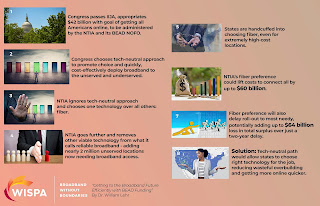
A just-released study commissioned by the Wireless Internet Service Providers Association (WISPA) finds that the National Information & Telecommunications Association's (NTIA) departure from the concept of technological neutrality could increase the cost to extend broadband connectivity to those (largely rural) locations as yet unserved by as much as $60 billion.


"Getting to the Broadband Future Efficiently with BEAD Funding," a white paper by MIT's Dr. William Lehr, concludes that:

Ignoring wireless ISPs that use unlicensed spectrum increases the number of unserved locations by over 1.922 million locations, or by almost a third. Those locations are concentrated in rural locations where deploying [Fiber-to-the-Premises (FTTP)] is extremely costly and much more costly than for fixed wireless alternatives. Requiring that those locations be served by FTTP instead of lower-cost alternative technologies could increase costs by upwards of $30 to $60 billion depending on the distribution of fiber deployment costs for the unserved locations.

Free State Foundation scholars write regularly about the importance of technological neutrality. For example, in his response to Senator John Thune's December 2022 broadband oversight letter, FSF President Randolph J. May pointed out that "[t]he value of a technology-neutral approach to government-subsidy eligibility is that it maximizes the pool of potential applicants. Just as additional entrants in a competitive marketplace can generate greater efficiency, better quality, increased innovation, and lower prices, so, too, can additional applicants make the best use of grant money."

Consequently, Mr. May criticized NTIA's rules for the $42.45 Broadband Equity, Access, and Deployment (BEAD) Program because they (1) "embody a blind preference for fiber broadband networks," and (2) "exclude by name proven solutions – specifically, satellite-based services and offerings that rely exclusively upon unlicensed spectrum – despite their potential ability in some circumstances to deliver 'broadband' … most efficiently to a specific area."

And in "Senators Urge NTIA to Acknowledge Role of Broadband via Unlicensed Spectrum," a December 2022 post to the FSF Blog describing a letter from seven Republican Senators urging NTIA Administrator Alan Davidson "to continue working to advance broadband deployment in rural states and unserved areas by remaining technology neutral and creating rules and funding opportunities that allow all forms of broadband technology to compete," I explained that:

With respect to any given location, its unique features (population density, geographic features, and so on) can favor certain different distribution platforms –including fiber, cable, DSL, 5G, satellite, and fixed wireless – over others. Such factors influence investment choices in the competitive broadband marketplace, and government-led efforts to extend broadband infrastructure to areas still unserved ought to encourage similarly efficient and informed decisionmaking by subsidy recipients.


Monday, February 06, 2023

Senate Broadband Oversight Focuses on Department of Agriculture

With the Department of Agriculture's ReConnect Program poised to distribute this fiscal year an additional $1.5 billion in broadband infrastructure subsidies and amid reports that the 2023 farm bill could provide that agency with even more construction funding, I am encouraged by the news that a bipartisan group of Senators is taking action to prevent (1) waste, fraud, and abuse, and (2) the use of federal dollars to overbuild existing, privately financed networks.

On January 30, 2023, Senators John Thune (R-SD), Ben Ray Luján (D-NM), Amy Klobuchar (D-MN), and Deb Fischer (R-NE), all members of the Senate Committee on Agriculture, Nutrition, and Forestry, reintroduced legislation designed to "streamline and bolster U.S. Department of Agriculture (USDA) Rural Development broadband programs and ensure that their funding is being targeted to rural areas that need it the most."

Seth L. Cooper, Free State Foundation Director of Policy Studies and Senior Fellow, detailed the specific provisions of the Rural Internet Improvement Act of 2022 in a December 2022 post to the FSF Blog. The Rural Internet Improvement Act of 2023, like the 2022 version, would combine Rural Utility Service (RUS) broadband loan and grant programs, specify that no more than 10 percent of locations targeted by a funded project already have access to broadband, encourage greater broadband provider participation, improve the challenge process, and promote greater interagency coordination with the FCC and NTIA.

The RUS manages multiple broadband subsidy programs, the largest being the ReConnect Loan and Grant Program, which to date has distributed more than $3 billion. In a recent interview, RUS administrator Andrew Berke stated his expectation that the ReConnect Program will dole out an additional $1.5 billion in 2023.

In addition, news reports indicate that the next farm bill could appropriate still more money to RUS – Representative David Scott (D-GA), ranking member of the House Committee on Agriculture, identified as his top priority that "[w]e must ensure that appropriate funding is given to USDA to help us bridge the digital divide between rural and urban America" (emphasis added) and argued that "USDA knows what works for our rural communities better than many other Federal agencies."

Considering that (1) tens of billions in taxpayers dollars have been appropriated for the expansion of broadband infrastructure but not yet put to use, and (2) the vast majority of those subsidies will flow to rural areas – after all, at this point in the rollout of broadband "unserved" and "rural" are virtually synonymous – regardless of the distributing agency, it is not at all clear that any additional funding is "appropriate" at this time.

In "Absent Oversight, the Broadband Funding Faucet Likely Will Overflow," a November 2022 Perspectives from FSF Scholars, I drew attention to the concerning potential that, given the large amount of money involved and absent better interagency coordination and oversight, the number of different agencies sharing responsibility for government-led efforts to extend broadband connectivity to those areas that remain unserved could lead to substantial waste and inefficiencies.

But as Mr. Cooper wrote, it is equally true that "intra-agency coordination of broadband deployment subsidy programs through streamlined processes or merging of disparate programs is no doubt essential to ensure that precious tax dollars are spent wisely and that duplicative efforts and other forms of fraud, waste, or abuse are avoided" (emphasis added).

As you may recall, Free State Foundation President Randolph May received a letter from Senator Thune on December 6, 2022, soliciting input on, among other things, the potential for waste, fraud, and abuse as a result of the sheer number of federal broadband subsidy programs, including those administered by the Department of Agriculture.

In his response, Mr. May wrote that "[g]iven the large number of separate programs, it seems self-evident that some of them should be combined and/or eliminated so that there are many fewer programs and fewer agencies disbursing subsidies. This would increase manageability and facilitate accountability and meaningful congressional oversight." He therefore referenced with approval the introduction the Rural Internet Improvement Act of 2022.

In addition, Mr. May drew attention to the fact that the ReConnect Program (1) opens the door to rate regulation via a preference for applicants that provide "at least one low-cost option"; (2) inappropriately encourages applicants to "commit to net neutrality"; and (3) permits grant and loan recipients to apply that assistance in areas where up to 50 percent of locations already are served, in many instances by privately funded networks, "thus disincentivizing further private investment." As noted above, the Rural Internet Improvement Act of 2023 would decrease that threshold to 10 percent.

Thursday, December 08, 2022

Senators Introduce the Rural Internet Improvement Act

 On November 29, Senators John Thune and Ben Ray Lujan introduced S.5137  the Rural Internet Improvement Act of 2022. The bill's purpose is to reform existing U.S. Department of Agriculture (USDA) Rural Development broadband programs and ensure that program dollars are directed to connect rural areas that are unserved or underserved.

According to a press release for the Rural Internet Improvement Act, the legislation would do the following: 

  1. Streamline USDA's broadband authorities by merging and codifying the popular Rural e-Connectivity Pilot Program (ReConnect) with USDA's traditional broadband loan and grant program;
  2. Ensure ReConnect funding is going to areas most in need of reliable broadband service by limiting funding to areas where at least 90 percent of households lack access to broadband service;
  3. Enhance the participation of all types of broadband providers in the ReConnect Program by removing unnecessary barriers;
  4. Increase transparency by improving the challenge process in the ReConnect Program;
  5. Improve the coordination between USDA and the Federal Communications Commission (FCC) on broadband programs; and
  6. Require USDA to enter into a memorandum of understanding with the FCC and National Telecommunications and Information Administration to facilitate outreach to rural residents and businesses of available federal programs that promote broadband access, broadband affordability, and broadband inclusion.

No House companion legislation to S.5137 has yet been announced. 


The Rural Internet Improvement Act appears to be a responsible and constructive measure for helping to ensure that broadband subsidy programs are efficiently and effectively implemented by USDA. Along with interagency coordination among USDA, NTIA, and the FCC, intra-agency coordination of broadband deployment subsidy programs through streamlined processes or merging of disparate programs is no doubt essential to ensure that precious tax dollars are spent wisely and that duplicative efforts and other forms of fraud, waste, or abuse are avoided. 


Congressional oversight is also necessary to help ensure that the billions in subsidies Congress has allocated to promote broadband deployment are well spent. Free State Foundation Senior Fellow Andrew Long addressed this important topic his November 10, 2022 Perspectives from FSF Scholars, "Absent Oversight, the Broadband Funding Faucet Likely Will Overflow." 

Thursday, December 01, 2022

Senators Urge NTIA to Acknowledge Role of Broadband via Unlicensed Spectrum

Seven Senators representing states with significant rural populations recently expressed their concerns regarding the exclusion of offerings operating solely within unlicensed spectrum from the definition of "Reliable Broadband Service" adopted by the National Telecommunications and Information Administration (NTIA) in connection with its $42.45 billion Broadband Equity, Access, and Deployment (BEAD) Program.

In a letter dated November 22, 2022, Senators Steve Daines (R-MT), Marsha Blackburn (R-TN), John Barrasso, M.D. (R-WY), Cynthia M. Lummis (R-WY), Ted Cruz (R-TX), Thom Tillis (R-NC), and John Cornyn (R-TX) urged Assistant Secretary of Commerce for Communications and Information and NTIA Administrator Alan Davidson "to continue working to advance broadband deployment in rural states and unserved areas by remaining technology neutral and creating rules and funding opportunities that allow all forms of broadband technology to compete."

NTIA's Notice of Funding Opportunity (NOFO) for the BEAD Program defines "Reliable Broadband Service" in relevant part as "broadband service that … is accessible to a location via … terrestrial fixed wireless technology utilizing entirely licensed spectrum or using a hybrid of licensed and unlicensed spectrum." Conspicuously absent from this list is broadband delivered exclusively by means of unlicensed spectrum.

According to the Wireless Internet Service Providers Association (WISPA), as of July 2020 its members delivered broadband over unlicensed spectrum "to approximately nine million Americans, business, anchor institutions and first responders." As a practical matter, fixed wireless Internet service providers (WISPs) are particularly well suited to "serving the hardest to reach, unserved areas of rural America."

Free State Foundation scholars long have argued that broadband infrastructure subsidy programs should embrace the concept of technological neutrality. For example, in a June 2021 Perspectives from FSF Scholars, FSF President Randolph May and I took issue with President Biden's proposal to "future proof" government-subsidized broadband infrastructure, which we interpreted as an intention to favor blindly fiber over other proven solutions:

Should the Biden Broadband Plan make available massive subsidies solely to one modality – fiber – under the meaningless guise of "future proofing," it will discourage continued private investment in otherwise viable alternatives and undermine the competition given birth by a longstanding adherence to the principle of technological neutrality.

With respect to any given location, its unique features (population density, geographic features, and so on) can favor certain different distribution platforms –including fiber, cable, DSL, 5G, satellite, and fixed wireless – over others. Such factors influence investment choices in the competitive broadband marketplace, and government-led efforts to extend broadband infrastructure to areas still unserved ought to encourage similarly efficient and informed decisionmaking by subsidy recipients.

As it stands, however, the BEAD Program's definition of "Reliable Broadband Service" renders ineligible for subsidies WISPs exclusively utilizing unlicensed spectrum, thereby constraining artificially the pool of potential applicants.

In addition, and as the Senators highlighted in their letter, the exclusion "runs the risk of wasting billions of taxpayer dollars by duplicating services in areas that already have access to speeds well above 25/3 Mbps, 100/20 Mbps or even higher, instead of prioritizing rural communities that are truly unserved."

Thursday, May 19, 2022

More Indicators of a Bright Future for Fixed Wireless Access Services

My April 25 Perspectives from FSF Scholars, "Fixed Wireless Access is Boosting Rural Broadband and Consumer Choice" highlighted the potential for 5G-enabled fixed wireless access (FWA) services to fast and affordable bring broadband connectivity to several million Americans in rural and small markets within the next few years. The Perspectives observed strong first quarter 2022 FWA subscriber additions for Verizon as confirming evidence of that potential. And my April 30 blog post spotlighted strong quarterly results in FWA service subscriber additions for T-Mobile.

And there are other news items regarding 5G-enabled FWA's outlook. According to one report, at the end of the first quarter of 2022, Verizon and T-Mobile combined have over 1.4 million subscribers to their FWA services. Moreover, on April 28, Telecompetitor reported that UScellular's Home Internet+ fixed wireless is now offered in 10 markets. It is reported that UScellular has an average of 400 MHz of spectrum in those markets. Plus, UScellular has plans to expand to "dozens" of new markets in 2022. Additionally, the Chairman of DISH Network reportedly stated that there is potential for DISH to make competitive entry in the FWA services market to reach rural America. 

For more on FWA services as an important technology platform for helping to close the digital divide and connect all Americans, check out my Perspectives.   

Wednesday, April 06, 2022

US Beats the EU in Head-to-Head Comparison of Broadband Trends

On April 4, USTelecom released a report titled US vs. EU Broadband Trends: 2012-2020. The new report highlights several different metrics by which the broadband Internet services market in America is outperforming the market in European Union nations.

Among its contents, USTelecom's report includes these key findings:

  • Deployment: US leads by 11 percentage points ≥30 Mbps; +25 pp ≥100 Mbps 
  • Adoption: US leads by 10 pp ≥25 Mbps; +21 pp ≥100 Mbps 
  • Competition: US benefits from nearly twice the fixed facilities-based competition of the EU overall; when comparing rural areas, the US lead extends to 7x. 

The US beats the EU by a particularly wide margin when it comes to high-speed fixed broadband in rural areas. USTelecom found that 91% of rural areas in America were covered with fixed broadband compared to 60% in the EU – a staggering 31% difference. Indeed, fixed broadband coverage in the US even exceeded fixed broadband coverage for all areas in the EU, 91% to 87%.


A critical reason for America's broadband advantage over the EU is the heavy investment in broadband infrastructure in the US, as seen in the following charts excerpted from the report:


(click to magnify)

For more on US versus EU comparisons on broadband, see USTelecom's report.

Wednesday, January 19, 2022

Starlink's Performance Shows Prudence of Swift FCC Approval

Recent Ookla data measuring the performance of Starlink's low-Earth orbit (LEO) satellite broadband network shows the prudence of the FCC's swift approval of LEO constellations. SpaceX's Starlink, the only operational satellite broadband network in LEO providing home broadband, posted industry-leading speeds and latency for Q3 2021. Most notably, Starlink's speeds and especially its latency are generally comparable to that of many fixed broadband networks, showing that, once sufficient LEO satellites are deployed, LEO constellations, realistically, can provide high quality connectivity to rural and hard-to-serve areas where building physical networks is cost-prohibitive.

Starlink posted 87.25 Mbps / 13.54 Mbps median broadband speeds with a median latency of 44 ms, far outpacing competitors HughesNet and Viasat, which operate broadband networks at higher orbital altitudes than LEO. Starlink's speeds are over 4.5 times faster than HughesNet (19.30 Mbps/ 2.54 Mbps) and Viasat (18.75 Mbps/ 2.96 Mbps) for both download and upload. And while fixed networks have superior speeds, Starlink comes far closer to the median fixed network speeds of 119.84 Mbps / 13.54 Mbps than its higher orbit competitors, which offer speeds that are roughly a fifth or sixth of median fixed network speeds.

But latency is where Starlink especially stands out. Starlink's median latency, 44 ms, is about 15 times smaller than the median latencies of its satellite competitors, and only 2.9 times larger than the median latency for fixed networks. High latency – meaning signal delay – has long characterized satellite networks, and this makes them less attractive options than terrestrial and wireless broadband. Broadband with high latency makes certain applications that depend on split-second connections like video games, voice and video calling, and livestreaming less usable and reliable. As Commissioner Brendan Carr noted in a 2018 statement approving part of Starlink's constellation, "[LEO satellites] promise lower latency connections because they typically orbit only a few hundred miles above Earth, as opposed to many thousands." Starlink's network is delivering on that promise at an early stage.

Starlink's high speeds and low latency are important because satellites generally provide global coverage, which makes Starlink a serious contender for providing affordable, high-quality service in rural and other hard-to-serve areas. Users simply need to install a dish on their home to receive satellite broadband, avoiding the expensive and often cost-prohibitive infrastructure buildouts needed to reach rural and other hard-to-serve areas. This is precisely the consumer demographic Starlink targets with its marketing. Its website states: "Starlink is ideally suited for areas where connectivity has been unreliable or completely unavailable." So far, Starlink has 145,000 customers, a figure that's quickly grown from the 90,000 it reported in July 2021.

Ookla does note that Starlink's service performance varies by region in the United States, ranging from about 45 Mbps download in some areas to 145 Mbps download in others. But as Starlink continues to launch satellites, its coverage and network capacity will improve. Starlink has FCC approval to deploy 12,000 satellites, but so far it only has roughly 2,000 in orbit. SpaceX has already launched more Starlink satellites this month.

Even though Starlink hasn't deployed its full constellation, its broadband performance is already stronger than median fixed speeds in multiple developed countries. Starlink's median speeds for Q3 2021 in Australia, Belgium, Germany, and the United Kingdom outperformed median speeds for fixed networks in those countries. This is largely because fixed broadband is much slower in those places than it is in United States, according to Ookla's measurements.

Starlink, the first operational LEO constellation, first applied for FCC approval in 2016. Nothing guaranteed a swift approval, and the Commission could have chosen to wait longer before approving the application. Such delay often denies lifechanging technologies to Americans. Thankfully, the Commission approved LEO constellations for Starlink and potential competitors Amazon, OneWeb, Boeing, and others, including some that already have exited the market.

Free State Foundation Director of Policy Studies Seth Cooper supported Starlink's approval back in 2018. I previously highlighted a planned backhaul deal between Amazon and Verizon that will start once Amazon's LEO constellation reaches orbit in the next few years.

Starlink's early performance metrics suggest that the FCC was smart to quickly approve LEO satellites. The Commission's swift approval and support for market competition has allowed Starlink and potentially others to serve the unconnected Americans our federal government has spent billions trying to reach over the last decade.


Tuesday, November 30, 2021

Charter to Commission: Pole Disputes Threaten Timely Deployment of Broadband Infrastructure

In two recent FCC filings, Charter Communications, Inc. (Charter) offered further evidence that efforts to connect rural Americans to broadband hinge upon agency action ensuring access to utility poles "on reasonable timelines, terms and conditions." Specifically, the grant, whether through declaratory ruling or notice-and comment rulemaking, of the forms of relief requested by NCTA – The Internet & Television Association (NCTA) in a Petition for Expedited Declaratory Ruling submitted in July 2020 and denied by the Wireline Competition Bureau in January of this year.

As I highlighted in "Charter Announces Ambitious Project to Deploy Broadband to Over One Million Unserved Locations," a February 2021 post to the FSF Blog, Charter is investing $5 billion, including $1.2 billion in subsidies secured via winning bids in the Rural Digital Opportunity Fund (RDOF) reverse auction, to expand its network in 24 states. This will enable it to offer high-speed Internet access – specifically, service that meets or exceeds the FCC's current 25 megabits per second (Mbps) downstream and 3 Mbps upstream definition of "broadband" – to more than one million locations at present unserved.

When it unveiled its plans, Charter cautioned that "pole applications, pole replacement rules and their affiliated issue resolution processes are all factors that can have a significant impact on the length of time it takes to build into these rural areas."

And in conversations last week with representatives of the Wireline Competition Bureau and legal advisors to Chairwoman Jessica Rosenworcel and Commissioner Geoffrey Starks, Charter presented specific evidence of issues relating to the processing of pole applications that threaten its ability not just to connect rural Americans, but to meet deadlines associated with RDOF subsidies.

Maureen O'Connell, Charter Vice President, Regulatory Affairs, detailed one impasse, involving the Warren Rural Electric Cooperative Corporation (WRECC) in rural Kentucky, that jeopardizes its plans to provide broadband to over six thousand unserved locations:

At the permit processing rate currently proposed by WRECC, it would take 14 years to complete the permitting process for attachments to poles to reach these locations – about seven times longer than planned and double the maximum allowed to deploy these federal taxpayer dollars under RDOF. That means a child in kindergarten now will have graduated from high school before the permitting phase is complete.

Charter also identified pole-related disputes in California, Hawaii, and South Carolina and "expressed concern that some pole owners have competitive incentives to delay broadband deployment by attaching entities because they are themselves affiliated with broadband providers who are putative competitors to the attaching entities, including (in the case of WRECC) affiliates or business partners receiving RDOF support."

In July 2020, NCTA filed with the FCC a Petition for Expedited Declaratory Ruling (NCTA Petition) seeking relief in rural areas including: (1) various clarifications regarding the appropriate allocation of pole replacement costs between attachers and owners, and (2) timely resolution of pole-related disputes via the Commission's Accelerated Docket.

Free State Foundation President Randolph May and Director of Policies Studies and Senior Fellow Seth Cooper filed Comments in support of the NCTA Petition.

In a January 2021 Declaratory Ruling, the Wireline Competition Bureau did clarify that "utilities may not require requesting attachers to pay the entire cost of pole replacements that are not necessitated solely by the new attacher and, thus, may not avoid responsibility for pole replacement costs by postponing replacements until new attachment requests are submitted."

As a general matter, however, the Wireline Competition Bureau denied the NCTA Petition, concluding that "it is more appropriate to address questions concerning the allocation of pole replacement costs within the context of a rulemaking, which provides the Commission with greater flexibility to tailor regulatory solutions."

The picture painted by Charter underscores how important it is for the FCC to provide additional clarity and guidance with respect to the respective rights and responsibilities of pole owners and attachers.

In that regard, I point out that, in a statement to Telecompetitor, a self-described "puzzled" WRECC disputed Charter's allegations and expressed "hope than we can come to an agreement soon." Thus, it would seem that the parties involved are not on the same page. Prompt intervention by the FCC holds the potential to accelerate the deployment of network infrastructure.

In other words, the policy goal of rapid rural broadband expansion compels precisely the relief requested in the NCTA Petition: "expedited consideration under the Accelerated Docket."

As noted above, the Wireline Competition Bureau denied NCTA's request for declaratory relief because it believed that a rulemaking of general applicability would be the more appropriate vehicle. It is time to begin that process.