Showing posts with label mobile data traffic. Show all posts

Friday, January 24, 2025

Spectrum Pipeline and FCC Auction Bill Introduced in House

In welcome news, on January 23, Rep. Rick Allen W. Allen announced the introduction in the House of Representatives of the Spectrum Pipeline Act of 2025. The Act, if it were to become law, would require the NTIA to identify at least 2,500 megahertz (MHz) of mid-band spectrum for reallocation from federal government use to non-federal or shared use in 5 years of the bill's enactment, including at least 1,250 MHz within the next 2 years.  

Additionally, the Act renews the FCC's authority to conduct spectrum license auctions and issue licenses to bid winners. The Commission's authority lapsed in March 2023. Under the Act, the Commission would be required to auction at least 1,250 MHz of spectrum for full-power commercial wireless service within 6 years, and at least 600 MHz of that spectrum must be auctioned within 3 years. 


Notably, the Act also requires the FCC to allocate at least 125 MHz of spectrum for unlicensed use, such as WiFi. 


At the January 23 hearing on wireless technology held by the House Subcommittee on Communications & Technology, there appeared to be bipartisan unanimity on the conclusion that more spectrum needs to be put into use for licensed and unlicensed use and that the FCC's lapsed spectrum license auction authority should be restored promptly. 


The Commission's 2024 Communications Marketplace Competition Report includes a chart by CTIA that shows the dramatic rise in mobile data traffic, and an unmistakable upward trend that will continue as more and more connected devices go into use and as data usage per subscriber continues to go up: 
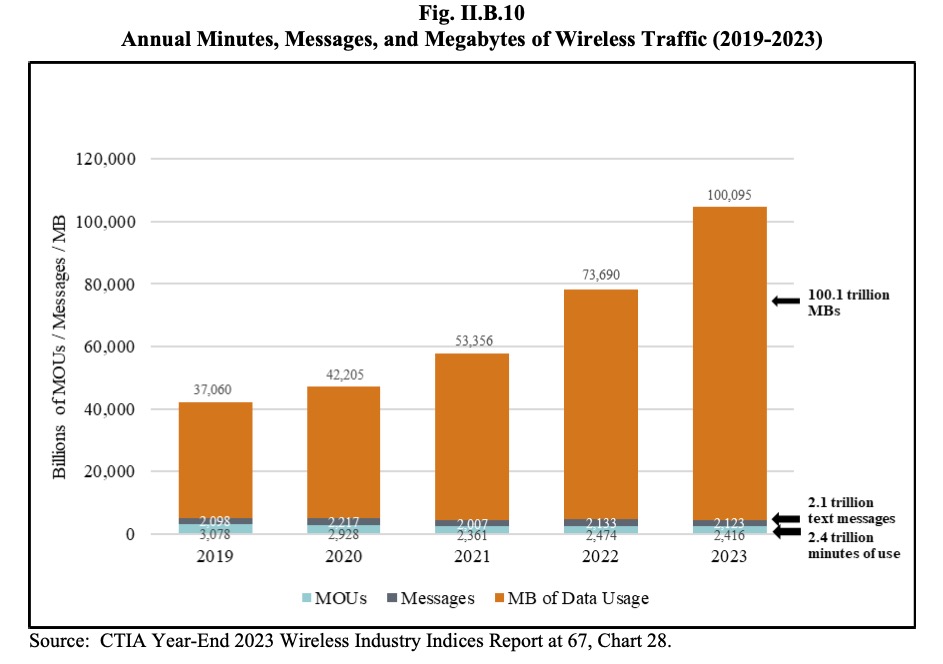

Additionally, the 2024 report observes that "[a] large proportion of mobile data traffic is delivered on an unlicensed basis through Wi-Fi, Bluetooth, and similar protocols." Furthermore: "Telecom Advisory Services asserts that the economic benefits associated with Wi-Fi in the United States will rapidly grow to $2.4 trillion in 2027, including an estimated $514 billion in consumer benefit, $624 billion in producer surplus, and $1,286 billion in GDP." And "[a]ccording to LightReading, the average Verizon subscriber offloads approximately 78% of their data onto Wi-Fi, for example, while Comcast subscribers offload approximately 94%." For other highlights from the report, see my Perspectives from FSF Scholars, "The FCC's 2024 Communications Marketplace Report: Time for a Broader View of Competing Broadband Services," published January 24, 2025. 


Also important is the NERA study published on January 23 that estimates the tremendous economic value created through the allocation of spectrum for licensed use. For more on that, see my January 23 blog post, "Report: Putting Mid-Band Spectrum into Licensed Use Adds Billions to Economy."


The Spectrum Pipeline Act that Rep. Allen introduced is a companion to the similarly-titled bill from March 2024 that Senators Ted Cruz and John Thune sponsored. As Free State Foundation President Randolph May stated in a March 11, 2024, Media Advisory regarding the Senate bill from the last Congress: 

No doubt there may be different views regarding the specific dates and amounts identified for reallocation contained in the bill. But there should be widespread agreement that it provides a good basis for moving forward promptly to develop a bipartisan, bicameral plan to address the nation's now-lagging spectrum efforts.

Everything President May said then applies with equal measure to the Spectrum Pipeline Act of 2025. Several months later, no substantial progress has been made on the wireless spectrum front. Timely action by Congress is even more important to get the desired result from having more spectrum in use. Rep. Allen deserves credit for filing the bill and undertaking efforts to make that happen. 

Wednesday, December 20, 2023

Report Chronicles the Competitiveness of Today's Wireless Services Market

On December 11, CTIA released a report by Compass Lexecon titled "An Economic Analysis of Mobile Wireless Competition in the United States." The report provides an excellent overview of data points demonstrating that the wireless market is effectively competitive. And as the report rightly concludes, the competitive state of the wireless market means that imposing "utility regulation like that found in Title II of the Communications Act is both unnecessary andlikely to be a harmful deterrent to future investment and industry performance due to imposed costs and diverted resources."

The Compass Lexecon report cites strong capital investment in wireless network infrastructure:  $364 billion in nominal dollars invested 2010 to 2022. It also cites rapid network deployment and upgrades, with a 64% increase in cell cites activated over the prior decade and 5G deployment by 3 nationwide wireless providers to 98% of the population. Also, speeds have quadrupled over the past seven years and doubled over the past three years. The number of devices and data usage per wireless user have risen, with overall U.S. mobile traffic growing at a compound rate of about 55% between 2010 and 2022, and overall subscribership grew at a compound annual rate of about 5% during that same time span. And inflation-adjusted wireless price indices published by the Bureau of Labor Statistics declined by 18%-to-19% since 2017, with the price of wireless declining over the past 24-month period while the price of other products has risen 12%. 


Citations to those data points as well as to other positive indicators of wireless competition are contained in Compass Lexecon's report. It is a worthwhile read.  


On December 14, the Free State Foundation filed public comments with the FCC in its Safeguarding and Securing the Open Internet proceeding. In those comments, we cite the strong competitive conditions of the wireless and overall broadband markets and make the case that imposing public utility regulation on broadband Internet access services is unjustified and harmful to investment and innovation. Wireless services have thrived in a light-touch regulatory environment and wireless competition is an important check on anticompetitive conduct. Wireless consumers are not facing any actual or likely harm that warrants public utility regulation, and regulating wireless services as a public utility would not expand or increase deployment of those services to anyone who does not already have it. 

Sunday, July 30, 2023

Survey Shows Big-Time Growth in 2022 for 5G Devices and Home Broadband

On July 25, CTIA released its 2023 Annual Survey. Survey highlights are posted on CTIA's website. It shows the remarkable growth in wireless services that took place in the U.S. during 2022.  

The survey highlights show that 2022 was a record-breaking year for wireless data traffic growth, as U.S. wireless networks supported 73.7 billion MB of traffic last year. That total was 20 trillion MB – or 38% more – than in 2021. Total wireless traffic for 2017 was 15.7 trillion MB. Additionally, annual wireless investment climbed to an industry record $39 billion in 2022, up from $35 billion in 2021. This marks the continuation of a series of annual increases in capital investment, going back to 2017, when annual investment totaled $26 billion. According to CTIA, over its history (presumably dating back to the early 1990s), the wireless industry has invested over $675 billion.

CTIA's 2023 Survey Highlights also revealed stunning growth in wireless connectivity, especially for 5G devices. At year's-end 2022, there were about 523 million connected wireless devices and 162 million active 5G devices. Those numbers are up significantly from 2021, when connected wireless devices totaled 499 million and active 5G devices totaled 86 million. Between the end of 2021 and 2022, here was a near doubling of 5G connected devices. 


The survey also shows that 2022 was a huge year for 5G home broadband. According to the survey highlights, 5G home broadband now covers more than 94 million U.S. households, and that 5G home broadband accounted for 90% of net broadband additions last year. The survey also contains 2022 figures regarding small cells, price per MB, and text. 


The continuing success of wireless services in the U.S. owes, in significant part, to a pro-investment, pro-competition, light-touch regulatory policy that dates back to the early 1990s.  Thirty years ago, Congress authorized competitive bidding spectrum license auctions and preempted state regulation of rates and entry as well as state and local government permit and zoning decisions on infrastructure citing that have the "effect of prohibiting" wireless services. To ensure the continued success of 5G services in the U.S. Congress should take action in 2023 to advance legislation such as H.R. 3557, the American Broadband Deployment Act of 2023, to clear away obstacles to timely infrastructure. Also helpful to promoting broadband deployment, including wireless broadband, are a slate of bipartisan bills for streamlining infrastructure deployment that were passed by the House Energy and Commerce Committee in May of this year and highlighted in a May 24 blog post. And as FSF Senior Fellow Andrew Long explained in a July 21 blog post, "Congress Should Reinstate the FCC's Spectrum Auction Authority" by passing H.R. 3565, the Spectrum Reauthorization Act of 2023. 

Monday, August 16, 2021

Latest Wireless Industry Survey Reveals Continued Growth in Investment, 5G Deployments, and More

The 2021 annual survey of the wireless industry conducted by CTIA details steadily increasing investment, rapidly expanding 5G deployments, and a robust response to the spike in demand driven by COVID-19.

Released by CTIA on July 27, 2021, the 2021 Annual Survey Highlights present a compelling portrayal of progress and performance during a year over which the pandemic cast a heavy shadow.

A few highlights:

  • Private investment in mobile networks increased for the third consecutive year, reaching a five-year high of $30 billion. Capital expenditures to date exceed $600 billion.
  • 5G networks were deployed at a pace exceeding that achieved by 4G networks and in 2020 covered 300 million Americans, compared to only 200 million twelve months prior. First launched in 2019, 5G already is available to 90 percent of the country.
  • In the last two years, mobile carriers constructed nearly 68,000 new cell sites, an achievement facilitated by wireless infrastructure reforms implemented by the FCC.
  • Total mobile data consumption exceeded 42 trillion megabytes in 2020, an increase of more than 200 percent since 2016. Over the past decade, mobile data traffic has grown by a factor of 108.

Tuesday, August 25, 2020

Strong U.S. Wireless Investment in 2019 Enabled Solid Performance Amidst Lockdowns

Today, CTIA released its 2020 Annual Survey. The survey highlights show stunning growth in mobile wireless networks and performance in 2019, including $29.1B in U.S. capex in wireless networks, about 46,000 new cell sites built, over 20 million new U.S. wireless subscriptions for a total of 442.5 million subscriptions, and 37.1 trillion megabytes of wireless data consumption. Importantly, the tremendous investment by the U.S. wireless industry in 2019 helped ensure that mobile wireless networks successfully accommodated surging data and wireless traffic in early 2020 amidst the first several weeks of lockdowns. That accomplishment sets U.S. networks apart from other nations in which speeds declined when faced with rising traffic. Be sure to check out the wireless industry's 2020 Annual Survey Highlights at CTIA's website.