Showing posts with label WiFi. Show all posts

Friday, January 24, 2025

Spectrum Pipeline and FCC Auction Bill Introduced in House

In welcome news, on January 23, Rep. Rick Allen W. Allen announced the introduction in the House of Representatives of the Spectrum Pipeline Act of 2025. The Act, if it were to become law, would require the NTIA to identify at least 2,500 megahertz (MHz) of mid-band spectrum for reallocation from federal government use to non-federal or shared use in 5 years of the bill's enactment, including at least 1,250 MHz within the next 2 years.  

Additionally, the Act renews the FCC's authority to conduct spectrum license auctions and issue licenses to bid winners. The Commission's authority lapsed in March 2023. Under the Act, the Commission would be required to auction at least 1,250 MHz of spectrum for full-power commercial wireless service within 6 years, and at least 600 MHz of that spectrum must be auctioned within 3 years. 


Notably, the Act also requires the FCC to allocate at least 125 MHz of spectrum for unlicensed use, such as WiFi. 


At the January 23 hearing on wireless technology held by the House Subcommittee on Communications & Technology, there appeared to be bipartisan unanimity on the conclusion that more spectrum needs to be put into use for licensed and unlicensed use and that the FCC's lapsed spectrum license auction authority should be restored promptly. 


The Commission's 2024 Communications Marketplace Competition Report includes a chart by CTIA that shows the dramatic rise in mobile data traffic, and an unmistakable upward trend that will continue as more and more connected devices go into use and as data usage per subscriber continues to go up: 
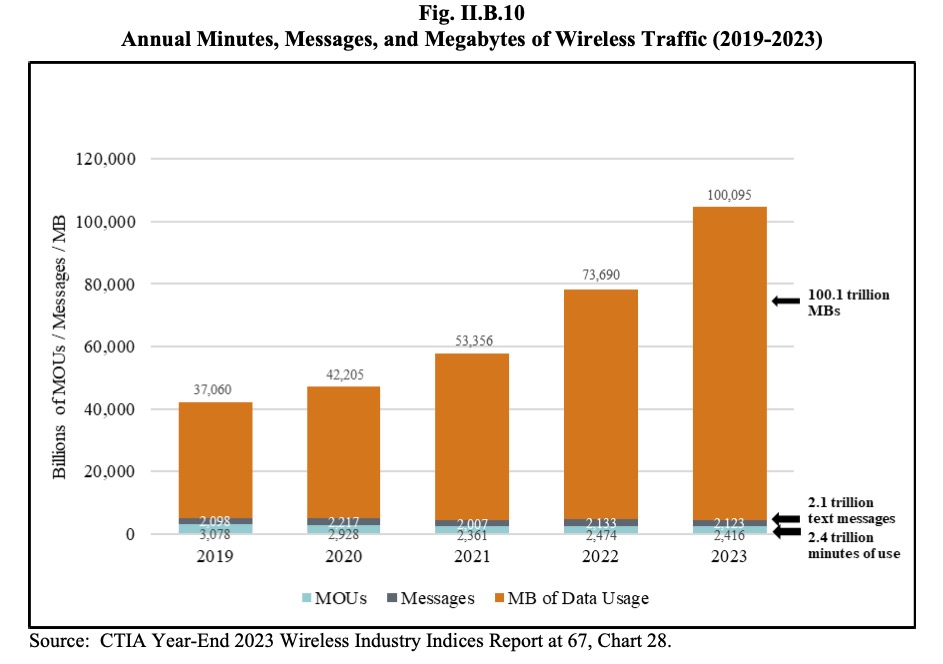

Additionally, the 2024 report observes that "[a] large proportion of mobile data traffic is delivered on an unlicensed basis through Wi-Fi, Bluetooth, and similar protocols." Furthermore: "Telecom Advisory Services asserts that the economic benefits associated with Wi-Fi in the United States will rapidly grow to $2.4 trillion in 2027, including an estimated $514 billion in consumer benefit, $624 billion in producer surplus, and $1,286 billion in GDP." And "[a]ccording to LightReading, the average Verizon subscriber offloads approximately 78% of their data onto Wi-Fi, for example, while Comcast subscribers offload approximately 94%." For other highlights from the report, see my Perspectives from FSF Scholars, "The FCC's 2024 Communications Marketplace Report: Time for a Broader View of Competing Broadband Services," published January 24, 2025. 


Also important is the NERA study published on January 23 that estimates the tremendous economic value created through the allocation of spectrum for licensed use. For more on that, see my January 23 blog post, "Report: Putting Mid-Band Spectrum into Licensed Use Adds Billions to Economy."


The Spectrum Pipeline Act that Rep. Allen introduced is a companion to the similarly-titled bill from March 2024 that Senators Ted Cruz and John Thune sponsored. As Free State Foundation President Randolph May stated in a March 11, 2024, Media Advisory regarding the Senate bill from the last Congress: 

No doubt there may be different views regarding the specific dates and amounts identified for reallocation contained in the bill. But there should be widespread agreement that it provides a good basis for moving forward promptly to develop a bipartisan, bicameral plan to address the nation's now-lagging spectrum efforts.

Everything President May said then applies with equal measure to the Spectrum Pipeline Act of 2025. Several months later, no substantial progress has been made on the wireless spectrum front. Timely action by Congress is even more important to get the desired result from having more spectrum in use. Rep. Allen deserves credit for filing the bill and undertaking efforts to make that happen. 

Monday, December 16, 2024

Wi-Fi 7 Innovation Is Now Deploying to Consumers

On November 25, Charter Communications announced that it has started deploying Wi-Fi 7 routers. Charter is apparently the first major broadband Internet service provider to launch an exclusively designed Wi-Fi 7 technology system for both its residential and business subscribers. In September, AT&T announced that it plans to introduce a new Wi-Fi 7-capable gateway before the end of the year. Also, it is reported that there are dozens of Wi-Fi 7-certified non-exclusive devices in the market as of 2024.

Wi-Fi 7 is an innovative upgrade over prior generations of Wi-Fi technology. It is reported that Wi-Fi 7 enables wider channels for increased bandwidth, improved reliability, and better speeds. In 2025, look for the deployment of Wi-Fi 7 routers, TVs, cell phones, and other Wi-Fi 7-compatible devices to improve network performance and capabilities for American broadband subscribers starting with Charter's subscribers. 


Wi-Fi 7 operates in the 2.4 GHz, 5 GHz, and 6 GHz bands. Fortunately, there is a large amount of spectrum dedicated to unlicensed wireless usage, such as Wi-Fi. The FCC's 6 GHz Order (2020) cleared 1200 MHZ of spectrum for unlicensed use, which quadrupled the total amount of spectrum available for unlicensed devices, most notably Wi-Fi routers and Internet of Things (IoT) devices that use Wi-Fi. 

Tuesday, November 05, 2024

Court Hears Arguments on Challenge to School Wi-Fi Bus Subsidies

 On November 4, oral arguments were held before the U.S. Court of Appeals for the Fifth Circuit in the case of Molak v. FCC. The case involves a legal challenge to the Commission's October 2023 School Bus Wi-Fi Order. The Petitioners, represented by David A. Suska during oral arguments, claim that the agency lacks authority under Section 254 of the Communications Act to use E-Rate funds to subsidize Wi-Fi on school buses. 

By a declaratory ruling passed on a 3-2 vote of the Commission's members, the agency is interpreting the law to effectively extend the Emergency Connectivity Fund (ECF) beyond its sunset date of June 2024. The ECF was a $58.2 billion subsidy program for subsidizing Wi-Fi hotspots and broadband services for school buses and off-campus connectivity. The program was authorized under the American Rescue Plan Act of 2021 (ARPA) as a lockdown-era emergency measure. Section 7402 of the ARPA expressly authorized subsidies for supporting "eligible equipment" and advanced telecommunications and information services for use by students, school staff, and library goers "at locations that include locations other than the school" and "other than the library."


In our February 2024 Perspectives from FSF Scholars, "FCC's School Bus Wi-Fi Subsidy Lacks Statutory Support," Free State Foundation President Randolph May and I addressed legal problems with the School Bus Wi-Fi Order. Section 254 of the Communications Act is more limited than Section 7402 of the ARPA. Section 254(h)(1)(B) authorizes the Commission to provide subsidy support to telecommunications carriers for "services to elementary schools, secondary schools, and libraries for educational purposes." And Section 254(h)(2)(A) directs the Commission to adopt competitively neutral rules to enhance "access to advanced telecommunications and information services for all public nonprofit elementary and secondary school classrooms, health care providers, and libraries." In short, we concluded that the FCC overreached in subsidizing school bus Wi-Fi subsidies under Section 254 because buses are notschools, classrooms, or libraries – and schools are not telecommunications carriers. 


Before the Fifth Circuit, Mr. Suska ably argued that the School Bus Wi-Fi Order exceeded the law in four ways: (1) by making subsidies available to anyone, not just telecommunications carriers; (2) by making subsidies available for any kind of service, not just telecommunications services; (3) by making subsidies available for equipment, which is not in the statute; and (4) by providing subsidies to schools instead of telecommunications carriers.  


On behalf of the FCC, Ms. Rachel Proctor May argued: "The word 'classroom' is best interpreted to include buses that have been outfitted with Wi-Fi so they can serve as rolling study halls." That type of elastic interpretation might have sufficed under the old "Chevron doctrine." But that is a decidedly strained and result-driven interpretation by the FCC, and one the agency cannot rely on for its authority now that the Supreme Court's decision in Loper-Bright v. Raimondo has overruled Chevron. Moreover, it goes against human experience to think that anything but the tiniest amount of homework will take place on Wi-Fi-connected school buses. No claimed agency technical expertise about imagined homework on school buses ought to rescue the FCC from the overreach of its School Bus Wi-Fi Order


A significant portion of the oral arguments before the court addressed threshold procedural issues regarding exhaustion of administrative remedies and standing. Yet if the Fifth Circuit rules on the merits, there is a strong likelihood that the court will vacate the FCC's School Bus Wi-Fi Order. 

Wednesday, September 04, 2024

Lawsuit Challenges FCC Order Subsidizing Wi-Fi Away from Schools and Libraries

On August 29, a petition was filed in the U.S. Court of Appeals for the Fifth Circuit that challenges the legal basis for the FCC's July 2024 Off-Premises Wi-Fi Order. The petition filed in Molak v. FCC states that the Commission's order "unlawfully expands the FCC’s E-Rate Program to subsidize Wi-Fi service and equipment anywhere students might go." E-Rate is part of the Universal Service Fund (USF), which is funded by surcharges – functional taxes – paid each month by voice consumers. The petition alleges that the order’s increase in E-Rate Program outlays will directly increase USF surcharges that the petitioners pay each month. It also alleges that subsidizing Wi-Fi use away from school premises "enabl[es] unsupervised social-media access by children and teenagers."

The unlawfulness of the Commission's Off-Premises Wi-Fi Order is the subject of my August 20 Perspectives from FSF Scholars, "FCC Can't Subsidize Wi-Fi Use Away from Schools and Libraries." As explained therein, Section 254(h) of the Communications Act, the statutory provision that provides the legal basis for the E-Rate Program and upon which the Commission relies for its order, authorizes universal service subsidies only to or for "schools," "classrooms," and "libraries." But subsidies for off-premises Wi-Fi use – potentially anywhere in the world – are not included in the statute.


Moreover, the legal challenge to the Off-Premises Wi-Fi Order in Molak v. FCC parallels a prior legal challenge with an identical case name that was filed in the Fifth Circuit last year against the Commission's 2023 School Bus Wi-Fi Order. The prior agency order authorized universal subsidies for Wi-Fi equipment and service on school buses. The unlawfulness of the prior order is the subject of a February 2024 Perspectives from FSF Scholars by Free State Foundation President Randolph May and I, titled "FCC's School Bus Wi-Fi Subsidy Lacks Statutory Support."


In both Molak v. FCC cases, the petitioners raise important issues about agency accountability to the law and to the American public. The outcome of these pending legal challenges to administrative agency overreach will have implications for responsible spending of precious dollars collected from the public and for child online safety.

Thursday, March 07, 2024

Sen. Ted Cruz Offers Eight Principles for USF Reform

On March 6, Sen. Ted Cruz released a white paper, "Protecting Americans from Hidden FCC Tax Hikes: A Blueprint for Universal Service Fund Reform." Credit due to Sen. Cruz for addressing the need for reforming the USF Program. The white paper puts forth Sen. Cruz's priorities for overhauling and updating the USF system to work more efficiently at connecting those who need it while protecting consumers from over taxation and wasteful spending. Sen. Cruz's white paper includes a list of eight principles to guide USF reform that merit careful attention. Those principles also are provided in a press release:

  1. Put Congress back in the driver’s seat;
  2. Move social welfare spending on-budget;
  3. Eliminate program duplication;
  4. Stop subsidizing networks that face unsubsidized competition;
  5. Do not subsidize Infrastructure Investment and Jobs Act-funded (IIJA) networks’ ongoing operational costs;
  6. Target low-income subsidies to those who truly need them;
  7. Ensure E-Rate is truly improving education and not aggravating kids’ screen addictions;
  8. Establish better controls to stop waste, fraud, and abuse.

Among other things, Sen. Cruz's white paper insists that USF distribution reform should come before contribution reform, or else the program will continue to expand and further burden consumers. It also addresses the FCC's recent expansion of the Lifeline program to include subsidies for Wi-Fi equipment on public school buses. Free State Foundation President Randolph May and I address this subject in our February 2024 Perspectives from FSF Scholars, "FCC's School Bus Wi-Fi Subsidy Lacks Statutory Support."


USF reform will be one of the topics to be discussed at FSF's Sixteenth Annual Policy Conference – #FSFConf16 – which will take place in Washington DC on March 12. There still is time to register online

Thursday, November 03, 2022

FCC Takes Action to Unleash Wi-Fi 6E, Wi-Fi 7

On November 2, 2022, the FCC's Office of Engineering and Technology (OET) announced that it had conditionally approved 13 Automated Frequency Coordination (AFC) systems designed to enable shared use of the 6 GHz band between licensed and unlicensed devices.

By preventing harmful interference to incumbent licensed microwave links, AFC will make available 1200 MHz of high-value, mid-band spectrum to Wi-Fi 6E devices operating at standard power levels – which, in turn, will deliver to consumers increasingly faster speeds, lower latency, and better coverage.


The consumer popularity of Wi-Fi is both immense and steadily growing. Consequently, existing unlicensed spectrum in the 2.4 GHz and 5 GHz bands long has been subject to overcrowding. More capacity, particularly contiguous swaths able to support wider Wi-Fi channels – and, thus, faster speeds – was needed.

In response, the FCC in April 2020 adopted a Report and Order opening the 6 GHz band to flexible unlicensed use, including Wi-Fi.

A December 28, 2021, post to the FSF Blog reported that the D.C. Circuit largely upheld that agency action in AT&T Services, Inc. v. FCC.

The following day, FSF President Randolph May in a Press Release heralded that decision "because of the way the court broadly viewed the exercise of the Commission's core spectrum management responsibilities" and for "emphasizing the considerable degree of deference to be accorded to the FCC regarding technical spectrum management matters."

Integral to the Commission's conclusion that unlicensed devices can operate at standard power levels in the 6 GHz band both indoors and outdoors without causing harmful interference to incumbent licensed users is the role to be played by the AFC spectrum use coordination system.

(By contrast, the agency determined that indoor-only devices could operate safely at lower power levels without AFC. As a result, such devices are available today in the retail marketplace as well as from broadband Internet service providers.)

By paving the way for testing to begin, OET's conditional approval of 13 AFC database systems represents a noteworthy step forward in wireless networking – not only Wi-Fi 6E, but also Wi-Fi 7, the under-development successor specification recently demonstrated for Commissioners and agency staff by Intel Corporation and Broadcom Inc.

As those companies described in a slide deck filed in ET Docket 18-295 and GN Docket No. 17-183, Wi-Fi 7 expands network capacity by a factor of 5, latency by up to a factor of 100, and further improves coverage.

Friday, August 12, 2022

D.C. Circuit Unanimously Affirms the FCC's 5.9 GHz Band Order

Earlier today, in a development that will benefit WiFi users and make way for modern wireless vehicle safety capabilities, the U.S. Court of Appeals for the District of Columbia Circuit unanimously affirmed the Commission's November 2020 Order repurposing 45 MHz of fallow spectrum in the 5.9 GHz band for unlicensed use.

In a Statement, NCTA – The Internet & Television Association called the court's decision in Intelligent Transportation Society of America v. FCC "an enormous victory for American consumers," one that will lead to "even more reliable high-speed Wi-Fi and access to next-generation automotive safety applications."

In 1999, the FCC dedicated 75 MHz of beachfront spectrum to a proprietary vehicle safety technology that never lived up to its promise. Over twenty years later, the 5.9 GHz Order put that valuable wireless capacity to its highest and best use, making 30 MHz available for successor intelligent transportation systems technologies and repurposing the lower 45 MHz for WiFi and other unlicensed services.

Free State Foundation President Randolph May and I filed comments in support of the FCC's proposal. And in a Perspectives from FSF Scholars published shortly before the Commission adopted the 5.9 GHz Order, I argued that it represented "a fresh approach to this vastly underutilized spectrum that advances both public safety and the capabilities of WiFi networks."

Regrettably, in one of several recent high-profile instances of a breakdown in interagency spectrum coordination efforts necessitating process reform, the Department of Transportation raised objections to the Commission's proposal outside of established channels.

Eventually, several interested parties challenged the 5.9 GHz Order in court.

As Free State Foundation Director of Policy Studies and Senior Fellow Seth Cooper explained in a December 2021 post to the FSF Blog, consistent with the Supreme Court's 1968 decision in U.S. v. Southwest Cable Company, "[a] decision by the D.C. Circuit to uphold the 5.9 GHz Order would constitute a small but helpful step toward vindicating the FCC's 'unified jurisdiction and regulatory power' over commercial spectrum from interference by other federal agencies."

Today's decision does just that. In response to petitioners' claims that the 5.9 GHz Order "was arbitrary and capricious because it violated the Transportation Equity Act," the D.C. Circuit succinctly responded as follows: "It was not."

Specifically, the court held that:

[T]he Transportation Equity Act did not transfer away from the FCC its broad authority to manage the spectrum related to intelligent transportation systems. Instead, as the FCC noted, it simply required the FCC to account for the Department of Transportation's views and the needs of intelligent transportation systems when it does so. The FCC did that here.

Monday, December 06, 2021

Article Forecasts Unlicensed Wi-Fi 6's Partnership with 5G Wireless

Amidst the fast rollout of 5G networks, it is all too easy to overlook the growth of Wi-Fi 6 and its role in supporting next-generation broadband network services. On December 1, Deloitte published an article titled "Wi-Fi 6: Unsung, underexposed—and indispensable to the future of enterprise connectivity." The Deloitte article offers the important insight that "5G may get the lion's share of the publicity, but Wi-Fi 6 devices are quietly outselling 5G devices by a large margin and will likely continue to do so for the next few years at least." Additionally: "Deloitte Global predicts that more Wi-Fi 6 devices will ship in 2022 than 5G devices, to the tune of at least 2.5 billion Wi-Fi 6 devices versus roughly 1.5 billion 5G devices." The article goes on to explain that "Wi-Fi 6 and 5G are designed to work together smoothly, and the wireless industry appears headed toward a future in which devices can roam securely and seamlessly between all types of wireless networks." As the article shows, Wi-Fi 6 will play a crucial role in the future of wireless services. 

Free State Foundation Senior Fellow Andrew Long provided an overview of the potential functional and economic benefits of next-gen Wi-Fi in his February 2020 Perspectives from FSF Scholars, "Wi-Fi 6E Can Modernize Unlicensed Wireless." The FCC's 2020 orders to repurpose spectrum in the 5.9 GHz and 6 GHz bands for unlicensed flexible use -- including Wi-Fi -- will help realize those benefits.

Monday, December 21, 2020

Wi-Fi Alliance Releases Report Highlighting Critical Role of Wireless Networks During COVID-19 Pandemic

2020 was a banner year for unlicensed spectrum. For the first time in decades, the FCC made available significant amounts of additional capacity for Wi-Fi. The Wi-Fi Alliance recently released a report that affirms the wisdom of those actions.

Long before the COVID-19 pandemic motivated many Americans to learn, work, seek treatment, and interact socially from the safety of their homes, Wi-Fi had started to outgrow unlicensed allocations in the 2.4 and 5 GHz bands. The exploding number of connected devices and ever-evolving requirements – higher speeds, lower latency – demanded not just more spectrum, but also contiguous wideband (160 MHz) channels able to take full advantage of Wi-Fi 6, the latest iteration of the technical standard.

The Commission responded in April by freeing up 1,200 MHz in the 6 GHz band for unlicensed use. I wrote in a February 2020 Perspectives from FSF Scholars about the potential of Wi-Fi 6 equipment operating in the 6 GHz band – branded commercially as "Wi-Fi 6E" devices – to modernize wireless networking.

In addition, in November the agency reallocated 45 MHz of spectrum in the 5.9 GHz band to unlicensed use. The Free State Foundation filed comments supporting that proposal, and I wrote a supporting piece, "The FCC's 5.9 GHz Proposal Would Advance Both Wi-Fi and Vehicle Safety," shortly before its adoption.

In a December 7 statement announcing the agency's approval of the first Wi-Fi 6E device, Chairman Ajit Pai highlighted the role that Wi-Fi has played during the current public health crisis and proclaimed a new era in wireless connectivity:

Today, we get an exciting glimpse of America's Wi-Fi future.... During the COVID-19 pandemic, we've all seen how Wi-Fi has enabled everything from work-at-home to telehealth to remote learning to streaming and gaming. Wi-Fi 6 will turbocharge each of these and more, and will also complement commercial 5G networks. Bottom line: The American consumer's wireless experience is about to be transformed for the better.

A December 2020 report prepared by Telecom Advisory Services LLC and released by the Wi-Fi Alliance quantifies just how important Wi-Fi networks are during these trying times. A few key takeaways:

  • Global Wi-Fi use has increased roughly 82 percent during the pandemic.
  • U.S. smartphone use of Wi-Fi increased over 10 percent in March.
  • The number of devices connected to Wi-Fi networks has increased by 11 percent.
  • The number of simultaneously connected devices has jumped at least 60 percent.

Wednesday, November 18, 2020

MEDIA ADVISORY: FCC's Actions Today Display Commendable Bipartisan Unity

The following statement may be attributed to Free State Foundation President Randolph May regarding today's actions by the FCC:

In a series of votes today, the FCC took some important steps to advance sound communications policy. Probably the most consequential action was the adoption of an order that immediately makes available additional spectrum for next-generation WiFi in the 5.9 GHZ spectrum band, while also reserving spectrum to be used to improve auto safety. While it is not to be expected that the commissioners always will agree across party lines on all consequential matters, nor should they, today's actions show that on many matters, especially those that are more technically and engineering-oriented such as spectrum allocations, they can and do agree on a bipartisan basis. In today's environment, and given the importance of more ubiquitous broadband connectivity and 5G deployment to the nation's social and economic well-being, this is worthy of note, and commendation.

Wednesday, October 28, 2020

Pending Proposal Would Dedicate 5.9 GHz Spectrum for Unlicensed Wireless Services

Free State Foundation President Randolph May tweeted the following regarding the FCC Chairman Ajit Pai's circulation of draft rules for dedicating 5.9 GHz spectrum for unlicensed services like Wi-Fi:

Tuesday, August 04, 2020

New FCC Speed Test App Now Available

On August 3, the FCC released an updated and upgraded edition of its FCC Speed Test app for determining a user's Wi-Fi and cellular upload and download speeds as well as other performance metrics. The new app, which tests 5G wireless speeds, is available for both Android and iPhone operating systems. For more, see the Commission's press release (which includes links for downloading the new app) and this write-up by Gary Arlen with Multichannel News.

Tuesday, March 03, 2020

Cisco's Annual Internet Report: Future Trends in Regional Wi-Fi Speeds

As my Free State Foundation colleague Seth Cooper highlighted recently, Cisco has released the 2020 edition of its always-informative Annual Internet Report. I commend Cisco for making this invaluable industry resource available and anticipate seeing, as well as making, references to its findings during the year ahead.

The report, which covers 2018 through 2023, provides valuable insights into the current state of, and future trends regarding, fixed wireline, mobile, and Wi-Fi connectivity worldwide.


In particular, one specific set of data points caught my attention. Cisco forecasts that, at some point in 2022, average Wi-Fi network connection speeds in the Asian Pacific region will overtake those in the North American region: 98.5 Mbps versus 98.4 Mbps. And by 2023, Asian Pacific speeds will average 116.1 Mbps, compared to only 109.5 Mbps in North America.

Pending FCC proposals could free additional spectrum for unlicensed devices in two frequency bands, 5.9 GHz and 6 GHz. Both would enable the wider (e.g., 80 and, in particular, 160 MHz) data channels essential to unleashing the full potential of the next generation of Wi-Fi technology, Wi-Fi 6 (IEEE 802.11ax).

Time will tell whether one or both of these proceedings in fact produce additional spectrum for unlicensed use and, if so, whether North America can maintain its global leadership position in Wi-Fi speeds as a result.

Tuesday, January 07, 2020

Moving WiFi Forward in the 6 GHz Band

On January 3, the Wi-Fi Alliance ("WifiForward") introduced Wi-Fi 6E, a new term to identify Wi-Fi 6 products that can operate in the 6 GHz band. Here is WifiForward's statement announcing the introduction:

Today, unlicensed spectrum stands out as one of the FCC’s most successful policy experiments ever. By allowing permissionless innovation in a band of spectrum, we’ve seen billions of dollars of economic value created, millions of people and devices connected and terabytes of critical data sent via technology like Wi-Fi. Today’s announcement by Wi-Fi Alliance shows that industry is ready to unleash even more innovation in the 6 GHz band, as soon as the FCC can make it available for technologies like Wi-Fi.”


After issuance of the WifiForward statement, FCC Commissioner Michael O'Rielly tweeted:

Must conclude @FCC proceeding ASAP, including parameters to protect incumbents, getting multiple unlicensed layers (LPI, VLP, & AFC-needing) into innovators' hands. Unlicensed in 6 GHz will be transformative!

I agree with Commissioner O'Rielly. It's important for the FCC to move forward with the 6 GHz proceeding with dispatch.