Showing posts with label GAO. Show all posts

Monday, October 06, 2025

Carr Updates Congress on Broadband Interagency Coordination

In a series of letters dated September 9, 2025, FCC Chairman Brendan Carr updated congressional leaders on steps taken by the Commission to improve data collection and interagency coordination efforts related to federal broadband infrastructure subsidies.

The Government Accountability Office (GAO) published "Broadband Programs: Agencies Need to Further Improve Their Data Quality and Coordination Efforts" on April 28, 2025. That report, which I described in detail in a May post to the FSF Blog, highlighted shortcomings in the processes by which the four agencies primarily responsible for distributing billions in federal dollars – the FCC, NTIA, and the Departments of Treasury and Agriculture – share data to prevent the awarding of duplicate grants and the overbuilding of privately funded infrastructure.

It also identified concerns relating to the accuracy of the FCC's maps – the National Broadband Map and the Broadband Funding Map – and the efficacy of federal and state agency coordination.

To address these issues, the GAO report made 14 recommendations, six specific to the FCC.

In his letters to committee leadership in both the Senate and the House, Chairman Carr wrote that the Commission "is pleased to inform you that the Commission is actively addressing and incorporating GAO's six recommendations into [its] processes and interagency coordination of federal broadband funding projects."

Regarding data collection, the FCC, consistent with its internal corrective action plan, has been documenting internal policies and procedures, reviewing how mapping data is validated, and aligning processes relating to verifications, audits, and enforcement.

To improve interagency coordination, the Commission has been working with other agencies to establish a common definition of "covered data" for the purpose of information sharing as well as timelines governing that sharing process.

In conclusion, the letters assert that, "[t]ogether, when fully implemented, the Commission, as well as our sister agencies, expect these process improvements will further minimize wasteful duplicative funding."

For more on the critical importance of effective interagency coordination regarding broadband subsidies, I direct your attention to "The Failure's in the Footnote: Agencies Must Improve Broadband Expenditure Coordination Efforts," my January 2025 Perspectives from FSF Scholars, as well as the numerous Free State Foundation publications referenced therein.

Tuesday, May 20, 2025

GAO Flags Broadband Funding Coordination Concerns

Last month, the Government Accountability Office (GAO) issued a report on the state of federal broadband funding interagency coordination. Not for the first time, it flagged breakdowns in process that could lead to duplication, waste, fraud, and abuse.

Publicly released on April 28, "Broadband Programs: Agencies Need to Further Improve Their Data Quality and Coordination Efforts," identifies two concerns:

  1. The FCC's failure to evaluate and document the accuracy of the service availability data underlying its National Broadband Map, which "adds both to the risk that agencies leveraging these data cannot effectively target funding to areas that lack high-speed internet and to users' existing concerns about the data's reliability."

  2. The need for the FCC, NTIA, and the Departments of Agriculture and Treasury to define with sufficient clarity their coordination processes to "better position the agencies to sustain their collaboration, manage fragmented federal broadband efforts, and ensure that the considerable federal broadband funding is spent efficiently and effectively."

Regarding the National Broadband Map, the Report states that:

FCC officials described its processes for data validations, verifications, audits, and enforcement referrals as a new workstream that continues to be informed by fresh rounds of data, citing this as the reason why FCC had not yet formally evaluated or finalized formal operating procedures for these processes. However, without evaluating the effectiveness of its validations, verifications, audits, and referrals processes, FCC cannot know the extent to which these processes are sufficient to ensure the accuracy of the data in the National Broadband Map.

With respect to interagency coordination, the Report identifies three shortcomings: (1) no clear shared definition as to what the "covered data" that the agencies have agreed to share actually entails; (2) delays in the submission of data to be included in the FCC's Broadband Funding Map, a separate map that I described in a May 2023 Perspectives from FSF Scholars; and (3) the fact that "officials … have not established a formal process to de-duplicate their funding prior to making decisions about projects to fund."

To address these concerns, the Report presents 14 recommendations for executive action.

As you may recall, the GAO assessed broadband funding interagency coordination efforts once before, in May 2022. As I noted in a contemporaneous post to the Free State Foundation's blog, "Broadband: National Strategy Needed to Guide Federal Efforts to Reduce Digital Divide" identified "at least 133 funding programs that could support increased broadband access" under the purview of 15 different agencies and warned that "[t]his patchwork of programs could lead to wasteful duplication of funding and effort."

Thursday, July 06, 2023

BEAD Program State-by-State Funding Allocations Announced

On June 26, 2023, the National Telecommunications and Information Administration (NTIA) announced the amount of funding each state and territory would receive from the $42.45 billion Broadband Equity, Access, and Deployment (BEAD) Program. The focus now shifts to state broadband offices, which have 180 days to submit their Initial Proposals.

The Infrastructure Investment and Jobs Act (IIJA), which established the BEAD Program, specified that every state would receive a minimum of $100 million in broadband infrastructure construction subsidies. Additional allocation decisions reflect the number of "unserved" locations – that is, those that lack access to a high-speed Internet connection at speeds of at least 25 Megabits per second (Mbps) downstream and 3 Mbps upstream (25/3 Mbps) – and "underserved" locations: those where speeds of at least 100/20 Mbps are not yet available.

Congress in the IIJA specified that the FCC's National Broadband Map, unveiled in November 2022 and updated in May, would serve as the definitive source for current service availability information. NTIA's BEAD Program funding allocations, therefore, in part are based on the number of "unserved" and "underserved" locations in a given state as indicated by the National Broadband Map.

As I have noted repeatedly, however, most recently in "Wasteful Duplication by Design: A Case Study on Overlapping Federal Broadband Subsidies," a May 2023 Perspectives from FSF Scholars, the BEAD Program's eligibility requirements, set forth in a Notice of Funding Opportunity (NOFO), treat locations with access to "broadband" provided via satellite or unlicensed spectrum as "unserved."

Accordingly, there is a real danger that BEAD Program money will be used to overbuild existing, privately funded networks. In the above-referenced Perspectives, I focused on a nearby neighborhood here in Colorado where, despite the existence of six competitors, four of which offer speeds that exceed 25/3 Mbps, BEAD Program subsidies might be awarded to yet another provider – simply because of the most-cost-effective technologies selected by those already serving consumers.

The BEAD Program allocation announcement reveals that Colorado is eligible to receive $827 million. Going forward I will keep a close eye on the areas to which that money is made available.

In addition, it is important to keep in mind that the National Broadband Map reveals only where service is available at the time of the data collection – for the updated version released in May, that would be the end of 2022. It does not reflect where federal money has been awarded but construction has not been completed (or even commenced, in many cases).

That responsibility falls to the FCC's other map: the Broadband Funding Map, the release of which I highlighted in a May 2023 post to the Free State Foundation's blog. Intended to facilitate critical interagency coordination efforts – as the Government Accountability Office (GAO) reiterated recently, the existence of over 130 different subsidy programs run by 15 different federal agencies amounts to a "patchwork of programs [that] could lead to wasteful duplication of funding and effort" – Congress required the creation of the Broadband Funding Map to illustrate those areas to which money from other sources (Treasury, Agriculture, and so on) has been committed.

At present, however, the bulk of those hundreds of billions in federal dollars are in process, thereby further complicating oversight efforts. For example, the Colorado Broadband Office, tasked with distributing $162 million just from Treasury's Capital Projects Fund, only began to accept applications on June 20, 2023.

Monday, June 12, 2023

GAO Reiterates Broadband Funding Coordination Concerns

On May 10, 2023, the Government Accountability Office (GAO) released "Broadband: A National Strategy Needed to Coordinate Fragmented, Overlapping Federal Programs," a Statement addressing the status of federal broadband subsidy efforts. It echoes the findings set forth in a May 2022 GAO Report that I summarized in a post to the FSF Blog – and that Senator John Thune (R-SD) underscored in prerecorded remarks delivered to the Free State Foundation's Fifteenth Annual Policy Conference on March 28, 2023.

Troublingly, it also indicates that little has changed over the past twelve months.

As Senator Thune noted, the May 2022 GAO Report concluded that "there are more than 130 federal broadband programs that are administered by 15 federal agencies" – a scenario he characterized as a "spiderweb of bureaucracy." The Statement, meanwhile, focuses on a subset of that total: the 25 programs whose "main purpose" is broadband, 13 of which "overlap because they can each be used for the purpose of broadband deployment," as illustrated in the chart reproduced below.

The Mosaic of 25 Federal Programs with Broadband as a Main Purpose,
as of November 2021, by Purpose Category

Continuing, the Report expressed concern that "[t]his patchwork of programs could lead to wasteful duplication of funding and effort." It therefore made the following recommendations:

  • That the National Telecommunications and Information Administration (NTIA), in consultation with other relevant agencies, "present to Congress a report that identifies the key statutory provisions that limit the beneficial alignment of broadband programs and offers legislative proposals to address the limitations, as appropriate."
  • That the "Executive Office of the President … develop and implement a national broadband strategy with clear roles, goals, objectives, and performance measures to support better management of fragmented, overlapping federal broadband programs and synchronize coordination efforts."

The publication of the Statement coincided with the appearance of Andrew Von Ah, GAO's Director, Physical Infrastructure, at a hearing held the same day by the House Energy and Commerce Committee's Oversight and Investigations Subcommittee entitled "Closing the Digital Divide: Overseeing Federal Funds for Broadband Deployment." (Indeed, it served as his official witness testimony.)

In terms of updates, the Statement reveals that little concrete progress on those recommendations has been made over the last year:

  • NTIA's report to Congress remains in the planning stage – and is not expected until May 31, 2026.
  • In May 2022, "the Executive Office of the President was considering if a national strategy was needed. As of this testimony, it has not developed a national strategy for broadband."

As I illustrated in "Wasteful Duplication by Design: A Case Study on Overlapping Federal Broadband Subsidies," a recent Perspectives from FSF Scholars, the status quo unacceptably – and seemingly intentionally – opens the door to redundant grants from multiple sources and the overbuilding of privately funded networks.

GAO once again has raised the alarm and proposed solutions. It is high time that the Biden Administration and Congress respond with meaningful coordinating measures.

Monday, August 15, 2022

PLAN for Broadband Act Addresses Funding Coordination Concerns

On August 4, Senators Roger Wicker and Ben Ray Lujan introduced the Proper Leadership to Align Networks (PLAN) for Broadband Act. That same day, a companion bill was introduced in the House by Representatives Tim Walberg and Peter Welch. The PLAN for Broadband Act would require the President, in consult with the heads of several federal agencies, to develop a "National Strategy to Close the Digital Divide" as well as an "Implementation Plan." Under the Act, the National Strategy would have to be submitted to Congress within one year of the legislation's enactment, and the Implementation Plan would have to be submitted to Congress 120 days later. 

The PLAN for Broadband Act was prompted by a May 2022 report by the Government Accountability Office (GAO) titled "Broadband: National Strategy Needed to Guide Federal Efforts to Reduce Digital Divide." As Free State Foundation Senior Fellow Andrew Long explained in a June 14 blog post, the GAO report warned about significant wasteful duplication of funding and effort to increase broadband access that could result from the lack of coordination among over 133 broadband access-related funding programs under the purview of 15 different agencies. To address this concern, the GAO report recommended that the Executive Office of the President develop and implement a national broadband strategy. 


The sponsors of the PLAN for Broadband Act deserve credit for calling attention to the issue of duplicative wasteful spending and for seeking to improve the effectiveness and efficiency of federal efforts to close the digital divide. In the meantime, nothing ought to prohibit federal agency heads from closely coordinating their efforts to expand broadband access to all Americans and to protect taxpayer dollars from being wasted. 

Thursday, August 04, 2022

Commissioner Carr Praises National Broadband Strategy Bill

In a statement released earlier today, FCC Commissioner Brendan Carr welcomed the introduction of bicameral and bipartisan legislation compelling the Biden Administration to create a national broadband strategy – a much-needed development for which he long has advocated.

As I pointed out in a June 2022 post to the FSF Blog, a report issued by the Government Accountability Office (GAO) the previous month found that 15 different federal agencies and departments had been tasked with administering upwards of 133 unique broadband funding sources – and cautioned that "[t]his patchwork of programs could lead to wasteful duplication of funding and effort."

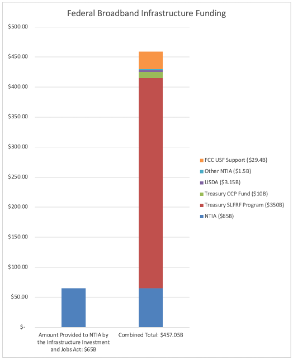
I raised a similar concern in March 2022's "Overlapping Broadband Appropriations Demand Agency Coordination: New FCC Maps Can Track Grants, Avert Waste," a Perspectives from FSF Scholars in which the above chart, depicting over $450 billion in potential subsidies overseen by just four agencies and departments (the FCC, NTIA, and Departments of Agriculture and Treasury), originally appeared.

Accordingly, the GAO report recommended that the "Executive Office of the President … develop and implement a national broadband strategy with clear roles, goals, objectives, and performance measures to support better management of fragmented, overlapping federal broadband programs and synchronize coordination efforts."

In a statement released in response, not for the first time Commissioner Carr voiced his concerns regarding this "troubling" state of affairs, concluding that "it appears that the Administration has turned the spigot on full blast and then walked away from the hose" and warning that "[a]s a result, taxpayers are about to get soaked."

For similar reasons, the Free State Foundation argued in comments submitted Monday regarding the effectiveness of the Interagency Broadband Coordination Agreement between the Commission, NTIA, and Department of Agriculture that "it is incumbent upon the Biden Administration to craft a national broadband strategy out of the current chaos."

Introduced by Senators Roger Wicker (R – MS) and Ben Ray Luján (D – NM) and Representatives Tim Walberg (R – MI) and Peter Welch (D – VT), the PLAN for Broadband Act would ensure that that occurs.

As Commissioner Carr's statement explains, "[t]his bipartisan, bicameral legislation would require the President to develop a national strategy to improve the coordination and management of broadband programs, including adopting accountability and performance measures, as well as an implementation plan to reduce waste, fraud, and abuse in federal broadband programs."

Tuesday, July 26, 2022

GAO Gives NTIA a To-Do List on Spectrum Management

On July 22, the Government Accountability Office (GAO) released a report urging NTIA to implement a series of policy recommendations that GAO previously made regarding spectrum management. GAO's report lists those recommendations, one of which is that NTIA and the FCC update their memorandum of understanding (MOU) regarding their respective roles and coordination on spectrum policy issues. 

For more on this topic, see the February 2022 Perspectives from FSF Scholars by Free State Foundation President Randolph May and I titled "Congress Should Require Better Agency Coordination on Spectrum Policy" as well as a short blog titled "Congress Should Set Parameters for Improved Interagency Spectrum Coordination." 

Tuesday, June 14, 2022

GAO, FCC's Carr Echo Broadband Funding Coordination Concerns

In a March 2022 Perspectives from FSF Scholars, I (1) called attention to the numerous, overlapping federal initiatives to extend broadband infrastructure to those areas that remain unserved, and (2) underscored the need to coordinate those efforts to ensure that taxpayer dollars are put to good use and the goal of ubiquitous connectivity in fact is achieved.

A recent report issued by the Government Accountability Office (GAO) made similar points – and inspired FCC Commissioner Brendan Carr, consistent with his comments during the Free State Foundation's Fourteenth Annual Policy Conference, to call for the Biden Administration to "put a national strategy in place to ensure that the federal government delivers on this opportunity to end the digital divide."

In "Overlapping Broadband Appropriations Demand Agency Coordination: New FCC Maps Can Track Grants, Avert Waste," I identified some of the biggest federal broadband subsidy programs, in terms of dollar amounts, and presented (via the chart reproduced below) a theoretical total spend of over $450 billion dollars.

The GAO report, entitled "Broadband: National Strategy Needed to Guide Federal Efforts to Reduce Digital Divide," identifies "at least 133 funding programs that could support increased broadband access" under the purview of 15 different agencies – and warns that "[t]his patchwork of programs could lead to wasteful duplication of funding and effort."

Accordingly, the report recommends that the "Executive Office of the President … should develop and implement a national broadband strategy with clear roles, goals, objectives, and performance measures to support better management of fragmented, overlapping federal broadband programs and synchronize coordination efforts."

In a Statement dated June 10, 2022, Commissioner Carr marked the release of the GAO report by "sounding the alarm," yet again, "on the troubling lack of oversight and coordination when it comes to the federal government's expenditure of hundreds of billions of dollars that Congress appropriated for ending the digital divide."

Contending that "it appears that the Administration has turned the spigot on full blast and then walked away from the hose," Commissioner Carr called for the creation of a national strategy.

As my colleague Seth Cooper highlighted in a May 31, 2022, post to the FSF Blog, Commissioner Carr made similar points during a #FSFConf14 panel moderated by Mr. Cooper.

Among other things, Commissioner Carr noted that, by his count, ten times the amount needed to connect every American – $80 billion – has been appropriated, but absent improved interagency coordination, he remains "very concerned that we're going to flash forward a couple of years, the $800 billion dollars is going to gone and we're still going to have a significant portion of the digital divide that we didn't close."