Showing posts with label Brendan Carr. Show all posts

Friday, August 08, 2025

James Byrnes, Meet Brendan Carr!

 You may not know the name James Byrnes! But, for me, he comes to mind. Mr. Byrnes once declared: The nearest approach to immortality on Earth is a government bureau." 

James Byrnes served as a governor of South Carolina, United States Senator, a Supreme Court Justice, and U.S. Secretary of State, aside from other government positions. Yes, you read that right!


So, by virtue of his experience, Mr. Byrnes knew a thing or two about the difficulty of shrinking the size of government.


Admittedly FCC Chairman Brendan Carr hasn't served in as many high-level government positions as James Byrnes. No one else has. But Carr has served in key FCC positions long enough – as General Counsel, Commissioner, and now Chairman – to understand that there are plenty of legacy regulations remaining in the FCC's rule book that are no longer necessary. Not only are they no longer necessary, but many of them, considering the dramatically changed telecommunications and media environment since they were adopted, impose costs and burdens that affirmatively harm consumers and competition.


I have criticized a few actions taken by Chairman Carr, for example, the use of the agency's transaction review process to impose extraneous conditions not unique to the transaction in approving the Skydance – Paramount CBS transaction, and the imposition of what appears to be an unwarranted forfeiture on Telnyx without fair notice of what standard it was expected to meet.


But, on the whole, I applaud the way that Chairman Carr is forging ahead in the DELETE, DELETE, DELETEproceeding and others to remove bunches of regulations that should no longer exist and, frankly, should have been eliminated years ago. For example, yesterday the Commission proposed to eliminate nearly 100 outdated, no longer necessary, broadcast rules using the Direct Final Rule process. The public will have 10 days after Federal Register publication to offer comments regarding any of the proposed rules. Absent the submission of a "significant adversecomment," the proposed elimination of the rule will occur. If the Commission determines that a "significant adverse comment" has been submitted, then that particular rule will go through the normal notice and comment process.


In a 1995 Recommendation, The Administrative Conference of the United States (ACUS), of which I have served as a Public Member and now Senior Fellow, suggested that agencies use the Direct Final Rule process to more quickly eliminate unnecessary regulations "in all cases where the ‘unnecessary’ prong of the good cause exemption is available…." On many occasions since then, to little or no avail, I have urged the FCC to consider employing the process.


So, I heartily commend Brendan Carr for taking the initiative to do so now. There will still be an opportunity for public comment when the Direct Final Rule process is employed, and, if experience proves there is a need, there can be adjustments to ensure that non-frivolous substantive objections are properly considered.


Shortly before becoming FCC Chairman, Ajit Pai, speaking at a Free State Foundation event, declared: “We need to fire up the weed whacker and remove those rules that are holding back investment, innovation and job creation.”Considering all the obstacles, including the time and energy expended to reverse the then-existing mandate regulating Internet service providers as public utilities, Chairman Pai made a good start. But now Chairman Carr has truly fired up the metaphorical "weed whacker" in a way that looks to make meaningful progress in the cause of eliminating costly, burdensome, unnecessary regulations.


He may not have eliminated a government bureau. But I suspect that James Byrnes would give Brendan Carr credit for what he's doing on the deregulation front.

Monday, June 09, 2025

Deregulation Is the Cure for the Video Regulatory Disparity

In a May 27 op-ed, just-departed FCC Commissioner Nathan Simington, along with his Chief of Staff Gavin Wax, argued that a 2014 proposal by then-Chairman Tom Wheeler to regulate "virtual" video distributors (vMVPDs) the same as facilities-based video distributors (MVPDs) "deserves a second look." Relatedly, Chairman Brendan Carr, in a March 7 letter to YouTube TV and its parent company, Alphabet, noted that "the FCC and Congress have been encouraged by a diverse group of stakeholders to expand the Commission's existing rules and to apply the same or a similar framework to virtual MVPDs like YouTube TV" and that it "has multiple open proceedings seeking comment on whether to do just that."

Without question, the intended goal – in the words of Simington and Wax, "placing [vMVPDs] on equal regulatory footing with cable and satellite operators" – is one that policymakers should prioritize. After all, and as I described most recently in "No Basis Exists in 2025 for Rules Targeting Traditional Video Providers," a March Perspectives from FSF Scholars, facilities-based MVPDs subject to FCC regulations have been shedding subscribers for years while their online competitors – including the vMVPD YouTube TV, which is expected to surpass Charter Communications, Inc.'s Spectrum to become the largest MVPD by the end of 2026 – have been adding subscribers at a breakneck pace.

However, given that the video distribution marketplace is, and grows steadily more, competitive, I (and others affiliated with the Free State Foundation) have argued consistently that the appropriate path to a level playing field is through the deregulation of facilities-based MVPDs, not the expansion of existing regulations to vMVPDs.

In Comments filed in the "IN RE: DELETE, DELETE, DELETE" proceeding, Free State Foundation President Randolph May and I pointed out that "what primarily stands in the way of unbridled, consumer-benefiting competition are ill-fitting rules that hamstring the subset of participants to which they uniquely apply: cable operators and Direct Broadcast Satellite (DBS) providers."

And in "Video Subscriber Updates Underscore Ongoing Shift to Streaming," an August 2023 post to the FSF Blog, I wrote that "the appropriate response to these ongoing trends is to eliminate outdated rules, not expand them."

The proposal to extend rules targeting legacy MVPDs to vMVPDs isn't only the wrong approach from a competition policy perspective, however. It also appears to lack a statutory justification.

In a March 2023 letter to Senator Charles Grassley (R-IA), then-FCC Chairwoman Jessica Rosenworcel explained that the plain language of 47 U.S.C. § 522(4), which defines a "channel" as "a portion of the electromagnetic frequency spectrum which is used in a cable system and which is capable of delivering a television channel," limits the FCC's ability to regulate vMVPDs that stream content over the public Internet:

It is imperative that the Commission give these words full meaning. As reflected in the record, online video programming distributors do not neatly fit in these statutory definitions because they lack a physical connection to subscribers and do not use any electromagnetic frequencies when delivering programming to their viewers. As you know, the Commission lacks the power to change these unambiguous provisions on its own but can do so if Congress changes the underlying law.

This statutory impediment has become more pointed in the wake of the Supreme Court's Loper Bright decision rejecting the Chevron doctrine. Rather than defer to an agency interpretation of an ambiguous statute, reviewing courts now will adopt what they view as the "best reading of the statute." In this case, and assuming for argument's sake that the statute is ambiguous, that seemingly would lead to the judicial conclusion that the FCC's regulatory authority over MVPDs does not extend to vMVPDs that deliver digital bits over the public Internet.


Thursday, June 05, 2025

FCC Chairman Carr Says DELETE Legacy Cable TV Rules

Yesterday FCC Chairman Brendan Carr said: ‘’Our dated and reticulated set of cable television rate regulations are one such example. That is why I would like to consider an order that gets rid of those obsolete and unworkable rules.”  He's proposing to remove "77 rules and requirements that have no meaningful application today."

This would be a meaningful regulatory reform accomplishment if it occurs.


The Free State Foundation's initial comments in the FCC's "DELETE DELETE DELETE" proceeding were focused most heavily on just what Chairman Carr is now proposing: the elimination of outdated legacy regulations applicable to cable and satellite TV operators.

Here is part of what FSF said in its comments:

The ability to deliver the highest-quality video over broadband, in any format and to any connected device, has proven to be the great equalizer – a development that indisputably eviscerates any policy rationale underlying legacy regulations premised upon the existence of claimed video distribution "bottlenecks." As ongoing trends in the marketplace make plain, facilities-based Multichannel Video Programming Distributors (MVPDs) enjoy no competitive advantage vis-à-vis over-the-top providers warranting one-sided regulations.

To the contrary, what primarily stands in the way of unbridled, consumer-benefitting competition are ill-fitting rules that hamstring the subset of participants to which they uniquely apply: cable operators and Direct Broadcast Satellite (DBS) providers. This proceeding can foster optimal efficiency levels in the operation of the marketplace by realigning the regulatory environment to fit the facts that exist on the ground today.

I'm encouraged by Chairman Carr's statement -- and I look forward to the deregulatory follow-through!


Thursday, May 15, 2025

FCC Internal DOGE Review Results in Big Expected Savings

On May 14, FCC Chairman Brendan Carr announced initial findings and anticipated savings by an internal "DOGE" team of FCC staff in coordination with the federal government’s Department of Government Efficiency (DOGE) team totaling over $567 million in wasteful or unnecessary but authorized contract spending. 

According to the announcement released by Chairman Carr's office:

In the near term, the elimination or modification of contracts has generated more than $6.7 million in savings for the remainder of 2025 from the cancellation of obligated spending. In addition, this effort has also generated more than $21.1 million in savings for 2026, effectively reducing planned contract spending for 2026 by 20 percent.

The Commission's internal review was undertaken under President Donald Trump's Executive Order 14222, "Implementing the President's 'Department of Government Efficiency' Cost Efficiency Initiative."


Thanks go to Chairman Carr, the FCC's internal staff team, and the DOGE team for their efforts to save over half a billion dollars. Hopefully, further efforts at the Commission and by DOGE will reveal any remaining wasteful spending and yield additional cost savings. 

Monday, November 18, 2024

MEDIA ADVISORY: FSF's Randolph May Congratulates Brendan Carr as the Next FCC Chairman

Free State Foundation President Randolph May issued the following statement regarding President-elect Trump's intention to appoint Brendan Carr as FCC Chairman:

I congratulate Brendan Carr as President-elect Trump's choice to be the FCC's next chairman. Given his long experience at the FCC, first as a staffer and then as a commissioner, and his acknowledged expertise regarding communications law and policy, Commissioner Carr is very well-qualified to undertake his new responsibilities leading the agency come January 20.


There is much work that still needs to be done to reform communications policies so that they reflect digital age technological and marketplace realities. Enhancing consumer welfare and increasing consumer choice, along with closing remaining digital divides, can be accomplished in free market-oriented ways that minimize unnecessary costs, reduce regulatory burdens, and avoid wasteful spending. And restoring a culture of free speech consistent with the First Amendment is an important objective.


I look forward to Brendan Carr getting to work as FCC Chairman. 

Thursday, August 04, 2022

Commissioner Carr Praises National Broadband Strategy Bill

In a statement released earlier today, FCC Commissioner Brendan Carr welcomed the introduction of bicameral and bipartisan legislation compelling the Biden Administration to create a national broadband strategy – a much-needed development for which he long has advocated.

As I pointed out in a June 2022 post to the FSF Blog, a report issued by the Government Accountability Office (GAO) the previous month found that 15 different federal agencies and departments had been tasked with administering upwards of 133 unique broadband funding sources – and cautioned that "[t]his patchwork of programs could lead to wasteful duplication of funding and effort."

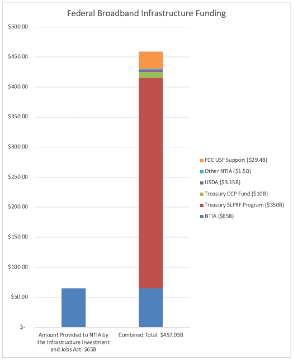
I raised a similar concern in March 2022's "Overlapping Broadband Appropriations Demand Agency Coordination: New FCC Maps Can Track Grants, Avert Waste," a Perspectives from FSF Scholars in which the above chart, depicting over $450 billion in potential subsidies overseen by just four agencies and departments (the FCC, NTIA, and Departments of Agriculture and Treasury), originally appeared.

Accordingly, the GAO report recommended that the "Executive Office of the President … develop and implement a national broadband strategy with clear roles, goals, objectives, and performance measures to support better management of fragmented, overlapping federal broadband programs and synchronize coordination efforts."

In a statement released in response, not for the first time Commissioner Carr voiced his concerns regarding this "troubling" state of affairs, concluding that "it appears that the Administration has turned the spigot on full blast and then walked away from the hose" and warning that "[a]s a result, taxpayers are about to get soaked."

For similar reasons, the Free State Foundation argued in comments submitted Monday regarding the effectiveness of the Interagency Broadband Coordination Agreement between the Commission, NTIA, and Department of Agriculture that "it is incumbent upon the Biden Administration to craft a national broadband strategy out of the current chaos."

Introduced by Senators Roger Wicker (R – MS) and Ben Ray Luján (D – NM) and Representatives Tim Walberg (R – MI) and Peter Welch (D – VT), the PLAN for Broadband Act would ensure that that occurs.

As Commissioner Carr's statement explains, "[t]his bipartisan, bicameral legislation would require the President to develop a national strategy to improve the coordination and management of broadband programs, including adopting accountability and performance measures, as well as an implementation plan to reduce waste, fraud, and abuse in federal broadband programs."

Monday, March 15, 2021

Commissioner Carr's 5G Policy Roadmap Prioritizes More Spectrum, Modernized Infrastructure Rules

Earlier today, in an address hosted by the American Enterprise Institute, FCC Commissioner Brendan Carr detailed his vision for continued American leadership in the race to 5G.

Mark your calendars: Commissioner Carr will participate in a fireside chat with Free State Foundation President Randolph J. May next Tuesday at 11 am EDT as part of FSF's Thirteenth Annual Telecom Policy Conference.

Characterizing the FCC's extensive efforts to accelerate the deployment of 5G under then-Chairman Ajit Pai as "one of the great success stories of the past four years," Commissioner Carr explained that that progress came to pass because the agency "bet on America's free enterprise system" and "went with a tried and true playbook – freeing up more spectrum and modernizing our infrastructure rules."

Looking ahead, Commissioner Carr identified a number of actions the agency can take in these two areas to ensure that the U.S. continues to reap the benefits of a first-mover advantage in 5G.

With regard to spectrum, he recommended a number of additional steps in 2021, including:

  • Auctioning 100 MHz in the 3.45 GHz – 3.55 GHz band and adopting rules that allow licensees to operate at sufficient power levels for 5G;
  • Auctioning 100+ MHz of mid-band spectrum in the 2.5 GHz band;
  • In the 6 GHz band, authorizing (1) very low power (VLP) devices, and (2) device-to-device communications;
  • Increasing permissible power levels in the 3.5 GHz (CBRS) band;
  • Updating the rules for the 5470-5725 MHz (U-NII-2C) band; and
  • Working with Congress to reauthorize the Commission's auction authority.

In 2022 and beyond, he suggested that still more spectrum might be made available between 1300 MHz and 1350 MHz, in the 42 GHz band, below 3.45 GHz, in the 4.8 GHz band, between 7.125 and 8.4 GHz, and above 95 GHz.

In terms of infrastructure reform, Commissioner Carr has led efforts to eliminate bureaucratic red tape; update rules, including those relating to environmental and historic preservation concerns; expedite small-cell deployments; and streamline local approval processes. He highlighted that, as a consequence, the number of new cell sites built annually has increased dramatically, from just over 700 in 2016 to more than 46,000 in 2019.

Moving forward, he urged the FCC to:

  • Make updated broadband maps available later this year, which would allow it to begin the 5G Fund for Rural America auction in early 2022;
  • Create a Federal Lands Desk at the Commission to facilitate 5G infrastructure construction on federal lands;
  • Revise its cost-sharing rules for replacing utility poles;
  • Expand his 5G jobs initiative to double the number of tower techs and telecom crew members; and
  • Reject regulatory proposals, including calls to subsidize private network overbuilds and reclassify broadband under Title II, that discourage private sector investment.

A copy of Commissioner Carr's prepared remarks is available on the FCC's website.

Expect to hear more on 5G, among other timely topics, during Commissioner Carr's fireside chat, which will take place virtually, via Zoom, on Tuesday, March 23, 2021, at 11:00 am EDT.

Please click here to register.

Friday, July 20, 2018

Telehealth, Lifeline, and Resellers

At its upcoming August meeting, the FCC will vote on issuing a Notice of Inquiry seeking, as Commissioner Brendan Carr put it in a July 11 news release, “to establish a new $100 million ‘Connected Care Pilot Program’ to support telehealth for low-income Americans, especially those living in rural areas and veterans.” While I am not an expert on telehealth, the initiative seems like a worthwhile effort. 
And an important part of what makes it worthwhile, in my view, is the emphasis on supporting low-income Americans. As I have stated frequently in this space, while I am a strong supporter of free market-oriented communications policies, I have always recognized – and long acknowledged – the role “safety net” programs play in aiding low-income persons. That’s why I have long been a supporter of a properly-run Lifeline program. And by properly-run, I mean one that takes seriously the need to police waste, fraud, and abuse.
In the FCC’s current “Bridging the Digital Divide for Low-Income Consumers” proceeding, I filed comments opposing the proposal to limit participation in the Lifeline program only to facilities-based providers. Here is part of what I said:
So, while promoting increased facilities investment is, in general, a worthwhile objective, the primary purpose of the Lifeline program is to promote the affordability of communications services for low-income persons…. The reality is that, today, almost 70% of Lifeline subscribers are served by resellers. As the Commission has recognized, many of these are minorities who rely primarily or exclusively on wireless services, including wireless broadband services, for access to communications. There is no dispute that wireless resellers, like TracFone, have focused their marketing on reaching Lifeline-eligible low-income consumers, and, this, in turn, has increased awareness of the program. In any event, the reality today is that facilities-based providers currently are serving only a minority of Lifeline subscribers, so that discontinuing support for resellers would be very disruptive to the program.
The Commission apparently intends to propose, as it did in the Lifeline “Bridging the Digital Divide for Low-Income Consumers” rulemaking notice, to limit participation in the Telehealth program to facilities-based providers. While I generally applaud initiatives designed to promote facilities-based investment, as I said in my Lifeline comments, “sometimes there are reasons justifying ‘exceptions to the general rule,’”
As the Commission moves forward to consider the issuance of the Telehealth Notice of Inquiry, in light of the Telehealth pilot program’s focus on aiding low-income persons, the agency should consider whether it really makes sense to limit participation to receive support funds only to facilities-based providers.
As with Lifeline, this may be another situation where there is good reason for an “exception to the general rule” favoring facilities investment.