Showing posts with label Interagency Coordination. Show all posts

Monday, October 06, 2025

Carr Updates Congress on Broadband Interagency Coordination

In a series of letters dated September 9, 2025, FCC Chairman Brendan Carr updated congressional leaders on steps taken by the Commission to improve data collection and interagency coordination efforts related to federal broadband infrastructure subsidies.

The Government Accountability Office (GAO) published "Broadband Programs: Agencies Need to Further Improve Their Data Quality and Coordination Efforts" on April 28, 2025. That report, which I described in detail in a May post to the FSF Blog, highlighted shortcomings in the processes by which the four agencies primarily responsible for distributing billions in federal dollars – the FCC, NTIA, and the Departments of Treasury and Agriculture – share data to prevent the awarding of duplicate grants and the overbuilding of privately funded infrastructure.

It also identified concerns relating to the accuracy of the FCC's maps – the National Broadband Map and the Broadband Funding Map – and the efficacy of federal and state agency coordination.

To address these issues, the GAO report made 14 recommendations, six specific to the FCC.

In his letters to committee leadership in both the Senate and the House, Chairman Carr wrote that the Commission "is pleased to inform you that the Commission is actively addressing and incorporating GAO's six recommendations into [its] processes and interagency coordination of federal broadband funding projects."

Regarding data collection, the FCC, consistent with its internal corrective action plan, has been documenting internal policies and procedures, reviewing how mapping data is validated, and aligning processes relating to verifications, audits, and enforcement.

To improve interagency coordination, the Commission has been working with other agencies to establish a common definition of "covered data" for the purpose of information sharing as well as timelines governing that sharing process.

In conclusion, the letters assert that, "[t]ogether, when fully implemented, the Commission, as well as our sister agencies, expect these process improvements will further minimize wasteful duplicative funding."

For more on the critical importance of effective interagency coordination regarding broadband subsidies, I direct your attention to "The Failure's in the Footnote: Agencies Must Improve Broadband Expenditure Coordination Efforts," my January 2025 Perspectives from FSF Scholars, as well as the numerous Free State Foundation publications referenced therein.

Tuesday, May 20, 2025

GAO Flags Broadband Funding Coordination Concerns

Last month, the Government Accountability Office (GAO) issued a report on the state of federal broadband funding interagency coordination. Not for the first time, it flagged breakdowns in process that could lead to duplication, waste, fraud, and abuse.

Publicly released on April 28, "Broadband Programs: Agencies Need to Further Improve Their Data Quality and Coordination Efforts," identifies two concerns:

  1. The FCC's failure to evaluate and document the accuracy of the service availability data underlying its National Broadband Map, which "adds both to the risk that agencies leveraging these data cannot effectively target funding to areas that lack high-speed internet and to users' existing concerns about the data's reliability."

  2. The need for the FCC, NTIA, and the Departments of Agriculture and Treasury to define with sufficient clarity their coordination processes to "better position the agencies to sustain their collaboration, manage fragmented federal broadband efforts, and ensure that the considerable federal broadband funding is spent efficiently and effectively."

Regarding the National Broadband Map, the Report states that:

FCC officials described its processes for data validations, verifications, audits, and enforcement referrals as a new workstream that continues to be informed by fresh rounds of data, citing this as the reason why FCC had not yet formally evaluated or finalized formal operating procedures for these processes. However, without evaluating the effectiveness of its validations, verifications, audits, and referrals processes, FCC cannot know the extent to which these processes are sufficient to ensure the accuracy of the data in the National Broadband Map.

With respect to interagency coordination, the Report identifies three shortcomings: (1) no clear shared definition as to what the "covered data" that the agencies have agreed to share actually entails; (2) delays in the submission of data to be included in the FCC's Broadband Funding Map, a separate map that I described in a May 2023 Perspectives from FSF Scholars; and (3) the fact that "officials … have not established a formal process to de-duplicate their funding prior to making decisions about projects to fund."

To address these concerns, the Report presents 14 recommendations for executive action.

As you may recall, the GAO assessed broadband funding interagency coordination efforts once before, in May 2022. As I noted in a contemporaneous post to the Free State Foundation's blog, "Broadband: National Strategy Needed to Guide Federal Efforts to Reduce Digital Divide" identified "at least 133 funding programs that could support increased broadband access" under the purview of 15 different agencies and warned that "[t]his patchwork of programs could lead to wasteful duplication of funding and effort."

Saturday, April 12, 2025

House Committee Advances New Bill to Reauthorize and Strengthen NTIA

On April 11, the House Commerce Committee voted to approve the National Telecommunications and Information Administration Act of 2025 – HR 2482, a bill introduced on March 31 by Representatives Bob Matsui and Doris Matsui. The bill would reauthorize the NTIA for the first time in over 30 years. Additionally, HR 2482 would elevate the position of NTIA Administrator from a Deputy Assistant Secretary in the Commerce Department to a Deputy Under Secretary.  

Elevating the position of NTIA Administrator likely would give the officer more clout in undertaking important agency functions, such as coordinating spectrum use and planning among executive branch agencies. Federal government agencies occupy a significant amount of spectrum. Stronger leadership at NTIA could help further a more effective interagency spectrum coordination process for repurposing some of that spectrum for private commercial use. 


As recounted in a blog post from July 31, 2023, the House Commerce Committee passed an earlier version of the NTIA Reauthorization Act during the 118th Congress. The prompt passage of HR 2482 in the 119th Congress indicates that this bi-partisan legislation could become law this year. 


Credit is due to Reps. Latta and Matsui for their persistence on the NTIA Reauthorization Act. HR 2482 deserves a timely vote by the House of Representatives.   

Wednesday, August 16, 2023

Early Activation of Extra Licensed C-band Spectrum Will Enhance 5G Services and Competition

On August 14, Verizon announced that it has gained access to all of the C-band spectrum that it acquired through the FCC's spectrum license auction in March 2021. And today, August 16, it is reported that AT&T has doubled its available licensed C-band spectrum for 5G deployment. Apparently, the C-band spectrum for both providers was cleared ahead of schedule. Consumers will benefit from the network coverage and performance improvements enabled by the activation of valuable C-band (3.7 GHz) spectrum. And this development should enhance the overall competitiveness of the wireless market.

In an October 2022 blog post, I noted findings by OpenSignal that activation of C-band spectrum was leading to improved speeds for Verizon's and AT&T's respective 5G network services. And now with additional C-band spectrum available for use, Verizon and AT&T will significantly boost the speeds and capacity of their 5G service offerings. According to a Verizon press release:

Verizon won C-Band licenses for between 140-200 MHz in all available markets, and began deploying 60 MHz in the first 46 areas in 2022. As the additional spectrum has been cleared by satellite companies outside of the first 46 areas, Verizon has been able to deploy 5G Ultra Wideband using a portion of its licensed bandwidth in many more markets coast to coast. Now, with final clearance from the satellite incumbents, Verizon will be able to use the entirety of its licensed C-band spectrum, an average of 161 MHz coast to coast with some markets accessing a full 200 MHz. Verizon has been deploying equipment that is capable of the full 200MHz of bandwidth, so with a mere software update, customers will start to see the effects of this dramatic increase in bandwidth in the immediate next few days and weeks.

And as observed a news article in FierceWireless, AT&T combines C-band spectrum with 3.45 GHz spectrum nationwide, and its 5G mid-band network now covers over 175 million people, and its nationwide 5G network, including low-band spectrum, covers approximately 290 million people. 


Verizon's press release states its 5G services currently are available to over 222 million people in 359 markets. It also is reported in FierceWireless that Verizon will be operating its 5G network using C-band spectrum at full power in the vicinity of airports. Free State Foundation President Randolph May and I wrote about the FAA's questionable late-in-the-game attempt to halt full use of licensed C-band spectrum by Verizon and AT&T in a November 2021 Perspectives from FSF Scholars, "The FAA Should Stop Interfering With 5G in the C-Band." The FCC has "unified jurisdiction and regulatory power" over commercial spectrum, not the FAA. And that midnight hour dispute regarding C-band spectrum near airports almost certainly would have been avoided had the FAA been more engaged earlier in the Commission's C-band proceeding, when it had ample opportunity to do so. Interagency disputes over spectrum have been too numerous in recent years, and the effect of those disputes is detrimental to the full use of valuable spectrum and timely deployment of next-generation wireless services. As President May and I also wrote a February 2022 Perspectives from FSF Scholars, "Congress Should Require Better Agency Coordination of Spectrum Policy."

Monday, July 31, 2023

House Committee Advances Bill to Reauthorize and Strengthen NTIA

On July 27, the House Energy and Commerce committee favorably reported, by a 48-0 vote, H.R. 4510, the NTIA Reauthorization Act of 2023. Introduced by House Communications & Technology Subcommittee Bob Latta, the bill was unanimously approved in the form of a substitute. As the title suggests, the legislation would reauthorize the agency, but it also includes several other provisions. Among other things, H.R. 4510 would elevate the position of NTIA Administrator from an Assistant Secretary of the Commerce Department to an Under Secretary position, and thereby give the Administrator and agency additional clout in overseeing federal use of spectrum and other important government functions. The legislation also would codify several offices within the agency, including the Office of Spectrum Management. It also would codify the Commerce Spectrum Management Advisory Committee (CSMAC).

Furthermore, H.R. 4510 would consolidate several disparate required agency reports into a consolidated annual report. And the NTIA would be required to prepare a strategy report on closing the digital divide.


Over the past few years, the NTIA's role in coordinating among executive branch agencies regarding federal spectrum policy and federal agency spectrum use has taken on added importance. The federal government is the primary user of a significant amount of valuable spectrum, and the NTIA plays a critical role to facilitate the repurposing of spectrum for private commercial use. By strengthening the position of the NTIA Administrator, H.R. 4510 hopefully will contribute positively to the agency's effectiveness in serving that role. At the same time, as pointed out in my July 14 blog post, "Successful Interagency Coordination Requires Discipline from the Top," presidential leadership appears to be a necessary ingredient for ensuring that executive branch agencies act in a disciplined manner and comply with interagency processes regarding federal agency spectrum use and the repurposing of spectrum for private use. 


In all, H.R. 4510 appears to be a reasonable piece of legislation. The unanimous approval it has received at the committee and subcommittee levels bodes well for the bill's chances of passage by the House of Representatives.  

Friday, July 14, 2023

Successful Interagency Spectrum Coordination Requires Discipline from the Top

On July 11, the Federalist Society hosted a webinar titled "Federal Spectrum Coordination: Pitfalls and Progress." The panel was moderated by attorney Scott Delacourt and the ITIF's Joe Kane, and featured two former NTIA Administrators as panelists: John Kneuer and David Redl. The panelists, drawing on their wealth of experience, discussed spectrum policy and interagency coordination on spectrum allocations. During the webinar, the panelists discussed the history of the NTIA and its Administrator position, processes overseen by the NTIA for coordinating among executive branch agencies for federal use of spectrum, interagency conflicts, as well as the issue of process reforms for improving interagency coordination among executive agencies and the FCC. The webinar is full of insights and worth a listen in full. But near the end, Mr. Redl made an excellent point about the necessity of the White House demanding discipline across the executive branch which is essential for ensuring that the interagency process is followed.

Also, as noted in an August 3, 2022 blog post, nearly a year ago the NTIA and the FCC signed a Memorandum of Understanding (MOU) on spectrum coordination. Now Congress needs to pass the Spectrum Reauthorization Act of 2023 – H.R. 3565, so that there will be more spectrum available for the agencies to coordinate and reallocation for commercial use. 

Thursday, July 06, 2023

BEAD Program State-by-State Funding Allocations Announced

On June 26, 2023, the National Telecommunications and Information Administration (NTIA) announced the amount of funding each state and territory would receive from the $42.45 billion Broadband Equity, Access, and Deployment (BEAD) Program. The focus now shifts to state broadband offices, which have 180 days to submit their Initial Proposals.

The Infrastructure Investment and Jobs Act (IIJA), which established the BEAD Program, specified that every state would receive a minimum of $100 million in broadband infrastructure construction subsidies. Additional allocation decisions reflect the number of "unserved" locations – that is, those that lack access to a high-speed Internet connection at speeds of at least 25 Megabits per second (Mbps) downstream and 3 Mbps upstream (25/3 Mbps) – and "underserved" locations: those where speeds of at least 100/20 Mbps are not yet available.

Congress in the IIJA specified that the FCC's National Broadband Map, unveiled in November 2022 and updated in May, would serve as the definitive source for current service availability information. NTIA's BEAD Program funding allocations, therefore, in part are based on the number of "unserved" and "underserved" locations in a given state as indicated by the National Broadband Map.

As I have noted repeatedly, however, most recently in "Wasteful Duplication by Design: A Case Study on Overlapping Federal Broadband Subsidies," a May 2023 Perspectives from FSF Scholars, the BEAD Program's eligibility requirements, set forth in a Notice of Funding Opportunity (NOFO), treat locations with access to "broadband" provided via satellite or unlicensed spectrum as "unserved."

Accordingly, there is a real danger that BEAD Program money will be used to overbuild existing, privately funded networks. In the above-referenced Perspectives, I focused on a nearby neighborhood here in Colorado where, despite the existence of six competitors, four of which offer speeds that exceed 25/3 Mbps, BEAD Program subsidies might be awarded to yet another provider – simply because of the most-cost-effective technologies selected by those already serving consumers.

The BEAD Program allocation announcement reveals that Colorado is eligible to receive $827 million. Going forward I will keep a close eye on the areas to which that money is made available.

In addition, it is important to keep in mind that the National Broadband Map reveals only where service is available at the time of the data collection – for the updated version released in May, that would be the end of 2022. It does not reflect where federal money has been awarded but construction has not been completed (or even commenced, in many cases).

That responsibility falls to the FCC's other map: the Broadband Funding Map, the release of which I highlighted in a May 2023 post to the Free State Foundation's blog. Intended to facilitate critical interagency coordination efforts – as the Government Accountability Office (GAO) reiterated recently, the existence of over 130 different subsidy programs run by 15 different federal agencies amounts to a "patchwork of programs [that] could lead to wasteful duplication of funding and effort" – Congress required the creation of the Broadband Funding Map to illustrate those areas to which money from other sources (Treasury, Agriculture, and so on) has been committed.

At present, however, the bulk of those hundreds of billions in federal dollars are in process, thereby further complicating oversight efforts. For example, the Colorado Broadband Office, tasked with distributing $162 million just from Treasury's Capital Projects Fund, only began to accept applications on June 20, 2023.

Monday, June 12, 2023

GAO Reiterates Broadband Funding Coordination Concerns

On May 10, 2023, the Government Accountability Office (GAO) released "Broadband: A National Strategy Needed to Coordinate Fragmented, Overlapping Federal Programs," a Statement addressing the status of federal broadband subsidy efforts. It echoes the findings set forth in a May 2022 GAO Report that I summarized in a post to the FSF Blog – and that Senator John Thune (R-SD) underscored in prerecorded remarks delivered to the Free State Foundation's Fifteenth Annual Policy Conference on March 28, 2023.

Troublingly, it also indicates that little has changed over the past twelve months.

As Senator Thune noted, the May 2022 GAO Report concluded that "there are more than 130 federal broadband programs that are administered by 15 federal agencies" – a scenario he characterized as a "spiderweb of bureaucracy." The Statement, meanwhile, focuses on a subset of that total: the 25 programs whose "main purpose" is broadband, 13 of which "overlap because they can each be used for the purpose of broadband deployment," as illustrated in the chart reproduced below.

The Mosaic of 25 Federal Programs with Broadband as a Main Purpose,
as of November 2021, by Purpose Category

Continuing, the Report expressed concern that "[t]his patchwork of programs could lead to wasteful duplication of funding and effort." It therefore made the following recommendations:

  • That the National Telecommunications and Information Administration (NTIA), in consultation with other relevant agencies, "present to Congress a report that identifies the key statutory provisions that limit the beneficial alignment of broadband programs and offers legislative proposals to address the limitations, as appropriate."
  • That the "Executive Office of the President … develop and implement a national broadband strategy with clear roles, goals, objectives, and performance measures to support better management of fragmented, overlapping federal broadband programs and synchronize coordination efforts."

The publication of the Statement coincided with the appearance of Andrew Von Ah, GAO's Director, Physical Infrastructure, at a hearing held the same day by the House Energy and Commerce Committee's Oversight and Investigations Subcommittee entitled "Closing the Digital Divide: Overseeing Federal Funds for Broadband Deployment." (Indeed, it served as his official witness testimony.)

In terms of updates, the Statement reveals that little concrete progress on those recommendations has been made over the last year:

  • NTIA's report to Congress remains in the planning stage – and is not expected until May 31, 2026.
  • In May 2022, "the Executive Office of the President was considering if a national strategy was needed. As of this testimony, it has not developed a national strategy for broadband."

As I illustrated in "Wasteful Duplication by Design: A Case Study on Overlapping Federal Broadband Subsidies," a recent Perspectives from FSF Scholars, the status quo unacceptably – and seemingly intentionally – opens the door to redundant grants from multiple sources and the overbuilding of privately funded networks.

GAO once again has raised the alarm and proposed solutions. It is high time that the Biden Administration and Congress respond with meaningful coordinating measures.

Tuesday, May 16, 2023

FCC Releases Broadband Funding Map

As required by the Infrastructure Investment and Jobs Act, yesterday the FCC released the Broadband Funding Map, a companion to the National Broadband Map intended to "to provide a locations overview of the overall geographic footprint of each broadband infrastructure deployment project funded by the Federal Government."

However, and as I highlighted in "Wasteful Duplication by Design: A Case Study on Overlapping Federal Broadband Subsidies," a recent Perspectives from FSF Scholars, the Broadband Funding Map's ability to prevent overbuilding and redundant funding is curtailed significantly by conflicting eligibility requirements across subsidy programs – including inconsistent minimum speed thresholds and exclusionary lists of approved distribution technologies – that open the door to duplication.

For the record, the Broadband Funding Map describes the neighborhood in the foothills west of Denver that was the focus of my case study as "Not Funded." Given that many federal funding sources, including the $42.45 billion Broadband Equity, Access, and Deployment (BEAD) Program, have not yet begun doling out dollars, this perhaps is not surprising.

I intend to revisit the Broadband Funding Map periodically as more funding decisions are made. Stay tuned.

Tuesday, April 25, 2023

Senators Thune, Luján Urge GAO to Revisit Broadband Funding

In a letter dated April 24, Senators John Thune (R – SD), ranking member of the Commerce Committee's Subcommittee on Communications, Media, and Broadband, and Ben Ray Luján (D – NM), subcommittee chairman, request that the Government Accountability Office (GAO) "conduct an additional review of federal, state, and local broadband efforts to determine the effectiveness of each program."

In a recent post to the FSF Blog describing an effort led by Senator Thune to compel the National Telecommunications and Information Administration (NTIA) to align with statutory intent its rules for the $42.45 billion Broadband Equity, Access, and Deployment (BEAD) Program, I pointed out that in prerecorded remarks delivered to the Free State Foundation's Fifteenth Annual Policy Conference, he cited a May 2022 GAO report cautioning that "there are more than 130 federal broadband programs that are administered by 15 federal agencies."

As I noted in a June 2022 post to the FSF Blog, the GAO concluded that "[t]his patchwork of programs could lead to wasteful duplication of funding and effort" and therefore recommended that the "Executive Office of the President … should develop and implement a national broadband strategy with clear roles, goals, objectives, and performance measures."

To date, no such national broadband strategy has emerged. Fortunately, however, Senator Thune's ongoing broadband funding oversight activities maintain a bright spotlight on this multi-agency, multi-program recipe for duplication, waste, fraud, and abuse.

For instance, his December 2022 oversight letter, to which FSF President Randolph J. May helpfully provided a comprehensive response, brought focused attention to the GAO report's findings. Yesterday's letter to the Honorable Gene L. Dodaro, Comptroller General of the United States, treads a similar path.

Specifically, Senators Thune and Luján request that the GAO investigate a number of topics, including:

  • Whether each of the 133 (and counting) federal subsidy programs "were … established in line with Congress' directive on the funding's intended purpose";
  • The "statutory basis" for each program;
  • The extent to which these programs have met their "specific policy goals";
  • The frequency with which – and how – "federal programs' funding [has] overlapped other federal programs";
  • The effect of "the fragmented and overlapping approach the federal government [has] taken" on the ability of these programs to accomplish their intended goals;
  • Whether the goals set forth in the May 2022 Memorandum of Understanding between the FCC, Department of Agriculture, NTIA, and Treasury Department have been achieved; and
  • The extent to which "federal agencies [have] coordinated their broadband programs with state and local broadband funding programs."

As the letter rightly concludes, "[a]ddressing weaknesses in each of these broadband programs will help ensure more Americans are connected to reliable broadband services."

Monday, February 06, 2023

Senate Broadband Oversight Focuses on Department of Agriculture

With the Department of Agriculture's ReConnect Program poised to distribute this fiscal year an additional $1.5 billion in broadband infrastructure subsidies and amid reports that the 2023 farm bill could provide that agency with even more construction funding, I am encouraged by the news that a bipartisan group of Senators is taking action to prevent (1) waste, fraud, and abuse, and (2) the use of federal dollars to overbuild existing, privately financed networks.

On January 30, 2023, Senators John Thune (R-SD), Ben Ray Luján (D-NM), Amy Klobuchar (D-MN), and Deb Fischer (R-NE), all members of the Senate Committee on Agriculture, Nutrition, and Forestry, reintroduced legislation designed to "streamline and bolster U.S. Department of Agriculture (USDA) Rural Development broadband programs and ensure that their funding is being targeted to rural areas that need it the most."

Seth L. Cooper, Free State Foundation Director of Policy Studies and Senior Fellow, detailed the specific provisions of the Rural Internet Improvement Act of 2022 in a December 2022 post to the FSF Blog. The Rural Internet Improvement Act of 2023, like the 2022 version, would combine Rural Utility Service (RUS) broadband loan and grant programs, specify that no more than 10 percent of locations targeted by a funded project already have access to broadband, encourage greater broadband provider participation, improve the challenge process, and promote greater interagency coordination with the FCC and NTIA.

The RUS manages multiple broadband subsidy programs, the largest being the ReConnect Loan and Grant Program, which to date has distributed more than $3 billion. In a recent interview, RUS administrator Andrew Berke stated his expectation that the ReConnect Program will dole out an additional $1.5 billion in 2023.

In addition, news reports indicate that the next farm bill could appropriate still more money to RUS – Representative David Scott (D-GA), ranking member of the House Committee on Agriculture, identified as his top priority that "[w]e must ensure that appropriate funding is given to USDA to help us bridge the digital divide between rural and urban America" (emphasis added) and argued that "USDA knows what works for our rural communities better than many other Federal agencies."

Considering that (1) tens of billions in taxpayers dollars have been appropriated for the expansion of broadband infrastructure but not yet put to use, and (2) the vast majority of those subsidies will flow to rural areas – after all, at this point in the rollout of broadband "unserved" and "rural" are virtually synonymous – regardless of the distributing agency, it is not at all clear that any additional funding is "appropriate" at this time.

In "Absent Oversight, the Broadband Funding Faucet Likely Will Overflow," a November 2022 Perspectives from FSF Scholars, I drew attention to the concerning potential that, given the large amount of money involved and absent better interagency coordination and oversight, the number of different agencies sharing responsibility for government-led efforts to extend broadband connectivity to those areas that remain unserved could lead to substantial waste and inefficiencies.

But as Mr. Cooper wrote, it is equally true that "intra-agency coordination of broadband deployment subsidy programs through streamlined processes or merging of disparate programs is no doubt essential to ensure that precious tax dollars are spent wisely and that duplicative efforts and other forms of fraud, waste, or abuse are avoided" (emphasis added).

As you may recall, Free State Foundation President Randolph May received a letter from Senator Thune on December 6, 2022, soliciting input on, among other things, the potential for waste, fraud, and abuse as a result of the sheer number of federal broadband subsidy programs, including those administered by the Department of Agriculture.

In his response, Mr. May wrote that "[g]iven the large number of separate programs, it seems self-evident that some of them should be combined and/or eliminated so that there are many fewer programs and fewer agencies disbursing subsidies. This would increase manageability and facilitate accountability and meaningful congressional oversight." He therefore referenced with approval the introduction the Rural Internet Improvement Act of 2022.

In addition, Mr. May drew attention to the fact that the ReConnect Program (1) opens the door to rate regulation via a preference for applicants that provide "at least one low-cost option"; (2) inappropriately encourages applicants to "commit to net neutrality"; and (3) permits grant and loan recipients to apply that assistance in areas where up to 50 percent of locations already are served, in many instances by privately funded networks, "thus disincentivizing further private investment." As noted above, the Rural Internet Improvement Act of 2023 would decrease that threshold to 10 percent.

Thursday, December 08, 2022

Senators Introduce the Rural Internet Improvement Act

 On November 29, Senators John Thune and Ben Ray Lujan introduced S.5137  the Rural Internet Improvement Act of 2022. The bill's purpose is to reform existing U.S. Department of Agriculture (USDA) Rural Development broadband programs and ensure that program dollars are directed to connect rural areas that are unserved or underserved.

According to a press release for the Rural Internet Improvement Act, the legislation would do the following: 

  1. Streamline USDA's broadband authorities by merging and codifying the popular Rural e-Connectivity Pilot Program (ReConnect) with USDA's traditional broadband loan and grant program;
  2. Ensure ReConnect funding is going to areas most in need of reliable broadband service by limiting funding to areas where at least 90 percent of households lack access to broadband service;
  3. Enhance the participation of all types of broadband providers in the ReConnect Program by removing unnecessary barriers;
  4. Increase transparency by improving the challenge process in the ReConnect Program;
  5. Improve the coordination between USDA and the Federal Communications Commission (FCC) on broadband programs; and
  6. Require USDA to enter into a memorandum of understanding with the FCC and National Telecommunications and Information Administration to facilitate outreach to rural residents and businesses of available federal programs that promote broadband access, broadband affordability, and broadband inclusion.

No House companion legislation to S.5137 has yet been announced. 


The Rural Internet Improvement Act appears to be a responsible and constructive measure for helping to ensure that broadband subsidy programs are efficiently and effectively implemented by USDA. Along with interagency coordination among USDA, NTIA, and the FCC, intra-agency coordination of broadband deployment subsidy programs through streamlined processes or merging of disparate programs is no doubt essential to ensure that precious tax dollars are spent wisely and that duplicative efforts and other forms of fraud, waste, or abuse are avoided. 


Congressional oversight is also necessary to help ensure that the billions in subsidies Congress has allocated to promote broadband deployment are well spent. Free State Foundation Senior Fellow Andrew Long addressed this important topic his November 10, 2022 Perspectives from FSF Scholars, "Absent Oversight, the Broadband Funding Faucet Likely Will Overflow." 

Thursday, November 17, 2022

Draft Bill Would Treat Broadband Subsidies as Nontaxable

Yesterday Senator Angus King (I-ME) became the latest cosponsor of the Broadband Grant Tax Treatment Act (BGTTA), joining a bipartisan group that includes Tim Kaine (D-VA), Roger Wicker (R-MS), Rev. Raphael Warnock (D-GA), and Shelley Moore Capito (R-WV). Introduced by Senators Mark Warner (D-VA) and Jerry Moran (R-KS), the BGTTA would exempt certain federal broadband grants from taxation – and thereby maximize the utility of that funding.

Currently, the IRS can shield from taxation certain broadband subsidies, as it did in 2010. Beginning next year, however, the 2017 Tax Cuts and Jobs Act will require that the Internal Revenue Service (IRS) treat all federal grants as taxable income.

The BGTTA would exclude from the definition of "taxable income" broadband infrastructure funding derived from the Infrastructure Investment and Jobs Act (most notably, the $42.45 billion Broadband Equity, Access, and Deployment (BEAD) Program) and the American Rescue Plan Act (in particular, the $350 billion State and Local Fiscal Recovery Funds Program and the $10 billion Coronavirus Capital Projects Fund).

In a letter dated November 2, 2022, to leadership of the Senate Finance Committee and the House Committee on Ways and Means, a group of trade associations (the Competitive Carriers Association, CTIA – The Wireless Association, NTCA – the Rural Broadband Association, TIA – The Telecommunications Industry Association, USTelecom – The Broadband Association, and WIA – Wireless Infrastructure Association) urged passage of the BGTTA.

Specifically, they wrote that "if Congress fails to act, grant recipients will be required to return as much as 21 percent of the broadband grants to the federal government in the form of taxes" and "it is … incumbent upon Congress to act to free the ARPA and IIJA broadband grants from taxation and ensure all of the broadband grants awarded will be used to reach Americans with connectivity needs."

Also on Wednesday, Senator Warner stated at the 2022 USTelecom Broadband Investment Forum that he is "engaged [in] real-time conversations with the finance committee and others to see if we could get this included (in) the end-of-the-year package."

At that same event, his fellow sponsor of the BGTTA Senator Moran reportedly "advocated robust congressional oversight," argued that "Congress should use its power of the purse to promote executive agency accountability," and "called for close coordination between the FCC, the National Telecommunications and Information Administration, and the [Department of Agriculture's] Rural Utilities Service."

In "Absent Oversight, the Broadband Funding Faucet Likely Will Overflow," a Perspectives from FSF Scholars published last week, I warned that, without improved interagency coordination, more federal dollars than are required to connect locations as yet unserved could be disbursed.

Whether taxed or not, the need to ensure the efficient and responsible allocation of broadband subsidies remains paramount.

Thursday, October 13, 2022

Report Finds C-Band Spectrum is Speeding Up 5G Services

OpenSignal released a report on October 12 titled "How C-Band is jump-starting AT&T and Verizon's 5G experience." According to the report, AT&T users' average 5G download speeds increased by 34.6% between March and September, going from 50 Mbps up to 67.3 Mbps. And during that same time span, Verizon users' 5G download speeds increased 15.8%, going from 70.3 Mbps up to 81.4 Mbps. As the OpenSignal report observes, during that seven-month timeframe, both mobile broadband providers boosted their use of licensed C-band spectrum in providing 5G services, with AT&T's use of C-band rising to more than 30% of user 5G readings while Verizon's use of C-band grew to almost 50% of user 5G readings.

The OpenSignal report findings reflect the importance of C-band spectrum for realizing the full potential of 5G wireless networks to enhance broadband market competition and offer value to consumers. As C-band increasingly is put into use, one can expect the performance metrics to show further significant improvements in speeds as well as capacity. 

The report also ought to serve as a reminder of the necessity of making more mid-band spectrum available for commercial use. There are presently three mid-band spectrum candidates for repurposing: the 3.1-3.45 GHz band, the 4.4-4.49 GHz band, and the 7.125-8.46 GHz band. Together, these three swaths comprise over 1,400 MHz of spectrum that potentially could be licensed for commercial wireless use, to the benefit of consumers, industry, and the American economy. Congress should pursue legislation to authorize the FCC to repurpose those bands for competitive bidding spectrum license auctions, and require NTIA and other executive branch agencies to coordinate efforts to address incumbent user needs and technical complexities that will need to be addressed in order to bring those auctions to fruition. 

Tuesday, September 13, 2022

MEDIA ADVISORY: FSF's Seth Cooper Reacts to NAS Study on Potential Spectrum Interference in L-Band

The following statement may be attributed to Free State Foundation Director of Policy Studies & Senior Fellow Seth Cooper:


Now that the National Academies of Sciences has completed its review of the FCC's 2020 order that authorizes Ligado Networks to operate mobile-satellite services in the L-band, NTIA hopefully will constructively work with Ligado to identify any old equipment owned by DOD that might need replacing. The FCC's order from April 2020, which was based on careful technical analysis, anticipated the possibility that some older equipment might need to be replaced due to harmful signal interference and it outlined a process for handling that. Importantly, the NAS study expressly states that it was not an evaluation of the FCC's decision from April 2020, and it has no legal operative effect. Executive branch agencies and members of Congress should not overread the NAS study's statements or miss the key point that the study acknowledged that most commercial GPS receivers will not experience significant harmful interference from Ligado's operations.

Tuesday, August 30, 2022

A True Assessment of the USF's Future Relevance Demands a Full Accounting of Broadband Subsidies

In a Perspectives from FSF Scholars published last Friday, Free State Foundation President Randolph May expressed his disappointment that the FCC's Report on the Future of the Universal Service Fund (Report) did not "go further than it did … in articulating a likely 'end state' for the USF's High Cost Fund."

As the Report does acknowledge, Congress has earmarked "billions" for broadband, an "unprecedented amount." However, it does not follow that money to its logical and inevitable conclusion: a near-term reality in which every location in America has access to a broadband connection – and in which the High Cost Fund therefore is no longer needed. And it exacerbates that lapse by failing to acknowledge nearly $9 billion in Department of Treasury subsidy grants publicized prior to the Report's adoption. The Report's failure to account for all of the known sources of federal funds necessarily casts doubt on its conclusions as to the future relevance and need for the agency's existing universal service programs, especially the High Cost Fund.

Over the last several years, Congress has passed multiple pieces of legislation allocating to multiple federal agencies historic amounts of government subsidies for the construction of high-speed Internet networks. Some of those appropriations provide specific dollar amounts. The most obvious example of this is the Infrastructure Investment and Jobs Act (IIJA), which included $65 billion, $46.45 billion of which targets broadband infrastructure construction via NTIA's Broadband Equity, Access, and Deployment (BEAD) Program and Enabling Middle Mile Broadband Infrastructure Program.

As I noted in a March 2022 Perspectives, however, the American Rescue Plan Act (ARPA) created two separate grant programs administered by the Department of Treasury, the State and Local Fiscal Recovery Funds (SLFRF) and the Coronavirus Capital Projects Fund (CPF), that combined make available a whopping $360 billion – some of which will be used for broadband. That uncertainty demands real-time accounting and close interagency coordination, a point that Mr. May and I emphasized in comments recently submitted to the FCC.

Arguably the best way to define the "end state" for the High Cost Fund, which subsidizes the construction and maintenance of broadband infrastructure in rural areas, is in terms of dollars. That is, the actual amount of money needed to extend broadband infrastructure to every location in the U.S. currently unserved. Generally speaking, the moment when federal subsidies reach that specific financial target is the moment when the goal of the High Cost Fund has been achieved.

Regrettably, the Report does not include such a number. However, the Biden White House, after first asking for $100 billion, in May 2021 did concede that with $65 billion – that is, the very amount that Congress included in the IIJA – "we can still achieve universal access to affordable high-speed internet."

Whatever that total – and, given inflation, it is conceivable that the final price tag may be higher than $65 billion – the other side of the equation is the cumulative amount of federal money allocated. Given the fact that Treasury has at its disposal far more ARPA money than required to supplement NTIA's BEAD and middle-mile coffers (to say nothing of the countless other federal broadband subsidy programs), it is essential that the FCC coordinate with Treasury, in addition to NTIA and the Department of Agriculture, on a running tally.

To its credit, the Report does reference some non-IIJA sources of federal broadband subsidies. Two examples: the ReConnect Program administered by the Department of Agriculture's Rural Utilities Service ($4.8 billion to date) and NTIA's Broadband Infrastructure Program ($288 million).

However, it effectively ignores ARPA's $360 billion – concluding that "we agree with the majority of commenters who caution that the Infrastructure Act will not achieve all of the universal service goals for broadband, and as such, the Commission should not abandon its universal service programs" (emphasis added).

Keep in mind, the relevant statutory language in the IIJA directs the Commission to "submit to Congress a report on the options of the Commission for improving its effectiveness in achieving the universal service goals for broadband in light of this Act and the amendments made by this Act, and other legislation that addresses those goals" (emphasis added). As such, the Report's narrow focus on the IIJA not only paints an incomplete picture of progress, it also runs afoul of congressional intent.

To be sure, the Report does point out that "there are billions of dollars more that are available for broadband programs now being implemented by … the Department of Treasury" and that "other recent legislation delivered unprecedented broadband funding to … Treasury." The Commission also commits, appropriately, to "extensive" and "continued close coordination with other agencies" and highlights the interagency agreement among the Commission, USDA, NTIA, and Treasury announced on May 12, 2022.

But prior to the Report's release, the White House and Department of Treasury publicized nearly $9 billion in disbursements from the $350 billion SLFRF Program and the $10 billion CPF – money that the FCC does not even mention in its report. Moreover, that number certainly will increase over time: As Treasury noted in a July 14, 2022, Press Release:

A key priority of the [CPF] is to make funding available for reliable, affordable broadband infrastructure and other digital connectivity technology projects. In addition to the $10 billion provided by the CPF, many governments are using a portion of their State and Local Fiscal Recovery Funds (SLFRF) toward meeting the Biden-Harris Administration's goal of connecting every American household to affordable, reliable high-speed internet.

A June 2022 Fact Sheet released by the White House proclaims that "[t]he American Rescue Plan has already spent or committed more than $25 billion to invest in affordable high-speed internet and connectivity" – a statement that assumes 100 percent of the CPF's $10 billion will be used for broadband.

Limiting the discussion to those grants in fact made prior to the Report's adoption, however, results in the following list of Administration announcements:

  • Per the White House Fact Sheet referenced above, "[e]ven without full reporting in, state and local governments have committed more than $8 billion in investments [from the SLFRF] toward expanding affordable digital connectivity, through construction of affordable and high-speed broadband infrastructure and providing assistance to households for Internet access and digital literacy."
  • In a June 2022 Press Release, Treasury announced grants from the CPF to four states to the tune of $582.8 million: Louisiana ($176.7 million), New Hampshire ($50 million), Virginia ($219.8 million), and West Virginia ($136.3 million).
  • In addition, that Press Release revealed that, as of July 21, 2022, Treasury had made 72 separate grants from the CPF to 76 different Tribal governments, with each receiving $167,504, for a total of over $12.73 million.
  • In a July 14, 2022, Press Release, Treasury announced an additional $356.9 million in awards from the CPF to four states: Kansas ($83.5 million), Maine ($110 million), Maryland ($95 million), and Minnesota ($68.4 million).

All told, Treasury announced $952.43 million in grants from the CPF prior to the Report's adoption. Combining that amount with the "more than $8 billion in investments" out of the SLFRF heralded by the White House results in nearly $9 billion, a substantial step toward the High Cost Fund's "end state" not even mentioned in the Report.

In sum, the Report's failure to account for these receipts inevitably casts doubt on its conclusions as to the future relevance of the USF, especially the High Cost Fund.

Monday, August 15, 2022

PLAN for Broadband Act Addresses Funding Coordination Concerns

On August 4, Senators Roger Wicker and Ben Ray Lujan introduced the Proper Leadership to Align Networks (PLAN) for Broadband Act. That same day, a companion bill was introduced in the House by Representatives Tim Walberg and Peter Welch. The PLAN for Broadband Act would require the President, in consult with the heads of several federal agencies, to develop a "National Strategy to Close the Digital Divide" as well as an "Implementation Plan." Under the Act, the National Strategy would have to be submitted to Congress within one year of the legislation's enactment, and the Implementation Plan would have to be submitted to Congress 120 days later. 

The PLAN for Broadband Act was prompted by a May 2022 report by the Government Accountability Office (GAO) titled "Broadband: National Strategy Needed to Guide Federal Efforts to Reduce Digital Divide." As Free State Foundation Senior Fellow Andrew Long explained in a June 14 blog post, the GAO report warned about significant wasteful duplication of funding and effort to increase broadband access that could result from the lack of coordination among over 133 broadband access-related funding programs under the purview of 15 different agencies. To address this concern, the GAO report recommended that the Executive Office of the President develop and implement a national broadband strategy. 


The sponsors of the PLAN for Broadband Act deserve credit for calling attention to the issue of duplicative wasteful spending and for seeking to improve the effectiveness and efficiency of federal efforts to close the digital divide. In the meantime, nothing ought to prohibit federal agency heads from closely coordinating their efforts to expand broadband access to all Americans and to protect taxpayer dollars from being wasted. 

Thursday, August 04, 2022

Commissioner Carr Praises National Broadband Strategy Bill

In a statement released earlier today, FCC Commissioner Brendan Carr welcomed the introduction of bicameral and bipartisan legislation compelling the Biden Administration to create a national broadband strategy – a much-needed development for which he long has advocated.

As I pointed out in a June 2022 post to the FSF Blog, a report issued by the Government Accountability Office (GAO) the previous month found that 15 different federal agencies and departments had been tasked with administering upwards of 133 unique broadband funding sources – and cautioned that "[t]his patchwork of programs could lead to wasteful duplication of funding and effort."

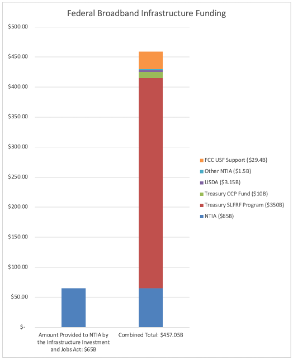
I raised a similar concern in March 2022's "Overlapping Broadband Appropriations Demand Agency Coordination: New FCC Maps Can Track Grants, Avert Waste," a Perspectives from FSF Scholars in which the above chart, depicting over $450 billion in potential subsidies overseen by just four agencies and departments (the FCC, NTIA, and Departments of Agriculture and Treasury), originally appeared.

Accordingly, the GAO report recommended that the "Executive Office of the President … develop and implement a national broadband strategy with clear roles, goals, objectives, and performance measures to support better management of fragmented, overlapping federal broadband programs and synchronize coordination efforts."

In a statement released in response, not for the first time Commissioner Carr voiced his concerns regarding this "troubling" state of affairs, concluding that "it appears that the Administration has turned the spigot on full blast and then walked away from the hose" and warning that "[a]s a result, taxpayers are about to get soaked."

For similar reasons, the Free State Foundation argued in comments submitted Monday regarding the effectiveness of the Interagency Broadband Coordination Agreement between the Commission, NTIA, and Department of Agriculture that "it is incumbent upon the Biden Administration to craft a national broadband strategy out of the current chaos."

Introduced by Senators Roger Wicker (R – MS) and Ben Ray Luján (D – NM) and Representatives Tim Walberg (R – MI) and Peter Welch (D – VT), the PLAN for Broadband Act would ensure that that occurs.

As Commissioner Carr's statement explains, "[t]his bipartisan, bicameral legislation would require the President to develop a national strategy to improve the coordination and management of broadband programs, including adopting accountability and performance measures, as well as an implementation plan to reduce waste, fraud, and abuse in federal broadband programs."

Wednesday, August 03, 2022

New Agreement Between FCC and NTIA Could Improve Spectrum Coordination

On August 2, the FCC and NTIA announced the signing of a new memorandum of understanding (MOU) on spectrum coordination. Free State Foundation President Randolph May and I addressed the topic of an updated MOU in a February 2022 Perspectives from FSF Scholars titled "Congress Should Require Better Agency Coordination on Spectrum Policy" and in a contemporaneous short blog titled "Congress Should Set Parameters for Improved Interagency Spectrum Coordination." Also, my July 26 blog post acknowledged the Government Accountability Office's (GAO) recommendation that the Commission and NTIA update their agreement. 

The signing of the MOU by Chairwoman Rosenworcel and Assistant Secretary Davidson is welcome news. It is to be hoped that the new MOU's framework for regular meetings and information sharing between the FCC and NTIA on spectrum management will foster conditions that are more conducive to interagency cooperation. In the last few years, we have witnessed conflicts between the Commission and executive branch agencies on spectrum policy in regarding 5.9 GHz band, the 24 GHz band, the C-band, and the L-band. The updated MOU may help reduce those types of conflicts in the future. In particular, the new MOU's formal requirements that the FCC and NTIA give each other 20-day advance notice regarding interference concerns and final actions on spectrum matters may help stop dubious process-based attacks on Commission spectrum decisions like the ones made against the 2020 L-band Order.

But we won't know how useful the new MOU is until we see it put into operation. As I explained in a July 13 blog post, new agreements and formal procedures will not mean anything unless the agencies act in good faith to resolve their disputes – through the interagency working group and through the new MOU framework – rather than employing hyperbolic, if not false, attacks on contested spectrum proposals using outside channels.