Showing posts with label Biden Administration. Show all posts

Thursday, August 07, 2025

Roth's NTIA Takes Early Aim at Rate Regulation

On July 30, 2025, Arielle Roth officially assumed the role of Assistant Secretary of Commerce for Communications and Information, a position that includes serving as Administrator of the National Telecommunications and Information Administration (NTIA). Days later, NTIA released updated Frequently Asked Questions (FAQs) regarding the $42.45 billion Broadband Equity, Access, and Deployment (BEAD) Program. Notably, the revised FAQs underscore a significant policy shift from the Biden Administration's approach, one that aligns with Congress's explicit prohibition against broadband rate regulation.

This latest version of the FAQs builds on the BEAD Restructuring Policy Notice (BEAD RPN) that was released in early June. The BEAD RPN made numerous substantive changes to the Notice of Funding Opportunity (NOFO) that the Biden Administration NTIA issued in May 2022, including several addressing the low-cost service option (LCSO) requirement for BEAD Program grant recipients.

Under the NOFO, NTIA imposed prescriptive price and service terms for the LCSO. These included effective mandates on the maximum monthly rate, restrictions that, in substance, amounted to prohibited rate regulation.

The RPN eliminated those requirements: "BEAD subgrantees must still comply with the statutory provision to offer at least one LCSO, but NTIA hereby prohibits [states] from explicitly or implicitly setting the LCSO rate a subgrantee must offer." The updated FAQ expounds upon this point:

The IIJA prohibits NTIA or the Assistant Secretary from engaging in rate regulation. Because the Assistant Secretary must approve the LCSO in the Final Proposal, the rate contained may not be the result of rate regulation. The RPN addressed this fundamental flaw in the BEAD NOFO. The RPN eliminated BEAD NOFO requirements dictating price and other terms for the required low-cost service option.

In addition, the FAQ notes that, "[p]er the RPN, states may not apply state laws to reimpose LCSO requirements removed by the RPN."

This, of course, is a sharp departure from the Biden Administration's deeply flawed approach. As I described in a February 2024 Perspectives from FSF Scholars, "Virginia Flags NTIA's Impermissible Pressure to Regulate Broadband Rates," NTIA sought to compel Virginia to "specify an exact price or formula" for the LCSO.

That demand directly conflicted with Section 60102(h)(5)(D) of the Infrastructure Investment and Jobs Act, which states that "[n]othing in this title may be construed to authorize the Assistant Secretary or the National Telecommunications and Information Administration to regulate the rates charged for broadband service."

By making explicit that neither NTIA nor a state may dictate broadband rates, the RPN and the updated FAQs realign BEAD Program implementation with the letter of the law. In doing so, they empower grant recipients to develop sustainable offerings. They also foster competition, innovation, and continued private investment (to the tune of $2.2 trillion and counting).

Released in the first few days of Roth's tenure as NTIA Administrator, these updated FAQs are a welcome indicator that, going forward, the BEAD Program will hew far more closely to congressional intent.

Monday, July 14, 2025

A Revisionist History of the BEAD Program Ignores Congressional Intent

Today's Policyband (subscription required) included a useful pointed critique of a July 9 Washington Monthly article suggesting a clandestine plot by Republican lawmakers to sabotage from within the $42.45 billion Broadband Equity, Access, and Deployment (BEAD) Program. But there is even more that can be said by way of rebuttal.

The extraneous, partisan policies layered on top of the Infrastructure Investment and Jobs Act (IIJA) by the Biden NTIA were not the issue, authors Paul Glastris and Kainoa Lowman insist. Instead, they make the unsupported claim that "the complexity and delays of the BEAD program and the broader failure of Washington over many years to solve the digital divide is overwhelmingly the result of telecom monopolies whose economic and political power previous administrations unleashed."

Likening NTIA's Notice of Funding Opportunity to an "everything bagel," the piece nevertheless goes to great lengths to assure us that requirements not found in the IIJA – promoting policies relating to labor standards, climate threats, net neutrality, third-party (so-called "open") access, and so on – "were not major time sinks." The real impediment, they suggest, was "incumbents' goal of avoiding competition to their existing infrastructure." The truth, meanwhile, is that lawmakers appropriately took reasonable steps to prevent the use of federal subsidies to overbuild privately financed networks to prevent waste and encourage additional private investment.


In the IIJA, Congress, exercising its authority under Article I of the Constitution's Spending Clause, reached a relatively rare bipartisan compromise. That compromise sought to learn from the mistakes of the past – mistakes that the authors describe at length – and once and for all connect those remaining locations not yet served by privately constructed broadband Internet infrastructure.

According to USTA | The Broadband Association, providers have invested nearly $2.2 trillion in broadband infrastructure since 1996 – including $94.7 billion just in 2023. Largely because of that capital spending, the FCC reported in May that "110 million homes and small businesses (95 percent) have access to a terrestrial fixed service with speeds of 100 Mbps download and 20 Mbps upload (100/20) or greater."

What the authors willfully choose to ignore is that the stated goal of the IIJA was to subsidize the prohibitively high price tag to connect primarily rural locations still "unserved" – not to use taxpayer dollars to compete with these existing, privately funded networks, which of course would disincentivize future investment.

Accordingly, Congress in the IIJA defined "unserved" as without access to speeds of at least 25/3 Mbps and "underserved" as lacking access to speeds of at least 100/20 Mbps; designated the FCC's then-under-development National Broadband Map as the definitive source of location-specific service availability information; established a challenge process to verify that information; and enlisted state-level offices to determine how best to overcome the unique geographic, financial, and other factors encountered within their borders.

To be sure, in practice BEAD Program implementation has left much to be desired. To suggest, however, that measures agreed to by Congress to avoid the wasteful overbuilding of existing broadband infrastructure using taxpayer dollars somehow tell a "story … of how telecom monopolies are behind the failure of government to solve the digital divide" ignores both the substantial role played by Biden NTIA overreach and the well-documented – in the article itself, no less – mistakes of the past.

Instead of engaging with the IIJA's actual text and structure, the authors rely on a convenient – but wrong-headed – narrative to try to deflect accountability away from those truly responsible and onto those that have invested the trillions necessary to connect nearly every location in the U.S.


Monday, August 19, 2024

FCC, Following White House Lead, Again Targets Cable and DBS

On August 12, 2024, the Biden Administration released a Fact Sheet noting a proposed FTC rule that "would require companies to make it as easy to cancel a subscription or service as it was to sign up for one" and announcing that the FCC "is initiating an inquiry into whether to extend similar requirements to companies in the communications industry" (emphasis added).

A News Release issued the same day by FCC Chairwoman Jessica Rosenworcel revealed that she has circulated to her fellow commissioners a draft Notice of Inquiry that "would seek information on ways to ensure that consumers have appropriate and efficient access to customer service resources when working with their phone, cable and broadband providers" (emphasis added).

Source: whitehouse.gov

When it comes to video distribution, of course, there is a wide chasm between "companies in the communications industry" and "cable." The former, broader category includes both unregulated streaming services and traditional Multichannel Video Programming Distributors (MVPDs) that rely upon facilities within their exclusive control. The latter category presumably is limited to the traditional MVPDs uniquely subject to FCC regulation: cable operators and Direct Broadcast Satellite (DBS) providers.

Given this critical distinction, if adopted, this Notice of Inquiry (and the Notice of Proposed Rulemaking sure to follow) first and foremost would result, not in a net benefit to consumers, but in yet another one-sided restraint on the ability of traditional MVPDs to compete effectively with far larger streaming services that grow more popular by the day. Similar instances in just the last year include:

For more on this topic, I recommend that you read "FCC's Dated View Drives Dramatic Shifts in Video Strategies," a July 2024 post to the FSF Blog, and "The FCC Is Complicit in the Decline of Traditional MVPDs," a May 2024 Perspectives.

Tuesday, June 04, 2024

Affordable Connectivity Program Ends, ISPs Voluntarily Fill the Void

On June 1, the Affordable Connectivity Program (ACP) officially came to an end, at least for now. Some hold out hope that Congress still might appropriate additional funding. In the meantime, Internet service providers (ISPs) have stepped in to make available to low-income households broadband service plans priced at or below $30 per month until at least the end of 2024.

Through April, the ACP provided to eligible households a $30 monthly subsidy ($75 on Tribal lands and, as I described in an August 2023 post to the FSF Blog, up to $75 in certain high-cost areas) that they could apply to their choice of broadband service plan offered by a participating provider. In May, the $14.2 billion appropriated by Congress in 2021's Infrastructure Investment and Jobs Act was close to running out, so participating households received only a partial benefit.

In a press release marking the program's final day, FCC Chairwoman Jessica Rosenworcel noted that over 23 million households participated in the ACP; urged Congress to provide additional funding; and highlighted the Lifeline program, which offers a $9.25 monthly benefit to a smaller set of eligible households. For one, Lifeline limits eligibility to those households whose income is less than 135 percent of the Federal Poverty Guidelines, a threshold that Free State Foundation President Randolph J. May urged Congress to adopt on numerous occasions, must recently in "The Conservative Case for Saving the Affordable Connectivity Program by Reforming It."

As the White House highlighted in its own press release, however, in the wake of the ACP's demise, fourteen ISPs have made voluntary commitments "to offer plans at $30 or less to low-income households through 2024, so that families across America can continue accessing low-cost Internet." That list includes AT&T, Comcast, Cox, Charter Communications, and Verizon, as well as a number of smaller ISPs that serve rural areas.

Tuesday, January 09, 2024

FCC Chairwoman Rosenworcel to Congress: Absent Additional Funding, Affordable Connectivity Program Will End in April

In letters to congressional leaders dated January 8, 2024, FCC Chairwoman Jessica Rosenworcel warned that the Affordable Connectivity Program (ACP), a broadband-service subsidy relied upon by over 22 million lower-income households, is projected to run out of money at some point in April of this year.

Established by the Infrastructure Investment and Jobs Act (IIJA) in 2021, the ACP provides eligible households with between $30 and $75 per month to be applied toward (and which, in many instances, covers) a monthly broadband subscription from the participating Internet service provider (ISP) of their choice. Absent additional congressional action, the ACP will end when the hefty initial appropriation – $14.2 billion – is depleted.

In October 2023, the Biden Administration asked Congress to appropriate sufficient funding to extend the ACP through the end of 2024: $6 billion. Chairwoman Rosenworcel's letters echoed that request, as did a White House Fact Sheet released the same day.

As Free State Foundation President Randolph May noted approvingly in an October 2022 Perspectives from FSF Scholars, the ACP "enables millions of lower-income consumers to participate on a relatively equal footing in the competitive marketplace for high-speed Internet access." He therefore called for Congress to "extend and revise" the ACP, specifically by "target[ing] its limited resources to those most in need."

And as I have pointed out in a series of posts to the FSF Blog, the ACP enjoys bipartisan support.

According to Chairwoman Rosenworcel, "the Commission expects to begin taking steps this week to start orderly wind-down procedures to give participating providers, households and other stakeholders sufficient time to prepare for the projected end of the ACP."

Those actions will include: (1) providing ISPs with "guidance on the timing and requirements for notifying participating households," (2) setting a date after which no additional households may enroll, and, ultimately, (3) formally determining a date certain for the program's termination.


Monday, October 23, 2023

Biden Administration, Democratic Senators: Fund the Affordable Connectivity Program

As the clock ticks steadily toward the moment in early 2024 when the Affordable Connectivity Program (ACP) runs out of money, the Biden White House and a group of 32 Democratic Senators recently added their voices to the bipartisan chorus calling for additional funding.

Created by the Infrastructure Investment and Jobs Act (IIJA), the ACP provides a monthly subsidy – up to $75 on qualifying Tribal lands and in certain high-cost areas, $30 elsewhere – that eligible lower-income households can apply toward a high-speed Internet access subscription. It also makes available up to $100 for the purchase of a connected device.

At the end of August, more than 20 million households had signed up for the ACP. Consequently, it is expected that the $14.2 billion initially appropriated will have been spent by some point early next year.

In an August 2023 post to the FSF Blog, I highlighted calls, from both sides of the aisle, for Congress to appropriate additional money to the ACP. I also noted that Free State Foundation President Randolph May, on multiple occasions, has urged Congress to extend the ACP – but also to "revise the program's eligibility requirements to target its limited resources to those most in need."

More recently, panelists at a Broadband Breakfast online event on October 11, 2023, spoke of the ACP's importance – one, Debra Lathen, President, Lathen Consulting LLC, described it as "critical" to the success of the $42.45 billion Broadband Equity, Access, and Deployment (BEAD) program.

In addition, 32 Democratic Senators, led by Jacky Rosen (NV), wrote in a letter to congressional leaders dated October 19, 2023, that, "as you finalize a government appropriations package, we urge you to include full funding for the ACP as well as a long-term solution that provides a sustainable, responsible funding stream, so that millions of Americans don't lose access to critical connectivity services."

And in an October 20, 2023, letter to House Speaker Pro Tempore Patrick McHenry, Shalanda D. Young, Director of the Office of Management and Budget, highlighted the importance of additional funding to "avoid the risk that millions of Americans lose access to affordable high-speed internet."

According to Communications Daily (subscription required), the White House is "is expected to seek about $4 billion in additional money for the [ACP] as part of a second part of the supplemental federal funding request it will send to Congress this week."

Thursday, August 04, 2022

Commissioner Carr Praises National Broadband Strategy Bill

In a statement released earlier today, FCC Commissioner Brendan Carr welcomed the introduction of bicameral and bipartisan legislation compelling the Biden Administration to create a national broadband strategy – a much-needed development for which he long has advocated.

As I pointed out in a June 2022 post to the FSF Blog, a report issued by the Government Accountability Office (GAO) the previous month found that 15 different federal agencies and departments had been tasked with administering upwards of 133 unique broadband funding sources – and cautioned that "[t]his patchwork of programs could lead to wasteful duplication of funding and effort."

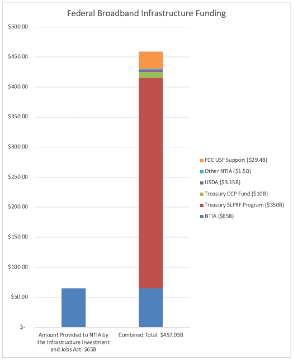
I raised a similar concern in March 2022's "Overlapping Broadband Appropriations Demand Agency Coordination: New FCC Maps Can Track Grants, Avert Waste," a Perspectives from FSF Scholars in which the above chart, depicting over $450 billion in potential subsidies overseen by just four agencies and departments (the FCC, NTIA, and Departments of Agriculture and Treasury), originally appeared.

Accordingly, the GAO report recommended that the "Executive Office of the President … develop and implement a national broadband strategy with clear roles, goals, objectives, and performance measures to support better management of fragmented, overlapping federal broadband programs and synchronize coordination efforts."

In a statement released in response, not for the first time Commissioner Carr voiced his concerns regarding this "troubling" state of affairs, concluding that "it appears that the Administration has turned the spigot on full blast and then walked away from the hose" and warning that "[a]s a result, taxpayers are about to get soaked."

For similar reasons, the Free State Foundation argued in comments submitted Monday regarding the effectiveness of the Interagency Broadband Coordination Agreement between the Commission, NTIA, and Department of Agriculture that "it is incumbent upon the Biden Administration to craft a national broadband strategy out of the current chaos."

Introduced by Senators Roger Wicker (R – MS) and Ben Ray Luján (D – NM) and Representatives Tim Walberg (R – MI) and Peter Welch (D – VT), the PLAN for Broadband Act would ensure that that occurs.

As Commissioner Carr's statement explains, "[t]his bipartisan, bicameral legislation would require the President to develop a national strategy to improve the coordination and management of broadband programs, including adopting accountability and performance measures, as well as an implementation plan to reduce waste, fraud, and abuse in federal broadband programs."

Thursday, December 09, 2021

Tilson Report Shows Lack of State Readiness for Biden's Broadband Programs

Tilson's new report, State Broadband Program Analysis, should set off alarms. According to the report, most state and territorial governments lack readiness for administering billions in broadband funds from President Biden's Infrastructure Bill and American Recovery Act. Only 25 of the 54 states and territories Tilson surveyed can administer broadband grants right now. And 30% of enacted broadband grant laws in states and territories are biased against wireless technologies that could help close the digital divide.

This lack of readiness is a problem because states can already apply for American Recovery Act funds, and the Infrastructure Bill requires the Department of Commerce to launch its grant program by mid-May of 2022. It takes time for states and territories to establish processes, assemble staff, and dedicate resources for administering broadband grants. The biggest time hurdle is often passing legislation, or at minimum, some sort of executive or agency order. There is no guarantee states and territories will be ready to go when the Infrastructure Bill's program launches, which risks delay, added cost, and reduced effectiveness for closing the digital divide.

Tilson grouped the 54 states and territories into four categories based on their readiness for administering broadband grants:

  • 6 have no capabilities for administering broadband grants
  • 9 have merely proposed legislation for administering broadband grants
  • 18 have passed legislation but have not begun administering broadband grants.
  • 25 are actively administering or have administered broadband grants of some sort.

Notably, while it appears that 43 state and territorial governments have at least passed legislation, the legislation Tilson counted includes laws for any past broadband grant program, including legacy state and federal programs and inactive programs. This means that some of the states and territories with laws on the books or even active grant programs could need to amend their laws or issue new orders to participate in Biden-era programs.

Additionally, Tilson estimates that 30% of states and territories with existing laws for broadband grants are biased against funding wireless technologies. This lack of tech-neutrality could lead to waste because low-cost solutions like fixed wireless will be excluded from competing for funds in unserved areas.

In sum, Tilson's report suggests that a lack of state capacity for administering broadband grants seriously risks needless delay and added costs to President Biden's broadband programs. Added costs and delay will reduce the effectiveness of funds Congress appropriated for closing the digital divide, possibly increasing the perceived need for future programs of similar size and scope.

And these added costs and delay highlight the risks inherent in Congress's decision to involve multiple layers of government in disbursing broadband funds. For example, the Infrastructure Bill requires NTIA to evaluate applications from state and territorial governments, which if approved, will then establish their own grant programs that review applications from broadband providers. There is another layer of complexity too—NTIA will administer the Infrastructure Bill funds while the Department of Treasury will administer the American Rescue Act funds. A simpler model—like having the FCC or NTIA administer grant programs to which broadband providers apply directly—could have reduced the risks that Tilson's report highlights.

Tuesday, October 26, 2021

Randolph May's Statement on President Biden's FCC Nominations

Press Release
October 26, 2021
Contact: Randolph May at 202-285-9926

Free State Foundation President Randolph May issued the following statement regarding President Biden's nominations of Jessica Rosenworcel and Gigi Sohn to FCC seats:

“I congratulate Jessica Rosenworcel upon her nomination to continue to serve as an FCC commissioner and her appointment to chair the Commission. And I congratulate Gigi Sohn on her nomination to serve as a commissioner. Gigi has participated as a speaker at many Free State Foundation events over the years, and I’ve always welcomed the opportunity for FSF to provide a platform for the presentation of her views. We always have been, and always will be, a forum that values respectful discussion and debate.

If they are confirmed by the Senate, I’m certain that Free State Foundation scholars will not always agree with Chairman Rosenworcel and Commissioner Sohn on the issues, especially with regard to proposals to maintain or impose regulation of communications and information service providers, and the media, in the absence of convincing evidence of market failure or consumer harm. In today’s marketplace environment, there should be a deregulatory rebuttable presumption. And it is important for the FCC to acknowledge that we live in an age of media abundance, not media scarcity. This too, along with the need to be cognizant of the First Amendment's free speech guarantee, suggests the need for application of a deregulatory presumption when considering media ownership regulation and regulatory proposals.

If the Commission looks to the existence or not of market failure and consumer harm as guideposts in considering regulatory issues, along with fidelity to the law, it will promote innovation and investment, and overall consumer welfare, along with the nation’s social and economic well-being. That’s the course we’ll be advocating, with respect, if the Commission is reconstituted."  

Monday, May 17, 2021

Broadband Organizations Join Together to Form America's Broadband Future

On May 14, seven broadband providers and trade associations announced the formation of America's Broadband Future, a coalition that "will urge lawmakers to bridge the digital divide by expanding access in rural America, equipping vulnerable communities with resources needed to get connected, and investing in digital literacy initiatives to empower all Americans to thrive in the digital age."

On its home page, America's Broadband Future asserts that:

Unfortunately, some of the broadband policy plans being discussed in Washington, D.C. fall short. They fail to provide the resources necessary to empower and enable vulnerable communities to get connected quickly. And they fail to prioritize those unserved areas of the country that are most in need of major broadband investment. 

Free State Foundation scholars have addressed various shortcomings of the broadband-specific provisions in President Biden's American Jobs Plan in the following Perspectives from FSF Scholars and blog post:

The founding members of America's Broadband Future are AT&T, Charter Communications, Comcast, Verizon, CTIA, NCTA – The Internet & Television Association, and USTelecom.

Friday, May 07, 2021

Latest FSF Critique of Biden Broadband Plan Disproves Claim That Service Is "Too Expensive"

The Free State Foundation today published the third piece in an ongoing series exposing flaws in the broadband-specific elements of President Biden's American Jobs Plan.

In "Biden Broadband Plan: Claims That Broadband Is 'Too Expensive' Are Unfounded," FSF President Randolph May and I tackle head-on the factually incorrect assertion that "Americans pay too much for the Internet." Citing multiple data sources, we demonstrate convincingly that the efficient operation of the competitive marketplace for high-speed Internet access is producing greater consumer choice, lower prices, and higher speeds. Make no mistake, time-tested trends prove that market forces are doing their job.

In "Biden Broadband Plan: Misdirected Broadband Subsidies Hurt Competition and Consumers," published on April 28, 2021, we described the harm that necessarily would result from the use of taxpayer dollars to overbuild existing, privately funded broadband networks: private investment would decrease, competition would suffer, and consumers ultimately would be worse off, not better.

And the first in the series, "'Future Proofing' Subsidized Broadband Would Inflate Consumer Prices," an April 13 post to the FSF Blog, explained how the Biden Administration's stated preference for "gold-plated" funding-eligible networks – that is, infrastructure capable of providing far more capacity than consumers demand, particularly in the upstream direction – inevitably would incentivize subsidy recipients to target areas already served and, more broadly, lead to higher, not lower, prices.

Tuesday, April 13, 2021

"Future Proofing" Subsidized Broadband Would Inflate Consumer Prices

The Biden Administration's American Jobs Plan (the Plan) would allocate a substantial amount of taxpayer money – $100 billion – to address broadband accessibility and affordability. The limited details we know at this point, however, suggest strongly that the overly ambitious Plan could lead to waste and, contrary to its stated goal, higher, not lower, prices.

There is much to critique about the Plan, but for now I want to limit my focus on the inescapable tension that exists between two of its primary priorities. The Fact Sheet released by the White House makes the following interrelated assertions:

  • "The President's plan prioritizes building 'future proof' broadband infrastructure …."
  • "Americans pay too much for the internet – much more than people in many other countries – and the President is committed to working with Congress to find a solution to reduce internet prices for all Americans, …."

Simply put, you can't have it both ways. The notion of "future proofing" suggests building "gold-plated" infrastructure that delivers more than what consumers need – and costs more than what they want to spend. And price regulation, the process hinted at in the second quote above and by which the government would dictate how much providers may charge, based upon its best educated guess as to what actual costs and an acceptable rate of return might be, wouldn't eliminate that problem – it simply would incorporate those additional costs into the calculation.

At this point, we cannot know with any certainty what the White House means when it says it wants to "'future proof' broadband infrastructure." However, press reports emphasize that the Accessible, Affordable Internet for All Act would appropriate $80 billion for infrastructure delivering gigabit speeds both upstream and downstream and the Leading Infrastructure for Tomorrow’s America (LIFT America) Act "would raise the FCC's current threshold definition of served areas from 25 Mbps download and 3 Mbps upload minimum to 25/25 symmetrical speed for low-tier service and 100/100 Mbps symmetrical for mid-tier service."

As Former FCC Commissioner Michael O'Rielly stated during recent testimony to the House Energy and Commerce Committee, "the push for symmetrical speeds at exorbitant levels, such as 100/100 megabits per second (Mbps), makes little sense" and "[a] 100-megabit upload speed does not reflect reality for now or any time soon."

And as Joan Marsh, AT&T Executive President of Federal Regulatory Relations, explained in a March 26, 2021, blog post, while 5G networks "easily" can deliver 100 Mbps downloads, "wireless networks are not built to deliver symmetrical speeds" and "adopting a symmetrical standard could result in overbuilding existing services today, including existing asymmetrical services that are currently meeting modern connectivity needs."

The private sector has spent nearly $2 trillion to provide broadband wherever it is economically feasible: that is, where – despite substantial uncertainty – there is at least a reasonable expectation of a return on that investment. Providers rely upon a range of technologies to connect homes: fiber to the home (FTTH), DOCSIS® cable modem service over hybrid fiber-coaxial (HFC) networks, Digital Subscriber Line (DSL) offerings over twisted-copper pairs, 4G/LTE and 5G mobile broadband, fixed wireless operating in both licensed and unlicensed spectrum, and satellite. In some instances, the chosen modality is suited best to the specific geographic and population characteristics of the area to be served. In others, enterprising businesses are rolling the dice – and taking the risk – on a competitive alternative.

The FCC's current definition of "broadband" – 25/3 Mbps – is sufficiently broad to encompass this wide range of network technologies. It also responds to the throughput needs of consumers, fosters intermodal competition, and maximizes the number of eligible bidders in reverse auctions for receipt of government subsidies, such as the $20.4 billion Rural Digital Opportunity Fund and the $9 billion 5G Fund for Rural America – two existing programs whose impact on closing remaining digital divides is not yet known, as Commissioner Brendan Carr emphasized in a recent op-ed.

In sum, the threshold established by the expert agency unleashes the most efficient investment and innovation mechanism – competitive forces – to drive down prices, expand access, and provide the speeds that consumers demand.

By contrast, in the name of "future proofing," the Plan would ratchet up the definition of "broadband" in a way that would increase inappropriately the costs of connecting unserved areas, incentivize providers able to meet that definition to replace existing facilities with "gold-plated" infrastructure rather than focus on expanding the reach of their networks, and render many viable distribution technologies ineligible to receive government subsidies simply due to their inability to deliver upstream speeds far exceeding the needs of consumers both today and in the foreseeable future.

The resulting wasteful overinvestment and suppression of competition would drive prices up, not down. And the specter of price regulation is no panacea. To the contrary, it would incorporate those additional costs into the government-established price – while at the same time serving to disincentivize investment and innovation.