Thursday, February 16, 2023

Senate Bill Would Require FCC Vetting Process in Awarding High-Cost Broadband Subsidies

On February, Sen. Shelley Moore Capito announced the reintroduction of the Rural Broadband Act. The bill is co-sponsored by Sen. Amy Klobuchar. The bill is intended to provide for an FCC vetting process for applicants seeking universal service dollars to deploy broadband, in order to ensure that the subsidy awards are given to entities that are capable of fulfilling their obligations. 

If passed by Congress, the Rural Broadband Act would require the FCC to conduct a rulemaking that would establish a vetting process for future applicants future high-cost universal program funding for deployment and supporting broadband Internet access services. Under the bill, the Commission would adopt rules requiring those applicants of "new covered funding awards" to include, in their initial applications, a proposal containing sufficient detail and documentation for the Commission to ascertain that the applicant possesses the technical capability, and has a reasonable plan, to deploy the proposed network and deliver services with the relevant characteristics defined by the Commission and as pledged by the applicant. The initial proposal must also include detail sufficient for the Commission to determine whether the applicant's technology would have the ability to perform as required. And the bill directs the Commission to evaluate the proposal using "well-established technical standards." 

The Rural Broadband Act was introduced in the last Congress but did not receive a committee hearing. On its face, the bill appears sensible. The 118th Congress ought to take up the Rural Broadband Act and seriously consider its merits. 


Of course, this legislation exists amidst the larger backdrop of questions surrounding the future of universal service, and whether or the extent to which Universal Service Fund programs should continue as they are presently constituted or be overhauled. Here are a handful of publications by Free State Foundation scholars on point:

  • Andrew Long, "A True Assessment of the USF's Future Relevance Demands a Full Accounting of Broadband Subsidies," FSF Blog (August 30, 2022). 
  • Randolph J. May, "The FCC's USF Report: Unprecedented Broadband Funding Requires Fundamental Universal Services Reforms," Perspectives from FSF Scholars, Vol. 17, No. 42 (August 26, 2022). 
  • Seth L. Cooper, "Congress Should Consider Expanding Universal Service Contributions: FCC Poses a Potential Answer to USF's Financial Problems," Perspectives from FSF Scholars, Vol. 17, No. 41 (August 23, 2022). 
  • Seth L. Cooper, "Congress Should Require Major Web Platforms to Support Universal Service," Perspectives from FSF Scholars, Vol. 17, No. 31 (June 14, 2022). 
  • Justin (Gus) Hurwitz, "Congress May Invest Billions in Broadband: It Should Reform the Universal Service Fund Too," Perspectives from FSF Scholars, Vol. 16, No. 34 (July 9, 2021). 

Wednesday, February 15, 2023

House Bill Would Require FCC List of Foreign Adversary Ownership of Communications Infrastructure

On February 3, Reps. Elise Stefanik, Ro Khanna, and Mike Gallagher announced the reintroduction in the House of Representatives of the Foreign Adversary Communications Transparency (FACT) Act. The bipartisan FACT Act was originally introduced in the 117th Congress on October 25, 2022. The bill – which does not have a number as of this posting – is intended to provide greater transparency regarding foreign governmental influence and access to critical communications infrastructure in the U.S. According to Congresswoman Stefanik's press release:

[T]his bill would provide critical telecommunications transparency by requiring the Federal Communications Commission (FCC) to publish a list of companies who hold FCC authorizations, licenses, or other grants of authority an[d] ownership by foreign adversarial governments, including China, Russia, Iran, North Korea, Venezuela, and Cuba.

The FACT Act appears to be a common-sense measure that deserves full and fair consideration by Congress.  

Tuesday, February 14, 2023

PRESS RELEASE: FTC Commissioner Wilson's Resignation Unfortunate Sign of FTC Breakdown


Regarding FTC Commissioner Christine Wilson’s resignation from the Federal Trade Commission, the following statement may be attributed to Free State Foundation President Randolph May:

“As she put in in the Wall Street Journal op-ed explaining her resignation, Commissioner Christine Wilson’s reached the point where she believed that a ’noisy exit’ was preferable to remaining. She acknowledged that elections have consequences and that she understood her own policy preferences likely wouldn’t prevail. But it is clear that Commissioner Wilson, to her mind, considered the problem with remaining not to be primarily differences of policy, but of process —  differences of process that led to abuse of power and lawlessness at the agency.

Commissioner Wilson’s depiction of what’s transpired at the FTC is disturbing for what it portends for the agency’s intent to carry out its own mission within the confines of the law and judicial precedent. But, viewed through a wider lens, what has transpired at the FTC may have broader implications for the administrative state. Like the FTC, the FCC, SEC, CFTC, and other multi-member agencies are, by design,, bipartisan commissions (with the party of the president able to have a majority of seats), with commissioners serving fixed, and staggered terms. When they were established by Congress, one key rationale for the multi-member model was that collegiality among the commissioners from different parties, with their different expertises and experiences, would lead to better decisions.  Obviously, the preexisting long-standing norms of collegiality and bipartisan cooperation, have completely broken down under Lina Khan’s chairmanship to the long-term detriment of the agency, assuming it can right itself. This is worth emphasizing at a time when there is much talk, sometimes too loose and unserious, about norms being broken." 

Friday, February 10, 2023

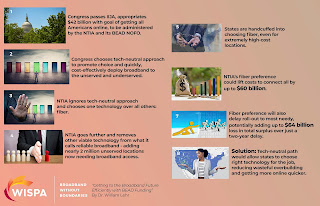
New Report Puts a $60B Price Tag on NTIA's Fiber-Broadband Bias

A just-released study commissioned by the Wireless Internet Service Providers Association (WISPA) finds that the National Information & Telecommunications Association's (NTIA) departure from the concept of technological neutrality could increase the cost to extend broadband connectivity to those (largely rural) locations as yet unserved by as much as $60 billion.


"Getting to the Broadband Future Efficiently with BEAD Funding," a white paper by MIT's Dr. William Lehr, concludes that:

Ignoring wireless ISPs that use unlicensed spectrum increases the number of unserved locations by over 1.922 million locations, or by almost a third. Those locations are concentrated in rural locations where deploying [Fiber-to-the-Premises (FTTP)] is extremely costly and much more costly than for fixed wireless alternatives. Requiring that those locations be served by FTTP instead of lower-cost alternative technologies could increase costs by upwards of $30 to $60 billion depending on the distribution of fiber deployment costs for the unserved locations.

Free State Foundation scholars write regularly about the importance of technological neutrality. For example, in his response to Senator John Thune's December 2022 broadband oversight letter, FSF President Randolph J. May pointed out that "[t]he value of a technology-neutral approach to government-subsidy eligibility is that it maximizes the pool of potential applicants. Just as additional entrants in a competitive marketplace can generate greater efficiency, better quality, increased innovation, and lower prices, so, too, can additional applicants make the best use of grant money."

Consequently, Mr. May criticized NTIA's rules for the $42.45 Broadband Equity, Access, and Deployment (BEAD) Program because they (1) "embody a blind preference for fiber broadband networks," and (2) "exclude by name proven solutions – specifically, satellite-based services and offerings that rely exclusively upon unlicensed spectrum – despite their potential ability in some circumstances to deliver 'broadband' … most efficiently to a specific area."

And in "Senators Urge NTIA to Acknowledge Role of Broadband via Unlicensed Spectrum," a December 2022 post to the FSF Blog describing a letter from seven Republican Senators urging NTIA Administrator Alan Davidson "to continue working to advance broadband deployment in rural states and unserved areas by remaining technology neutral and creating rules and funding opportunities that allow all forms of broadband technology to compete," I explained that:

With respect to any given location, its unique features (population density, geographic features, and so on) can favor certain different distribution platforms –including fiber, cable, DSL, 5G, satellite, and fixed wireless – over others. Such factors influence investment choices in the competitive broadband marketplace, and government-led efforts to extend broadband infrastructure to areas still unserved ought to encourage similarly efficient and informed decisionmaking by subsidy recipients.


Wednesday, February 08, 2023

Carr, Simington, and Wilson Among Keynoters at #FSFConf15 on March 28!

Fifteenth Annual Policy Conference

REGISTER NOW HERE!


Keynote Speakers Include:


FCC Commissioner Brendan Carr


FCC Commissioner Nathan Simington


FTC Commissioner Christine Wilson

WHAT: FSF's Fifteenth Annual Policy Conference


WHERE: National Press Club, Washington, DC


WHEN: Tuesday, March 28, 2023 – 9:00 AM - 2:30 PM


The Free State Foundation will hold its Fifteenth Annual Policy Conference on Tuesday, March 28, 2023, at the National Press Club in Washington, DC. This annual conference is widely acknowledged to be one of the nation's premier law and policy events.


As in previous years, a truly outstanding lineup of senior officials and prominent experts from the FCC, FTC, other government agencies, industry, academia, and think tanks will discuss and debate the most important communications and Internet policy issues of the day, as well as competition policy and other issues.


REGISTRATION IS COMPLIMENTARY, INCLUDING CONTINENTAL BREAKFAST AND LUNCH.


BUT YOU MUST REGISTER TO ATTEND.

REGISTER NOW HERE!


#FSFConf15

Tuesday, February 07, 2023

Ninth Circuit Upholds California LifeLine's $0 Rate Requirement

On January 31, the U.S. Court of Appeals for the Ninth Circuit upheld a 2020 order by the California Public Utility Commission' (CPUC) that required all wireless provider participants in the state's LifeLine Program to offer at least one plan with a $0 co-payment to low-income subscribers. In National Lifeline Association v. Batjer, the Ninth Circuit reversed a lower court had ruled that the CPUC's order conflicted with Section 332(c)(3)(A). That section bars states from regulating rates for wireless services. But the Ninth Circuit concluded that the CPUC's $0 co-payment requirement did not amount to rate regulation; instead, it was a condition for a wireless provider's voluntary participation in the California LifeLine Program.

According to the Ninth Circuit's opinion

California is not engaged in rate regulation within the meaning of § 332(c)(3)(A) because service providers may leave and set their own rates if they do not wish to comply with the California LifeLine's subsidy requirements. The 2020 Rule sets requirements for voluntary participation in California LifeLine to advance universal service…


[T]he 2020 Rule does not require all California service providers to offer certain services to consumers at specific rates; the rule applies only to those that desire a state subsidy. That some NLA members might lose money providing affordable plans to low-income consumers because they cannot charge a co-pay for certain plans is of no moment under § 332(c)(3)(A): service providers may forgo the state subsidy and set their own rates if they do not wish to comply with the 2020 Rule's eligibility conditions. The rule therefore does not directly control—and thus does not impermissibly regulate—the rates that providers may set. 

My December 13, 2022 Perspectives from FSF Scholars, "The Ninth Circuit Should Uphold Preemption of State Controls on Wireless Services" analyzed the legal issues raised in Batjer. In that Perspectives, I suggested that the court reach a conclusion that is contrary to the one that it ultimately handed down on January 31. But given the voluntary nature of the California Lifeline Program, the court's decision is understandable. Underscoring the limited applicability of its decision, the court designated its opinion as "not for publication," meaning that it will not be a precedent that may be cited as binding authority in future federal court cases. 


Notwithstanding the Ninth Circuit's decision in Batjer, Section 332(c)(3)(A)'s express preemption provision remains an indispensable part of federal policy for wireless services. Barring state regulation of wireless rates and entry has fostered a pro-market environment in which investment, innovation, and competition in wireless services continue to thrive and to benefit consumers with a variety of advanced service options, including 5G. 

Monday, February 06, 2023

Senate Broadband Oversight Focuses on Department of Agriculture

With the Department of Agriculture's ReConnect Program poised to distribute this fiscal year an additional $1.5 billion in broadband infrastructure subsidies and amid reports that the 2023 farm bill could provide that agency with even more construction funding, I am encouraged by the news that a bipartisan group of Senators is taking action to prevent (1) waste, fraud, and abuse, and (2) the use of federal dollars to overbuild existing, privately financed networks.

On January 30, 2023, Senators John Thune (R-SD), Ben Ray Luján (D-NM), Amy Klobuchar (D-MN), and Deb Fischer (R-NE), all members of the Senate Committee on Agriculture, Nutrition, and Forestry, reintroduced legislation designed to "streamline and bolster U.S. Department of Agriculture (USDA) Rural Development broadband programs and ensure that their funding is being targeted to rural areas that need it the most."

Seth L. Cooper, Free State Foundation Director of Policy Studies and Senior Fellow, detailed the specific provisions of the Rural Internet Improvement Act of 2022 in a December 2022 post to the FSF Blog. The Rural Internet Improvement Act of 2023, like the 2022 version, would combine Rural Utility Service (RUS) broadband loan and grant programs, specify that no more than 10 percent of locations targeted by a funded project already have access to broadband, encourage greater broadband provider participation, improve the challenge process, and promote greater interagency coordination with the FCC and NTIA.

The RUS manages multiple broadband subsidy programs, the largest being the ReConnect Loan and Grant Program, which to date has distributed more than $3 billion. In a recent interview, RUS administrator Andrew Berke stated his expectation that the ReConnect Program will dole out an additional $1.5 billion in 2023.

In addition, news reports indicate that the next farm bill could appropriate still more money to RUS – Representative David Scott (D-GA), ranking member of the House Committee on Agriculture, identified as his top priority that "[w]e must ensure that appropriate funding is given to USDA to help us bridge the digital divide between rural and urban America" (emphasis added) and argued that "USDA knows what works for our rural communities better than many other Federal agencies."

Considering that (1) tens of billions in taxpayers dollars have been appropriated for the expansion of broadband infrastructure but not yet put to use, and (2) the vast majority of those subsidies will flow to rural areas – after all, at this point in the rollout of broadband "unserved" and "rural" are virtually synonymous – regardless of the distributing agency, it is not at all clear that any additional funding is "appropriate" at this time.

In "Absent Oversight, the Broadband Funding Faucet Likely Will Overflow," a November 2022 Perspectives from FSF Scholars, I drew attention to the concerning potential that, given the large amount of money involved and absent better interagency coordination and oversight, the number of different agencies sharing responsibility for government-led efforts to extend broadband connectivity to those areas that remain unserved could lead to substantial waste and inefficiencies.

But as Mr. Cooper wrote, it is equally true that "intra-agency coordination of broadband deployment subsidy programs through streamlined processes or merging of disparate programs is no doubt essential to ensure that precious tax dollars are spent wisely and that duplicative efforts and other forms of fraud, waste, or abuse are avoided" (emphasis added).

As you may recall, Free State Foundation President Randolph May received a letter from Senator Thune on December 6, 2022, soliciting input on, among other things, the potential for waste, fraud, and abuse as a result of the sheer number of federal broadband subsidy programs, including those administered by the Department of Agriculture.

In his response, Mr. May wrote that "[g]iven the large number of separate programs, it seems self-evident that some of them should be combined and/or eliminated so that there are many fewer programs and fewer agencies disbursing subsidies. This would increase manageability and facilitate accountability and meaningful congressional oversight." He therefore referenced with approval the introduction the Rural Internet Improvement Act of 2022.

In addition, Mr. May drew attention to the fact that the ReConnect Program (1) opens the door to rate regulation via a preference for applicants that provide "at least one low-cost option"; (2) inappropriately encourages applicants to "commit to net neutrality"; and (3) permits grant and loan recipients to apply that assistance in areas where up to 50 percent of locations already are served, in many instances by privately funded networks, "thus disincentivizing further private investment." As noted above, the Rural Internet Improvement Act of 2023 would decrease that threshold to 10 percent.

Friday, February 03, 2023

The Last Groundhog Day for Musicians to Wait for AMFA Passage

Well, with the reintroduction yesterday - on Groundhog Day - of the American Music Fairness Act (AMFA) in this Congress by a bipartisan, bicameral group of Senators and Representatives, it's easy to get a sense of deja vu "all over again." The AMFA would require terrestrial radio broadcasters to pay royalties to American music creators when they play their songs. Importantly, it allows small and local broadcast stations that have less than $1.5 million annual revenue and whose parent companies have less than $10 million annual revenue overall to play unlimited music for less than $500 annually.

The bill's sponsors are Republican Senators Marsha Blackburn and Thom Tillis, and Democrats Alex Padilla and Dianne Feinstein. In the House, Reps. Jerry Nadler (D) and Darrell Issa (R). Like I said, bipartisan and bicameral.


As Free State Foundation scholars have contended for many years now, the AMFA bill should become law. Don't you deserve to be paid for the work you create or produce? Well, so do recording artists and those who produce their works!

Long before the next Groundhog Day, Congress should have enacted and the president should have signed the AMFA!

Wireless Taxes and Surcharges Increase, At Least Partially Negating Wireless Price Declines

The U.S. wireless industry is one of the primary drivers of the American economy, and the quality of wireless broadband is increasing as the price of service decreases. The International Chamber of Commerce (ICC) consistently found that wireless infrastructure investment enables an entire entrepreneurial culture to focus on creating applications and devices to make businesses more productive and improve consumers’ lives. From 2010-2020, the price of wireless service decreased. Mobile wireless providers served consumers with 108 times more mobile data and download speeds 31 times faster. Since 2012, the average per line charge by wireless providers decreased by 24 percent, from $47.00 per month to $35.74.


According to a recent report from the Tax Foundation, a significant portion of the average consumer's wireless bill is comprised of taxes, fees, and government surcharges rather than the actual charges for the service provided. Taxes and fees on the typical American wireless consumer increased again in 2022, to a record 25.4 percent of the taxable (voice services) portion of a typical monthly bill. This total includes state and local taxes averaging 13.2 percent and the Federal Universal Service Fund (FUSF) surcharge rate of 12.2 percent. State and local taxes and fees fell slightly from 2021 to 2022, but this drop was offset by a FUSF rate increase from 11.8 percent to 12.2 percent. In 2022 wireless consumers paid $11.2 billion in taxes, fees, and government surcharges to state and local governments. About half of those taxes are discriminatory in nature in that they only apply to telecommunications services rather than goods and services more broadly.

But the ongoing decrease in the charges for wireless services is negated to some extent by the increase in wireless taxes, fees, and government surcharges. Since 2012, while wireless prices were decreasing, wireless taxes, fees, and government surcharges increased from 17.2 percent to 25.4 percent of the average taxable portion of wireless bills.[8] According to the Tax Foundation's most recent data, Illinois has the highest tax (23 percent) and Idaho has the lowest (2.8 percent). 52.2 percent of total wireless service revenues for the industry are from the sale of Internet access. The decline in the price of telecommunications service, combined with the shift in consumer purchases from telecommunications services to Internet access, has forced the Federal Communications Commission to increase rates just to keep revenues constant, as seen with the FUSF surcharge increases. To maintain USF support at current levels, the surcharge rate likely will continue as wireless consumers utilize more Internet access and less voice telephone service each year.

These increasing taxes, fees, and surcharges on consumers wireless bills disproportionately impact lower-income Americans. These taxes are regressive in the sense that they impose higher wireless charges on low-income consumers than on high-income consumers, measured as a percentage of income.

PS – A hat tip to FSF intern Naomi Singer for her assistance on this post.

Thursday, February 02, 2023

Congress Should Promote Copyright Protection Technologies

On December 20, 2022, Register of Copyrights Shira Perlmutter submitted to members of the Senate Subcommittee on Intellectual Property the U.S. Copyright Office's report on standard technical measures (STMs) under Section 512(i) of the Digital Millennium Copyright Act of 1998 (DMCA). The 118th Congress should take up the Copyright Office's recommendation to amend language Section 512(i) to facilitate adoption of STMs. 

Under the DMCA, an online platform receives legal immunity from copyright infringements on its websites, provided that it meets certain conditions. One such condition is that platform "accommodates and does not interfere with standard technical measures." STMs are technologies that are "used by copyright owners to identify or protect copyrighted works," that have been "developed pursuant to a broad consensus of copyright owners and service providers" in an "open, fair, voluntary, multi-industry standards process," that are made available on reasonable and non-discriminatory terms, and that do not impose substantial costs or burdens on online platforms.

But the problem with Section 512(i) is that it has never worked. As the Copyright Office's report acknowledges, no technology has ever been designated an STM under the law. Online platforms continue to receive the benefit of legal immunity for infringements on their sites without having to accommodate any STMs – because there are no STMs. 


In its report, the Copyright Office recommended that Congress amend Section 512(i) by: (1) clarifying that terms broad consensus and multi-industry "require substantial agreement, but not unanimity, and only of those industries directly affected by an STM"; (2) replacing "developed" with "designated" in order to confirm that they qualify if they're designated by broad consensus of copyright owners and online platforms, even if they originally were developed by a narrower subset of stakeholders or emerged through proprietary processes; and (3) list factors for weighing whether particular measure imposes substantial costs and burdens on service providers. The Copyright Office concluded that these amendments to the law could help facilitate Section 512(i) and thus give the provision a better chance at finally working. Congress should take up the Copyright Office's recommendation and make those changes to the law. 


The Copyright Office stopped short of recommending that Congress amend Section 512(i) by establishing an administrative process by which the Office would recognize designated technological measures (DTMs). Online platforms would be required to accommodate and not interfere with DTMs as a condition for receiving legal immunity for copyright infringement. Such an administrative process would serve as a supplemental or alternative approach to the current, unsuccessful voluntary process for STMs. The report raised staffing and resource concerns with a DTM process. 


But Congress shouldn't let the Office's report be the last word on DTMs. The idea of a establishing a DTM process within the Office has merit and deserves further attention by Congress. DTMs were the subject of my April 2022 Perspective from FSF Scholars, "SMART Act Would Help Prevent Online Copyright Infringement." The SMART Act, which was introduced in the Senate and in the House of Representatives last year, would have authorized the Copyright Office to recognize DTMs. The SMART Act ought to be reintroduced in the 118th Congress and hearings should be held on DTMs in order to give the proposal the full consideration that it deserves. 

Wednesday, February 01, 2023

Panel Discusses Gonzalez v. Google and the Future of Section 230 Immunity

For an incisive debate and discussion about legal immunity for editorial, publishing, and distribution decisions by major online platforms, tune in to the video or audio of the January 24 webinar hosted by the Federalist Society titled "Section 230 Goes to Court: Gonzalez v. Google and the Future of the Electronic Town Square."  

The webinar was moderated by Boyd Garriott and it featured panelists Ashkhen Kazaryan, Joel Thayer, and Free State Foundation President Randolph May. The webinar expert panel discussed the meaning and scope of immunity conferred on online platforms under Section 230 of the Communications Decency Act, particularly in light of the case of Gonzalez v. Google. The issue in focus in the case is whether immunity under Section 230(c)(1) applies when online platforms make targeted recommendations of content to viewers. The U.S. Supreme Court has schedule oral argument in the case for February 21. 
 

FSF President May wrote about Gonzalez v. Google in his August 2022 Perspectives from FSF Scholars, "Thinking Clearly and Speaking Freely – Part 13: A Reasonableness Standard for Fixing Section 230."